01 / Reading Guide
Reading Guide
Citation
Stephens, J., Munro, R., & O'Rourke, E. (2025). Crash Course Anatomy and Physiology: For the MLA and Medical Exams (6th ed.; C. Smith & P. Xiu, Eds.). Elsevier.
Chapter Summary
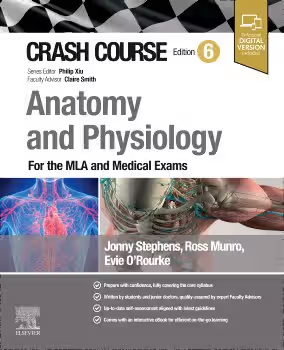
The sixth edition runs to about 350 pages in six chapters followed by a self-assessment section. Like other volumes in the Crash Course series, it is written by students and junior doctors and checked by faculty advisers, here Claire Smith and Philip Xiu. The publisher describes chapters that move briskly through the curriculum, integrate clinical considerations with the basic science and use text boxes for hints, tips and key points, and the purchase includes a downloadable enhanced eBook. The subtitle ties the edition to the UK Medical Licensing Assessment (MLA) and other medical examinations.
The most important fact about this edition is its structure. The fifth edition (2018) had nine chapters organised largely by body system: the nervous system, the head and neck, the respiratory, cardiovascular and gastrointestinal systems, the kidneys and urinary tract, the reproductive system and pelvis, and the musculoskeletal system. The sixth edition is reorganised into five body regions, in the manner of a regional anatomy course. The published contents do not show how the physiology of each system is distributed among the regional chapters.
Chapter 1: Introduction
An opening chapter that precedes the regional material.
Chapter 2: Head and neck
The first regional chapter. In the fifth edition the nervous system had a chapter of its own; in the sixth there is no separate nervous system chapter in the contents.
Chapter 3: Thorax
The thoracic region, home of the heart and lungs, which the fifth edition treated as separate respiratory and cardiovascular chapters.
Chapter 4: Abdomen
The abdominal region. In the fifth edition the gastrointestinal system and the kidneys and urinary tract each had a chapter of their own.
Chapter 5: Pelvis
The publisher highlights new and more detailed coverage of pelvic structures, transgender anatomy and a comprehensive women's health section, including the menopausal transition, pregnancy and the physiology of labour, all of which fall naturally in or alongside this region.
Chapter 6: Musculoskeletal system
The final chapter, the only one titled by system rather than region, covering the musculoskeletal system.
Self-assessment: MLA Single Best Answer (SBA) questions and answers
A closing bank of single-best-answer questions in the format of the Medical Licensing Assessment, with answers, which the publisher describes as revised in line with the latest guidelines.
Key Concepts
Chapters 1–2: Introduction; head and neck
- Regional anatomy: learning the body region by region rather than system by system, the organising principle of this edition.
- Head and neck: the first region covered after the introduction.
Chapters 3–4: Thorax and abdomen
- Thorax: the chest region with the heart and lungs.
- Abdomen: the region containing most of the digestive tract.
Chapters 5–6: Pelvis and musculoskeletal system
- Pelvic structures: given more detailed treatment in this edition.
- Transgender anatomy: new content highlighted by the publisher.
- Women's health: menopausal transition, pregnancy and the physiology of labour.
- Musculoskeletal system: bones, joints and muscles, treated as a system.
Self-assessment
- Single best answer (SBA) questions: the multiple-choice format used in the MLA, in which one option is the best of several plausible ones.
Critical Analysis
Strengths
- Written from the student side. Crash Course volumes are written by senior students or junior doctors and checked by faculty advisers; the publisher's case is that authors close to their own examinations know what is essential and what can be left out.
- Clinical integration. The series description stresses integrating clinical considerations with the basic science and avoiding unnecessary detail, and text boxes collect hints, tips and key points for revision.
- Examination alignment. The subtitle and the SBA question bank tie the book to the Medical Licensing Assessment, which makes it a direct tool for students facing that or similar single-best-answer examinations.
- Updated content. The sixth edition adds material on transgender anatomy, the pelvis and women's health, areas the publisher singles out as new.
Limitations
- A revision book, not a first textbook. The series presents itself as a study companion and exam aid, and about 350 pages for both anatomy and physiology means the explanations are necessarily brief. Students need a full anatomy text and a full physiology text for first learning.
- Physiology placement unclear. With chapters named by region, a student looking for, say, renal or respiratory physiology cannot tell from the contents where it is treated, and topics such as the nervous system, endocrine system or blood have no chapter titles. Check the chapter subheadings in the eBook before relying on the book for physiology.
- Edition confusion. The fifth and sixth editions are organised differently and have different authors. Notes, question banks or recommendations written for the fifth edition will not map onto the sixth chapter by chapter.
- UK examination focus. The self-assessment is built around the UK's MLA; students elsewhere will find the format useful but not tailored to their own examinations.
Where It Fits in the Course
In this anatomy course the book is the quickest overview and the main revision tool rather than the core text. Drake, Vogl and Mitchell's Gray's Anatomy for Students and Dalley and Agur's Moore's Clinically Oriented Anatomy are full regional textbooks with extensive illustration, surface anatomy and imaging, and one of them should carry the first learning; since the sixth edition of Crash Course is now also organised by region, its chapters line up well with those books. Ellis and Mahadevan's Clinical Anatomy sits between: longer and more detailed than Crash Course, selected for clinical use, and strong on surface anatomy and surgical relevance. Gray's Anatomy: The Anatomical Basis of Clinical Practice and the Oxford Textbook of Functional Anatomy are reference works far beyond the scope of a revision guide.
For the physiology half of the title, students will need a physiology text from the physiology course, such as Physiology at a Glance for a visual overview or Costanzo Physiology for a full single-author account.
How to Use This Book
The publisher's readership is medical students and junior doctors, and the series is meant to suit other health students too. School biology is enough background, but the book works best once a region has been taught.
A practical plan:
- Use it after the lecture or dissection, not before. Read the matching regional chapter after a region has been taught from a main text, to consolidate the essentials and see what examiners expect.
- Check the physiology map early. Look through the eBook's subheadings at the start of the year and note where each system's physiology appears, then pair those sections with a physiology textbook.
- Read the hints-and-tips boxes actively. Turn them into flashcards or questions and revisit them in the weeks before examinations.
- Pelvis and women's health: Chapter 5 is the edition's main update and is worth reading in full, even if a course covers these topics late.
- Use the SBA questions under exam conditions. Attempt a block without notes, mark it, then return to the chapter for every question missed. For students sitting the MLA, these questions give direct practice in its format.
- Do not mix editions. If classmates or older notes refer to the fifth edition, map their chapters onto the new regional structure before relying on them.