01 / Reading Guide
Reading Guide
Citation
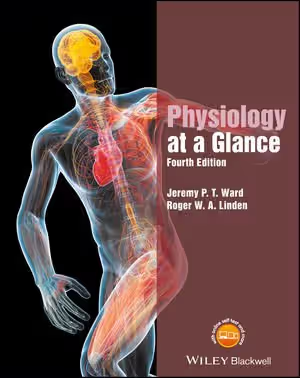
Ward, J. P. T., & Linden, R. W. A. (Eds.). (2017). Physiology at a Glance (4th ed.). Wiley-Blackwell.
Chapter Summary
The fourth edition runs to about 176 pages in eight parts and 63 chapters, followed by a glossary, two appendices (a comparison of skeletal, cardiac and smooth muscle, and a table of normal physiological values) and an index. As in the rest of the At a Glance series, each chapter is a two-page spread: a page of numbered figures faces a page of text that refers to them and cross-references other chapters by number. New to this edition, according to Wiley, are three chapters (cell signalling, thermoregulation, and altitude and aerospace physiology) and the glossary. A companion website accompanies the book.
Part 1: Introduction (Chapters 1–14)
Homeostasis and the physiology of proteins; Body water compartments and physiological fluids; Cells, membranes and organelles; Membrane transport and ion channels; Biological electricity; Conduction of action potentials; Cell signalling; The autonomic nervous system; Blood; Platelets and haemostasis; Defence: inflammation and immunity; Principles of diffusion and flow; Thermoregulation; Altitude and aerospace physiology. The sample first chapter opens with Claude Bernard's idea of the internal environment, explains negative feedback through detectors, comparator and effectors, notes that the set point is really a narrow range that can be reset (as in acclimatisation to altitude), uses Cheyne–Stokes breathing to show what long delays in feedback do, contrasts positive feedback, and argues that homeostasis ultimately protects the folded shape and function of proteins.
Part 2: Muscles (Chapters 15–18)
Skeletal muscle and its contraction; Neuromuscular junction and whole muscle contraction; Motor units, recruitment and summation; Cardiac and smooth muscle. A short part on contractile tissue, supported by the appendix comparing the three muscle types.
Part 3: The cardiovascular system (Chapters 19–27)
Introduction to the cardiovascular system; The heart; The cardiac cycle; Initiation of the heart beat and excitation–contraction coupling; Control of cardiac output and Starling's law of the heart; Blood vessels; Control of blood pressure and blood volume; The microcirculation, filtration and lymphatics; Local control of blood flow and specific circulations.
Part 4: The respiratory system (Chapters 28–33)
Introduction to the respiratory system; Lung mechanics; Transport of gases and the gas laws; Carriage of oxygen and carbon dioxide by the blood; Control of breathing; Ventilation–perfusion matching and right to left shunts.
Part 5: The renal system (Chapters 34–39)
Introduction to the renal system; Renal filtration; Reabsorption, secretion and the proximal tubule; The loop of Henle and distal nephron; Regulation of plasma osmolality and fluid volume; Control of acid–base status.
Part 6: The gut and metabolism (Chapters 40–44)
Gastrointestinal tract: overview and the mouth; Oesophagus and stomach; Small intestine; The exocrine pancreas, liver and gallbladder; Large intestine.
Part 7: Endocrinology and reproduction (Chapters 45–56)
Endocrine control; Control of metabolic fuels; The hypothalamus and pituitary gland; Thyroid hormones and metabolic rate; Growth factors; Somatic and skeletal growth; Control of plasma calcium; The adrenal glands and stress; Endocrine control of reproduction; Sexual differentiation and function; Fertilization, pregnancy and parturition; Lactation.
Part 8: The sensory and motor systems (Chapters 57–63)
Introduction to sensory systems; Sensory receptors; Special senses: taste and smell; Special senses: vision; Special senses: hearing and balance; Motor control and the cerebellum; Proprioception and reflexes.
Key Concepts
Part 1: Introduction
- Negative feedback: control by detectors, a comparator and effectors that push a variable back towards its set point, with some oscillation because responses take time.
- Positive feedback: self-amplifying responses, such as the upstroke of the action potential, which need a mechanism to switch them off.
- Protein structure and homeostasis: the folded shape of proteins depends on their environment, which homeostasis keeps within tolerable limits.
- Membrane transport and biological electricity: how ions cross membranes and generate electrical signals.
Parts 2–3: Muscle and circulation
- Motor units and recruitment: how the force of a whole muscle is graded.
- Starling's law of the heart: the dependence of cardiac output on filling.
- Microcirculation and filtration: exchange between blood and tissues and the role of lymphatics.
Parts 4–5: Lungs and kidneys
- Ventilation–perfusion matching: the balance of air and blood flow in the lung, and the effect of shunts.
- Nephron function: filtration, reabsorption and secretion along the tubule.
- Acid–base control: the regulation of hydrogen ion concentration in body fluids.
Parts 6–8: Gut, hormones and the nervous system
- Control of metabolic fuels: the hormonal regulation of energy supply.
- Hypothalamus and pituitary: the central link between the nervous and endocrine systems.
- Sensory receptors and special senses: transduction and the senses of taste, smell, vision, hearing and balance.
- Proprioception and reflexes: the sensory basis of motor control.
Critical Analysis
Strengths
- Complete coverage in a small space. Sixty-three chapters run from cell physiology to reproduction and the senses, giving a full systematic course in under 180 pages.
- Explanation, not just lists. The sample chapter is continuous prose that reasons through mechanisms (why feedback oscillates, why long delays cause Cheyne–Stokes breathing, why protein shape matters), with clinical and environmental examples tied to later chapters.
- Diagram and text designed together. Each spread pairs a page of numbered figures with text that refers to them, which makes the book well suited to learning from diagrams and redrawing them.
- Useful reference material. The glossary, the comparison of muscle types and the table of normal values make the book handy for quick lookup during a course.
- Current additions. The fourth edition adds chapters on cell signalling, thermoregulation and altitude and aerospace physiology, topics that general introductions often omit.
Limitations
- One spread per topic. Large subjects such as the control of blood pressure or the loop of Henle get two pages each, so the book summarises rather than develops them; a fuller textbook is needed for understanding in depth.
- Thin on the central nervous system. Beyond the autonomic nervous system, the nervous system appears only as sensory and motor systems at the end of the book; higher functions such as sleep, memory and language have no chapter, and students should use a neuroscience text for these.
- No questions in the contents. The table of contents lists no self-assessment section, so practice questions must come from the companion website or elsewhere.
Where It Fits in the Course
In this physiology course, Physiology at a Glance is the compact systematic overview. Davies's Human Physiology: A Very Short Introduction is the gentler, non-technical entry point, organised around the body's tasks rather than its systems, and is worth reading first if physiology is entirely new. Costanzo Physiology is the full single-author textbook to learn from, with equations, sample problems and clinical cases; Ganong's Review of Medical Physiology is a denser review that assumes some biochemistry; and the Guyton and Hall Textbook of Medical Physiology is the comprehensive systems-based reference.
The most effective use is in parallel: learn each system from a main textbook and use the matching part of this book to consolidate it, or use the book as a quick review before examinations. In the anatomy course, Crash Course Anatomy and Physiology is organised by body region; this book supplies the system-by-system physiology that a regional revision guide does not lay out.
How to Use This Book
Wiley presents the book as an introduction for medical, dental, health-science and biomedical students at all levels, useful both as a revision guide and as a help with basic understanding. School biology and chemistry are enough to begin.
A practical plan:
- Start with Part 1. Chapters 1–7 on homeostasis, fluids, membranes, transport, electricity, conduction and signalling are the foundation for every later part; Chapters 9–11 on blood, haemostasis and defence can be read when a course reaches them.
- Follow the course order for the systems. Parts 3–8 are self-contained enough to be read in the order a course teaches them; within each, read the introductory chapter first.
- Use the spreads actively. Read the text with the figures, then cover the text and explain each figure aloud or redraw it from memory.
- Use the back matter. Keep the normal values appendix to hand when working on cases, and use the glossary for unfamiliar terms.
- Optional chapters: Chapters 13–14 (thermoregulation, altitude and aerospace physiology) apply the principles of Part 1 to special conditions and can wait until after a first pass, unless a course examines them.
- Test yourself. Use the companion website and a main textbook's questions, since the book itself does not list a question section.