01 / Reading Guide
Reading Guide
Citation
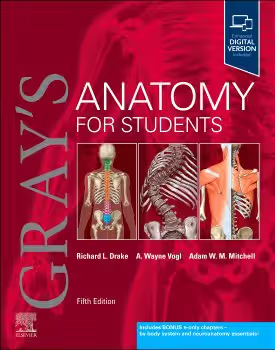
Drake, R. L., Vogl, A. W., & Mitchell, A. W. M. (2023). Gray's Anatomy for Students (5th ed.). Elsevier.
Chapter Summary
The book is a regional anatomy text of nine chapters, running to about 1,170 pages. The publisher says it presents anatomy by body region and focuses on the core information that medical students need, with unique coverage of surface anatomy, correlative diagnostic images and clinical case studies. Conceptual Overviews let readers review the basic ideas of each chapter quickly, and schematic drawings of key structures and topics in every chapter offer a simplified route into each topic as well as a guide for students' own drawings.
Chapter 1: The Body
The title indicates a general opening chapter that precedes the regional chapters; the publisher does not itemise its contents.
Chapters 2–5: Back; Thorax; Abdomen; Pelvis and Perineum
The trunk is covered region by region: the back, the thorax, the abdomen, and the pelvis with the perineum.
Chapters 6–7: Lower Limb; Upper Limb
The limbs follow, with the lower limb taken before the upper limb.
Chapter 8: Head and Neck
The head and neck are combined in one chapter. Separately, the publisher says the edition improves comprehension of the complex cranial nerves with a visual map summarising their distribution and function; the publisher does not say in which chapter the map sits.
Chapter 9: Neuroanatomy
The book closes with neuroanatomy. The publisher describes an updated neuroanatomy eBook chapter intended to let students learn key aspects of this challenging topic in the context of general anatomy; it is worth checking whether the print copy carries the full chapter.
Key Concepts
Chapter 1: The Body
- Regional organisation: the arrangement of the book by body region.
- Conceptual overview: the feature the publisher offers for quickly reviewing the basic concepts of each chapter.
Chapters 2–5: Trunk regions
- Back, thorax, abdomen, pelvis and perineum: the four trunk regions treated in turn.
- Surface anatomy and correlative imaging: the links the publisher draws between structures, the living body and diagnostic images.
Chapters 6–9: Limbs, head and neck, and the nervous system
- Lower and upper limb: Chapters 6 and 7.
- Cranial nerves: the topic the publisher supports with a visual map of distribution and function.
- Neuroanatomy in the context of general anatomy: Chapter 9.
Critical Analysis
Strengths
- Concise and focused. The publisher stresses core information and a regionally logical presentation, and a Doody's review of the fifth edition by Brian MacPherson (University of Kentucky College of Medicine, 2025; five stars, score 100) praises the concise, readable text and the art programme.
- Illustration-led. The publisher credits more than 1,000 original illustrations by Richard Tibbitts and Paul Richardson, plus schematic drawings in every chapter. The publisher presents the schematics as a quick way into each topic and as a guide for students' own anatomy drawings, which suits active study.
- Clinical and surface links throughout. Surface anatomy, correlative diagnostic images and In the Clinic boxes tie structure to clinical practice. The publisher also reports a wider range of skin tones in illustrations and clinical considerations related to transgender and intersex individuals.
- Systems view as a supplement. Alongside the regional print chapters, the enhanced eBook adds bonus chapters for each major body system, so the same material can be reviewed in a systems order, an approach Doody's reviewer singled out.
Limitations
- Neuroanatomy has one chapter. A single chapter covers the nervous system, and the publisher's description frames it as an eBook chapter within general anatomy rather than a full treatment. A course with a dedicated neuroanatomy block will need a separate text.
- Part of the learning package is online. The systems chapters, new and updated clinical cases, self-assessment questions and the Interactive Surface Anatomy tool are described as eBook or online features. The eBook is included with purchase, but students who prefer print alone will not get the full set.
- Size. At about 1,170 pages it is a substantial book, even though its text is described as concise. A shorter revision book is still useful before examinations.
Where It Fits in the Course
Within the anatomy course list, Gray's Anatomy for Students is a core, region-by-region text for medical and health-professions students. Moore's Clinically Oriented Anatomy is the other main regional text in the list, with its clinical "blue boxes", surface anatomy and medical images; the two are alternatives, and a student rarely needs both as primary texts. Clinical Anatomy by Ellis and Mahadevan is a concise region-by-region account suited to students and junior doctors, and Crash Course Anatomy and Physiology is a compact revision text that pairs anatomy with the physiology of each system.
Gray's Anatomy: The Anatomical Basis of Clinical Practice is the long-established reference work, also organised by region, which describes structure together with development, microstructure and variation. It is a place to look things up rather than a first text, and Gray's Anatomy for Students is the more manageable book to read through.
How to Use This Book
The publisher addresses medical students, and the regional structure suits a first anatomy course. The publisher does not state prerequisites.
A practical plan: read Chapter 1 first for orientation, then take the regional chapters in whatever order the course teaches them. For each region, read the Conceptual Overview, study the schematic drawings and redraw them, then read the detailed text with the surface anatomy and correlative images, and finish with the In the Clinic boxes. Use the self-assessment questions and the systems chapters in the eBook for review. Read the cranial nerve map alongside the head and neck and neuroanatomy chapters, and add a dedicated neuroanatomy text if the course demands depth beyond a single chapter.