01 / Reading Guide
Reading Guide
Citation
Levine, R. S. (General Ed.). (2026). The Norton Anthology of American Literature (11th ed., Vols. A–E). W. W. Norton & Company.
Chapter Summary
This is a five-volume anthology arranged by period. Each volume opens with a preface and acknowledgments, an introduction and a timeline, then presents authors in chronological order, each with a headnote and annotated texts, and ends with selected bibliographies, permissions acknowledgments and an index. Norton lists six editors: Robert S. Levine as general editor, with returning editors Sandra Gustafson and Lisa Siraganian and three new editors for the eleventh edition, Cody Marrs, Gretchen Murphy and Stephanie Li. The sections below follow the volumes, not chapters.
Volume A: Beginnings to 1820
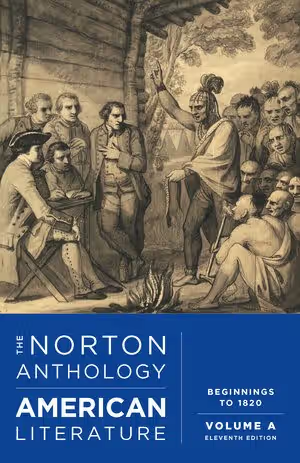
The volume opens with Native American literature: creation stories (Iroquois, Navajo, Pottawattamie), "material texts" such as codices, petroglyphs, quipus, wampum belts, the Cherokee syllabary and skin paintings, trickster tales, oratory and songs. It continues with Columbus, Las Casas, Cabeza de Vaca and a group of early European accounts of Native America (Cortés, Harriot, Champlain, Juet, Heckewelder, Bradford and Winslow). The core is colonial writing: John Smith, Bradford, Morton, Winthrop, Roger Williams, Bradstreet, Wigglesworth, Rowlandson, Mather and Edwards, with a cluster on religious expression. The later sections cover ethnographic and naturalist writing, Franklin, Crèvecoeur, the Adamses, Paine, Jefferson and the Federalist papers, Murray, Freneau and Wheatley, a cluster on slavery and freedom in the age of revolution that includes narratives of enslavement and Equiano, and early American fiction and drama (Tyler, Rowson, Brown), ending with Irving.
Volume B: American Literature, 1820–1865
The volume concentrates on the antebellum period: Irving, Cooper, Sedgwick, Sigourney, Bryant, Apess, Schoolcraft, Child, Emerson, Hawthorne, Longfellow, Whittier, Poe, Lincoln, Fuller, Stowe, Jacobs, William Wells Brown, Thoreau, Douglass, Whitman, Melville (including "Hawthorne and His Mosses" and chapters of Moby-Dick), Harper, Ridge, Dickinson, Davis and Spofford. Clusters address Native Americans (removal and resistance), women's rights and women writing, slavery, race and the making of American literature, literature and the environment, and the literatures of the Civil War.
Volume C: American Literature, 1865–1914
Whitman and Dickinson continue, and a cluster addresses writing about Reconstruction. Twain appears with Adventures of Huckleberry Finn and a "critical controversy" cluster on race and language in the novel (Julius Lester, David L. Smith, Toni Morrison, Alan Gribben and Percival Everett). A cluster on realism, regionalism and naturalism frames Howells, Henry James, Jewett, Chopin, Freeman, Wharton, Norris, Dreiser, Crane and Jack London. The volume also gives space to Sarah Winnemucca, Emma Lazarus, José Martí, Booker T. Washington, Charles Chesnutt, Abraham Cahan, Charlotte Perkins Gilman, W. E. B. Du Bois, Paul Laurence Dunbar and others. Further clusters cover utopian and speculative futures, the Wounded Knee massacre and becoming American in the Gilded Age.
Volume D: American Literature, 1914–1945
The volume presents American modernism through Stein, Frost, Pound, Williams, Stevens, H.D., Moore, Eliot (The Waste Land), Cummings and Hart Crane, with a cluster of modernist manifestos. Prose and drama include Cather, Glaspell, Anderson, O'Neill, Fitzgerald (The Great Gatsby, "Winter Dreams" and "Babylon Revisited"), Dos Passos, Faulkner and Hemingway. Black writers of the 1920s and 1930s appear through McKay, Hurston, Larsen, Toomer, Hughes, Cullen, Wright and Petry, with a "Debating Black Art" cluster. Other clusters cover popular genre fiction, the Great Depression and social upheaval, and transnational American modernism.
Volume E: American Literature, 1945 to the Present
The volume ranges from Nabokov, Roethke, Welty, Bishop and Tennessee Williams through Ellison, Miller, Lowell, Brooks, Salinger, Kerouac, Baldwin, O'Connor, Ginsberg and Rich to Morrison, Plath, Roth, Cormac McCarthy, Lorde, Carver and Anzaldúa and on to contemporary writers such as Harjo, Cisneros, Erdrich, Saunders, Rankine, Alexie, Lahiri, Díaz, Viet Thanh Nguyen, Tracy K. Smith and Natalie Diaz. It includes Hansberry's A Raisin in the Sun, August Wilson's Fences, Spiegelman's Maus (a chapter) and Bechdel's Fun Home (an excerpt). Clusters cover postmodernism, science fiction ("Reimagining Humanity," with Dick, Le Guin and Butler) and civil rights, politics and aesthetics.
Key Concepts
Organization of the Anthology
- Period introductions and timelines: each volume opens with an editor-written overview of its era and a chronology.
- Headnotes, annotations and bibliographies: each author has a headnote and annotated texts, and each volume ends with selected bibliographies.
- Clusters: groups of short related texts, such as the Huckleberry Finn controversy, "Debating Black Art" and science fiction, that focus a class on a theme or controversy.
Recurring Movements and Themes
- Manifestos: Volume D collects modernist manifestos and Volume E's postmodernism cluster is a comparable gathering.
- Realism, regionalism and naturalism: the cluster that frames later nineteenth-century fiction in Volume C.
- Multiple American literatures: Native American, African American, Latinx, Asian American and immigrant writing appear in every volume.
- Environment and speculative futures: clusters including "Literature and the Environment" in Volume B and "Utopian and Speculative Futures" in Volume C.
Critical Analysis
Strengths
- Period range under one general editor. The five volumes run from Native American oral traditions to the twenty-first century, so students move between eras with the same kind of apparatus.
- Breadth of voices. Native American oral literature, abolitionist and African American writing and later multicultural fiction and poetry sit beside the canonical authors in each volume, not in a separate section.
- Whole works as well as excerpts. The contents list The Great Gatsby (Volume D), A Raisin in the Sun and Fences (Volume E) without chapter selections.
- Context built in. Clusters, such as the critical controversy over Huckleberry Finn, give classroom material that a text-only anthology would lack, and the publisher describes an annotatable ebook with embedded videos from period editors and adaptive InQuizitive activities.
Limitations
- Selections for the largest works. Moby-Dick and many other novels appear as chapters or excerpts, so a course on a single novel needs a separate edition.
- Weight and cost of the set. Volumes run to roughly a thousand pages or more (the publisher lists 948 pages for Volume A, 1,104 for Volume D and 1,296 for Volume E), and the set is sold as separate volumes and packages, so a shorter survey needs a volume pair or a shorter edition.
- Anthology, not a literary history. The introductions and headnotes provide context, but the book offers no continuous narrative of American literature; a history of the kind listed in the course fills that role.
- Edition changes. The eleventh edition has new editors and new clusters, so contents, page numbers and clusters differ from the tenth edition (2022).
Where It Fits in the Course
Within the American literature course, the anthology is the primary-text collection. Richard Gray's A Brief History of American Literature and Mario Klarer's A Short Literary History of the United States are concise period-by-period histories and work well alongside the anthology, since the anthology provides the texts and the histories provide continuous narrative. Individual works in the list (Beloved, Black Boy, the Norton Critical Edition of Moby-Dick) can be read in full once a survey has introduced their authors: the anthology carries Moby-Dick chapters, and Morrison appears in Volume E with "Sweetness" and her Nobel lecture. Leo Marx's The Machine in the Garden is a critical study of pastoral and technology in American writing and suits students who have read several of the nineteenth-century authors first.
How to Use This Book
The anthology serves undergraduate survey courses and general readers who want a wide range of primary texts with editorial help. No special prerequisites are needed beyond the willingness to read long assignments.
For a one-term survey, choose a volume pair (A–B for early and antebellum, C–E for later periods). Read each period introduction and timeline first, then the headnote before each author. A workable plan is one author or cluster per class: for example Franklin, Equiano, Emerson, Douglass, Whitman and Dickinson in the early weeks, then Twain, James, Chopin and Du Bois, then the modernists and the Black writers of the 1920s and 1930s, then Ellison, Baldwin, Morrison and contemporary poets. Use the clusters for discussion and writing assignments.
Pair the anthology with a literary history for the narrative, and with full editions of the novels that appear only as excerpts. Check which edition (tenth or eleventh) your course uses before buying.