01 / Reading Guide
Reading Guide
Citation
Melville, H. (2017). Moby-Dick (H. Parker, Ed.; 3rd ed.; Norton Critical Edition). W. W. Norton & Company.
Chapter Summary
The Edition
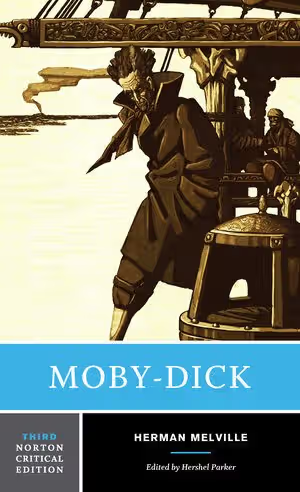
This Norton Critical Edition (third edition, published in November 2017, about 700 pages) is built on Hershel Parker's revision of the 1967 text edited by Harrison Hayford and Parker. It contains a list of illustrations (page ix), a preface (page xi), acknowledgments, and two maps ("Principal Ports of Southeastern New England" and "Melville's Voyages and the Route of the Pequod, 1841-44"). The novel occupies pages 1 to 410, followed by a list of emendations (page 411). Contexts (pages 419 to 575) and criticism (pages 577 to 702) follow, and a selected bibliography ends the book. Twenty-six illustrations, including maps, engravings and diagrams of whaleboat rigging, are included.
Etymology and Extracts
Before the story proper come an "Etymology" and "Extracts (Supplied by a Sub-Sub-Librarian)", a collection of passages about whales taken from many writers and texts.
Chapters 1–22: Ishmael Ships Out
The narrator opens with "Call me Ishmael." In "Loomings" he explains why he goes to sea. He lodges at the Spouter-Inn in New Bedford, shares a bed with the harpooner Queequeg, and hears Father Mapple's sermon in the Whaleman's Chapel. The two sign on and sail from Nantucket. The Pequod is a Nantucket ship, and a stranger, Elijah, warns them off in "The Prophet". The sequence ends with the departure on Christmas Day.
Chapters 23–35: The Ship and Its Captain
After "The Lee Shore" and "The Advocate," Ishmael introduces the mates and harpooners ("Knights and Squires") and, in Chapter 28, Ahab. Chapter 32, "Cetology," is the first of the novel's classifications of whales, and the "Mast-Head" chapter describes watching for whales.
Chapters 36–54: The Quarter-Deck and the Hunt
In "The Quarter-Deck" Ahab binds the crew to the hunt for Moby Dick. "Moby Dick" and "The Whiteness of the Whale" give the whale's history and meaning, and "The Chart," "The First Lowering," Fedallah, "The Spirit-Spout," "The Albatross," "The Gam" and "The Town-Ho's Story" build the voyage.
Chapters 55–105: Whales and Whaling
This long section mixes action with information. The chapters on pictures of whales, "Stubb Kills a Whale," "Cutting In," "The Try-Works," and the anatomy chapters ("The Sperm Whale's Head," "The Tail") alternate with "The Castaway" (Pip), "The Doubloon," "The Pequod Meets the Rose-Bud," and the chapters about the whale's skeleton, magnitude and survival.
Chapters 106–131: Ahab's Leg to the Rachel
Ahab has his leg repaired, talks with the carpenter and with Starbuck, and has Queequeg's coffin converted into a life-buoy. The Pequod meets the Bachelor, the Rachel (whose captain begs Ahab to help search for his lost son) and the Delight, and the novel moves through storms, the lightning and the needle.
Chapters 132–135 and Epilogue: The Chase
"The Symphony" precedes the chase on three days. The Pequod is destroyed, and the Epilogue is spoken by Ishmael, who survives on the coffin life-buoy and is picked up by the Rachel.
Contexts and Criticism
The contexts section opens with Parker's essay "Glimpses of Melville as Performer" and covers whaling and whalecraft (a glossary of nautical terms, John B. Putnam's pictorial account, engravings), "Before Moby-Dick: International Controversy over Melville," sources of and influences on the book (including Mocha Dick, Owen Chase's account of the Essex, and "Hawthorne and His Mosses"), and thirteen letters from the time. The criticism section has some thirty reviews of The Whale and Moby-Dick, Parker's "Damned by Dollars," pieces from the Melville revival of 1879 to 1927, two works of literary criticism by Walter Bezanson and Harrison Hayford, and six pieces on the novel in the twenty-first century.
Key Concepts
The Voyage
- Narrator and voice: Ishmael tells the story and shifts between narration, comedy, lecture and reflection.
- Obsession and command: Ahab's pursuit of the white whale, and the way he binds the crew, drives the plot.
- Whiteness and meaning: the chapters on the whale's whiteness ask what the whale stands for.
- Cetology: classifying whales is one of the book's long digressions.
Contexts
- Whaling as work: the glossary, the pictorial account and the engravings give the working practice of the trade.
- Sources and reception: Melville's sources (Mocha Dick, the Essex) and the reviews show how the book was made and how readers first received it.
- Letters to Hawthorne: Melville's letters from the time give his own account of the book as he wrote it.
Critical Analysis
Strengths
- A well-prepared text. The edition follows the Hayford–Parker text with Parker's revisions, and it lists emendations at the back.
- Documents arranged around the novel. The contexts group sources, the author's letters and international reception, so a student can follow the book from its raw material to its reviews.
- Long criticism record. Norton counts forty-four reviews and interpretations over three centuries. Mary K. Bercaw Edwards, quoted by Norton, praises the commentary from 1851 into the twenty-first century.
- Illustrations and maps. Twenty-six illustrations and two maps help a landlubber follow a whaling voyage.
Limitations
- Length and digressions. The novel and its apparatus run to about 700 pages, and the cetology and whaling chapters break the narrative for many readers.
- A heavy apparatus for a first read. Emendations, the glossary and many documents are useful for study but add weight for a reader who only wants the novel.
- A criticism section weighted towards reception. The reviews, the Melville revival and the twenty-first-century pieces take most of the space, and only two essays sit under "Literary Criticism" (Bezanson and Hayford), so a student wanting a range of modern interpretive approaches will need to look beyond the volume.
Where It Fits in the Course
In the American literature course, Moby-Dick is the nineteenth-century novel on the list and the one with the fullest apparatus. Morrison's Beloved and Wright's Black Boy are twentieth-century works on race and memory, and Gray's A Brief History of American Literature and Klarer's A Short Literary History of the United States supply the survey background. The Norton Anthology of American Literature gives a wider range of primary texts, and Leo Marx's The Machine in the Garden is a critical study of how American writers handled landscape and technology.
How to Use This Book
Plan for a long read. Start with Parker's preface and the maps, then read the novel in order, using the glossary of nautical terms and the footnotes when ship life gets unfamiliar. Do not skip the cetology chapters, which carry much of the book's thought. Read Melville's letters to Hawthorne alongside the chapters written in the same months.
After finishing, read the contemporary reviews to see how differently the book looked in 1851, then choose two or three of the later essays to prepare an essay. If you are short of time, the core chapters are 1 to 4, 9, 28 to 42, 54, 93, 99, 110, 126 to 128 and 132 to the Epilogue.