01 / Reading Guide
Reading Guide
Citation
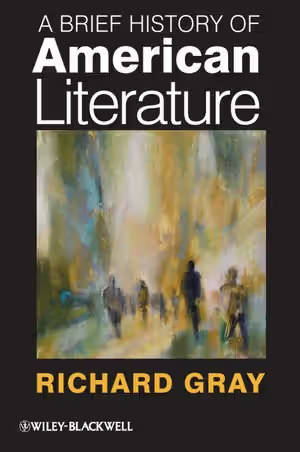
Gray, R. (2011). A Brief History of American Literature. Wiley-Blackwell.
Chapter Summary
The book is an abridged version of Richard Gray's longer History of American Literature. It tells the story of American writing in five long chapters, each opening with a short framing section ("Making a Nation", "Rebuilding a Nation" and so on) and then dividing into thematic sections, followed by an index; the text runs to about 370 pages. Wiley describes it as covering fiction, poetry, drama and non-fiction, together with folktales, spirituals, the detective story, the thriller and science fiction, and as reflecting how the understanding of American literature has changed over the past twenty years. Judie Newman, reviewing it in the Journal of American Studies (2012), places it within Gray's long effort to advance a pluralist account of American literature and notes that it is written at least partly for the intelligent general reader.
Chapter 1: The First Americans: American Literature During the Colonial and Revolutionary Periods
The chapter, which Wiley offers as a free excerpt, opens with "Imagining Eden", on the European dream of America as a new land outside history and how it erased earlier American lives. It then works through Puritan narratives (Bradford's Of Plymouth Plantation, read as a search for providential meaning, and Winthrop), challenges to the Puritan order such as Anne Hutchinson, colonial poetry from The Day of Doom and The Bay Psalm Book onwards, Mary Rowlandson's captivity narrative, the secular travel journals of Sarah Kemble Knight and William Byrd, Jonathan Edwards and Benjamin Franklin as two developments of Puritanism, "alternative voices" of the Revolution such as Abigail Adams, and early African American poets including Jupiter Hammon and Phillis Wheatley. It ends with Charles Brockden Brown, whose novels it presents as anticipating Poe, Hawthorne, Melville and Cooper.
Chapter 2: Inventing Americas: The Making of American Literature 1800–1865
Under the heading "Making a Nation", the chapter has four sections: the making of American myths, of American selves, of many Americas, and of an American fiction and poetry. The index shows Emerson, Douglass, Native American writing, spirituals and folk songs, Poe, Melville, Whitman and Dickinson among its subjects, so the period's canonical writers are set beside slave narratives and other voices.
Chapter 3: Reconstructing the Past, Reimagining the Future: The Development of American Literature 1865–1900
After "Rebuilding a Nation", the sections cover literary regionalisms, realism and naturalism, women's writing and, again, "many Americas". Henry James, Kate Chopin, Stephen Crane and Theodore Dreiser are among the writers the index places here.
Chapter 4: Making It New: The Emergence of Modern American Literature 1900–1945
At about 90 pages, the chapter moves from "Changing National Identities" through "Between Victorianism and Modernism", "The Inventions of Modernism", "Traditionalism, Politics, and Prophecy" and "Community and Identity" to "Mass Culture and the Writer". Pound, T. S. Eliot, Stevens, Fitzgerald, Faulkner, Hemingway, Hughes and Hurston appear in it, together with Native American voices and hard-boiled detective fiction.
Chapter 5: Negotiating the American Century: American Literature since 1945
The final chapter, at more than 120 pages the longest, opens with "Towards a Transnational Nation" and then has seven sections: formalists and confessionals; public and private histories; Beats, prophets and aesthetes; the art and politics of race; realism and its discontents; language and genre; and creating new Americas. The index locates Robert Lowell and Plath, Roth, DeLillo and Cormac McCarthy, Ellison, Baldwin and Morrison, Tennessee Williams, Pynchon, science fiction and Walter Mosley, and Maxine Hong Kingston, N. Scott Momaday, Leslie Marmon Silko and Louise Erdrich within it.
Key Concepts
Colonial to Civil War (Chapters 1–2)
- America as Eden: the European idea of a new land outside history, which shaped how America was written into existence.
- Providential narrative: the Puritan habit of reading every event as part of God's design, which the chapter argues left lasting marks on American writing.
- Captivity narrative: accounts such as Rowlandson's of capture by Native Americans, an early American form.
- Many Americas: Gray's recurring heading for the writing of groups outside the dominant culture, from Native American and African American voices onwards.
Reconstruction to the present (Chapters 3–5)
- Regionalism, realism and naturalism: the literary movements that followed the Civil War.
- Modernism: the "inventions" of the early twentieth century, set against traditionalist and political writing.
- Mass culture and genre: popular forms such as detective fiction and science fiction, treated as part of the history.
- Transnational nation: the frame for writing since 1945, including the politics of race and new ethnic literatures.
Critical Analysis
Strengths
- One narrative from the beginnings to the present. Five chapters carry the story from colonial writing to the twenty-first century; the endorsements Wiley prints, by Andrew Hook, Paul Giles and Susan Castillo, praise its range and its synoptic, accessible treatment.
- A pluralist history. Every chapter makes room for "many Americas": Native American, African American, women's and ethnic writing sit alongside the canonical authors. Newman sees this pluralism as the thread of Gray's work.
- Genre writing taken seriously. Spirituals, folk songs, detective fiction, the thriller and science fiction appear as part of literary history, not as an appendix.
- Readable prose with argument. The sample chapter shows the method: short biographical and historical framing, close attention to particular works, and claims about their influence on later writing, as in the reading of Brockden Brown.
Limitations
- An abridgement. The book condenses a longer history, so individual authors often receive only a few pages; readers who need more depth can turn to the full History of American Literature.
- Thematic sections cut across chronology. Because each period is divided by theme, an author may appear in several places, and the index is the best way to follow a single writer.
- Dated at the end. Published in 2011, the book stops at the first decade of the century; more recent writing is outside its scope.
Where It Fits in the Course
In the American literature course this is the fuller of the two short histories. Mario Klarer's A Short Literary History of the United States is a briefer outline arranged by period and movement, with a glossary; read Klarer first for orientation, or use it for quick revision, and use Gray for continuous discussion of authors and works. Gray's chapters also make a natural companion to The Norton Anthology of American Literature, which supplies the texts: read the matching section of Gray before each block of anthology reading.
The individual works on the list fit into Gray's chapters: according to the index, Moby-Dick is discussed in Chapter 2's section on the making of an American fiction and poetry, Richard Wright's Black Boy in Chapter 4's section on community and identity, and Toni Morrison's Beloved in Chapter 5's section on the art and politics of race. Leo Marx's The Machine in the Garden is a sustained critical argument about the pastoral ideal; Gray's opening section on the dream of America as Eden gives useful background for it.
How to Use This Book
The book is aimed at students of American literature and American studies and at general readers; no previous study of American literature or history is assumed. For a survey course, read the opening section of each chapter for the historical frame, then the thematic section that covers the authors you are reading that week. Use the index to gather everything said about one writer across chapters.
Begin with the free sample chapter on Wiley's website to judge whether the style suits you. When writing essays, treat Gray as a map and starting point: note the connections he draws between periods (for example from Brockden Brown to Poe and Hawthorne), check them against the primary texts, and follow up in fuller critical studies. For writing after 2010 a more recent source is needed.