01 / Reading Guide
Reading Guide
Citation
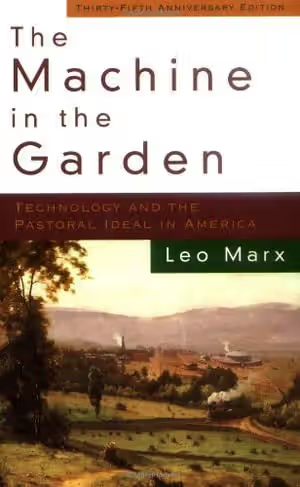
Marx, L. (2000). The Machine in the Garden: Technology and the Pastoral Ideal in America (35th anniversary ed.). Oxford University Press.
Chapter Summary
First published in 1964, the book runs to about 414 pages in the 2000 anniversary edition, which adds an afterword by the author on the process of writing it. The main text has five chapters and an epilogue, followed by the afterword, notes, acknowledgments and an index.
Context and Argument
Marx follows a recurring image in nineteenth-century American writing: the sudden entrance of the machine into a pastoral scene, as when a locomotive's whistle breaks into the calm of Walden Pond. He reads this image as a sign of the tension between two ideals, the pastoral wish for a simple life in a rural landscape and the progressive commitment to productivity, wealth and power. His interest is less in the physical transformation of the land than in the "landscape of the psyche", and he argues that serious literature, unlike sentimental popular pastoralism, faces the contradiction squarely.
Chapter 1: Sleepy Hollow
The opening chapter introduces the central image of an intrusion on a quiet rural setting and the idea of pastoral that gives it force. It sets the terms for everything that follows.
Chapter 2: Shakespeare's American Fable
Marx treats The Tempest as a prologue to American pastoral. Its island and its figures, including Prospero and Caliban, serve as an early version of the encounter between a cultivated order and a natural world that later American writers kept reworking.
Chapter 3: The Garden
The chapter turns to early American versions of the garden ideal, including Robert Beverley and Thomas Jefferson, and to the notion of a "middle landscape" between wilderness and city.
Chapters 4–5: The Machine; Two Kingdoms of Force
These chapters set the arrival of industrial technology (railroads, factories, steam power) against the pastoral ideal and read the major writers of the period. Emerson and Thoreau, Hawthorne, Melville and Mark Twain are the central figures; in Adventures of Huckleberry Finn, the raft is the garden and the steamboat the machine that destroys it.
Epilogue: The Garden of Ashes
The last section carries the argument into the twentieth century, with The Great Gatsby as the closing example. Marx concludes that the writers he discusses clarified the situation but did not supply the new symbols that would resolve it, and he looks to politics, not literature, for solutions.
Afterword
The 2000 edition adds the author's account of the process of writing the book.
Key Concepts
The argument as a whole
- The machine in the garden: the recurring image of technology breaking into a pastoral landscape, used as a key to cultural tension.
- Pastoral ideal: the longing for a simple, harmonious life close to nature, which Marx follows through its literary forms into American writing.
- Progressive ideal: the commitment to economic and technological advance that the pastoral wish runs up against.
- Middle landscape: an imagined settled space between wild nature and the city, associated with the American garden.
- Sentimental and serious pastoralism: the difference between a popular, unreflective rural nostalgia and literary works that expose the contradiction.
Critical Analysis
Strengths
- A single guiding image. The title phrase gives the book a clear thread, so five chapters on different writers read as one argument.
- Close reading with a cultural question. Marx uses canonical literary texts to ask how Americans understood technology, which has made the book a founding work for American studies (according to the publisher, it "all but founded" the discipline) and a reference for environmental and technological debates.
- Lasting attention. The 35th anniversary edition adds the author's afterword, and the book has since been the subject of retrospective essays (Jeffrey Meikle in Technology and Culture, 2003; David Robinson in Reviews in American History, 2013) and of the edited collection Rereading the Machine in the Garden (2014).
Limitations
- Literary evidence for a cultural argument. Marx looks at the interior landscape through a small group of major writers rather than at the historical record of landscape change, so readers wanting social or economic history will need other books.
- A debated method. Essays such as Bryant's study of Marx's method in American Studies (1975) and Decker's critique of American studies in New Literary History (1992) show that the symbol-centred approach has been questioned.
- Narrow set of authors. The central chapters concentrate on nineteenth-century white male writers, with Fitzgerald as the main twentieth-century example, so it does not address the later writers in the course.
- No resolution. By Marx's own conclusion, literature clarifies the problem without providing solutions, which may disappoint readers looking for a constructive programme.
Where It Fits in the Course
Within the American literature course, this is an advanced interpretive study to read after a survey and after the primary texts it discusses. Richard Gray's A Brief History of American Literature and Mario Klarer's A Short Literary History of the United States supply the period framework, and The Norton Anthology of American Literature is a convenient source for the shorter works by Emerson, Thoreau, Hawthorne, Twain and others. Melville's Moby-Dick, in the Norton Critical Edition on the list, is the one long text Marx discusses that the course supplies in full.
Toni Morrison's Beloved and Richard Wright's Black Boy come from the twentieth century and from Black American experience, which Marx's argument does not address, so they offer a useful contrast. Reading them after Marx raises the question of whose landscape and whose machine the pastoral tradition describes.
How to Use This Book
The book suits advanced undergraduates and graduate students in American literature, American studies, the history of technology and environmental humanities. A survey course and some nineteenth-century reading should come first.
For a first pass, read the opening chapter and the epilogue, which together state the thesis and its outcome. Then take the chapters on the machine and on the two kingdoms of force alongside the primary texts: the Walden passages, a few chapters of Huckleberry Finn and selected chapters of Moby-Dick. The chapter on The Tempest and the chapter on the garden are the most useful for readers working on colonial and early national writing and can be left until later by others. The afterword gives the author's own account of the process of writing the book. Keep a short list of the places where each author describes the machine entering the landscape, and compare them.