01 / Reading Guide
Reading Guide
Citation
Gazzaniga, M. S., Ivry, R. B., Mangun, G. R., Bassett, D. S., & Phelps, E. A. (2025). Cognitive Neuroscience: The Biology of the Mind (6th ed.). W. W. Norton & Company.
Chapter Summary
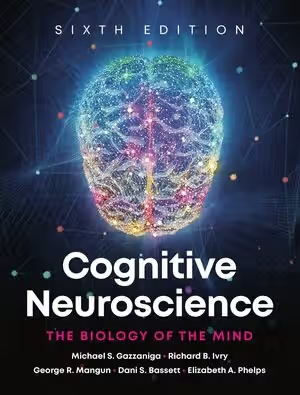
The sixth edition has 14 chapters. Its arc is easy to read from the chapter titles: a historical opening, two chapters on the brain and on the methods used to study it, a chapter on the two cerebral hemispheres, and then a run of topic chapters that follow the cognitive-psychology curriculum (perception, recognition, attention, action, memory, emotion, language, control and social cognition) before the book ends on consciousness. Gazzaniga, Ivry and Mangun are the original authors; Dani Bassett and Elizabeth Phelps joined for this edition. The publisher says Bassett contributes expertise in network science and Phelps in memory and social cognition.
Chapter 1: A Brief History of Cognitive Neuroscience--and a Look Beyond
The opening chapter places the field in its history and looks toward what comes next, setting the questions that the rest of the book takes up.
Chapter 2: Structure and Function of the Nervous System
The anatomical and physiological foundation: the nervous system that the later chapters assume.
Chapter 3: Methods of Cognitive Neuroscience
The tools by which the field draws its conclusions. Reading this chapter before the topic chapters makes the later evidence easier to judge,.
Chapter 4: Hemispheric Specialization
The chapter on the division of function between the two hemispheres, a classic theme of the field.
Chapters 5–6: Sensation and Perception; Object Recognition
Two chapters on how the brain turns sensory input into perceptual experience and recognised objects.
Chapters 7–8: Attention; Action
Selective attention, and the control of movement and action. Mangun's research is on attention and Ivry's on the relation between cognition and action, according to the publisher's author notes.
Chapter 9: Memory
Phelps, whose expertise the publisher describes as memory and social cognition, is one of the authors of this edition; the chapter covers memory in the brain.
Chapter 10: Emotion
The neural basis of emotion. Phelps is described by the publisher as an expert on emotion in relation to learning and memory.
Chapter 11: Language
The biology of language.
Chapters 12–13: Cognitive Control; Social Cognition
Executive control of thought and behaviour, and the brain mechanisms of thinking about other people. Social cognition is the other area the publisher names as Phelps's expertise.
Chapter 14: The Consciousness Problem
The closing chapter takes on the problem of conscious experience as a question for cognitive neuroscience.
Key Concepts
Chapters 1–4: Foundations
- Nervous system structure and function: the anatomical base for the chapters that follow.
- Methods of cognitive neuroscience: the techniques that link brain measures to cognitive claims.
- Hemispheric specialization: differences in what the two halves of the brain contribute.
Chapters 5–11: Cognitive domains
- Sensation and perception, object recognition: from sensory input to recognised objects.
- Attention and action: selecting information and acting on it.
- Memory and emotion: two systems that interact in learning.
- Language: its neural basis.
Chapters 12–14: Control, social cognition and consciousness
- Cognitive control: regulation of thought and behaviour.
- Social cognition: how the brain supports understanding of other people.
- The consciousness problem: how conscious experience relates to brain activity.
Critical Analysis
Strengths
- A coherent teaching design. The publisher's site emphasises a "strong overarching narrative" and "recurrent organizational structure," in the words of one instructor it quotes (Assaf Harel, Wright State University), together with clear writing.
- A multimedia study environment. The publisher describes a Norton Illumine ebook with embedded patient videos, an interactive 3-D brain and low-stakes assessment, plus "Behind the Citation" videos featuring working neuroscientists. These resources are useful for a subject in which spatial anatomy and clinical cases are central.
- Authors who are active researchers. The author team is made up of researchers in memory, emotion, attention, action and network science, and the publisher says the two new authors bring current research and technologies, in network science and in memory and social cognition.
- A familiar topic order. Because the topic chapters follow the standard divisions of a cognitive psychology course, the book can be read alongside a cognitive psychology text, chapter against chapter.
Limitations
- Prior knowledge assumed. The chapter order moves quickly from the nervous system to methods; readers who have not met neurons and basic brain anatomy will need to read Chapter 2 carefully and look elsewhere for revision.
- Cognitive and biological focus. The chapter list has no separate chapters on development, individual differences, clinical disorders or computational modelling; the book is organised around cognitive functions and the brain systems that support them, and those other topics need other books.
- Breadth over depth for specialists. At about 600 to 700 pages (the length is given as 612 and 720 pages in different catalogues) in 14 chapters, some topic chapters will cover only the main lines of a large literature. Readers who want to specialise will need review articles on the topic.
Where It Fits in the Course
This is the biologically oriented book in the cognitive psychology course list. The more introductory texts come first: Taylor and Workman's Cognitive Psychology: The Basics and Eysenck and Brysbaert's Fundamentals of Cognition are written for readers meeting the subject for the first time, and Reisberg's Cognition is an accessible mid-length undergraduate text. Eysenck and Keane's Cognitive Psychology: A Student's Handbook is the comprehensive companion that integrates experimental work, cognitive neuroscience, neuropsychology and computational modelling, so it overlaps most with Gazzaniga.
Gazzaniga and colleagues give a deeper account of the brain side of the same topics. Griffiths, Chater and Tenenbaum's Bayesian Models of Cognition is a more specialised book that explains cognition at the level of computational problems; the two books complement each other, one asking where and how the brain implements a function and the other what problem the function solves.
How to Use This Book
The book is aimed at undergraduates who have taken a course in cognitive psychology and have some introduction to neurons and brain anatomy. It also suits graduate students from other fields who need a broad survey of the neural basis of cognition.
A practical plan:
- Core: Chapters 2 and 3 first, because they supply the anatomy and the methods vocabulary for everything else. Treat Chapter 1 as context.
- Then by topic: follow the order of a cognitive psychology course, taking Chapters 5–6 with perception, Chapter 7 with attention, Chapter 9 with memory, Chapter 11 with language and Chapter 12 with thinking and executive function.
- Selected: Chapter 4 (hemispheric specialization), Chapter 10 (emotion), Chapter 13 (social cognition) and Chapter 14 (consciousness) can be assigned singly according to the course.
- Alongside the text: use the publisher's ebook features, especially the 3-D brain, for anatomy, and read Chapters 5–6 and 9 beside the matching chapters of a cognitive psychology text to see behavioural and neural evidence together.