01 / Reading Guide
Reading Guide
Citation
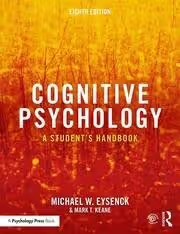
Eysenck, M. W., & Keane, M. T. (2020). Cognitive Psychology: A Student's Handbook (8th ed.). Psychology Press (Routledge).
Chapter Summary
The eighth edition runs to 980 pages and sixteen chapters in five parts, followed by a glossary, references and indexes. According to the publisher, every chapter includes key definitions, real-life applications, a chapter summary and suggested further reading, and the new edition places more emphasis on neuroscience.
Chapter 1: Approaches to human cognition
Introduces four approaches: cognitive psychology, cognitive neuropsychology, cognitive neuroscience (the brain in action) and computational cognitive science. It then compares the major approaches, asks whether there is a replication crisis, and outlines the rest of the book.
Part I, Chapters 2–5: Visual perception and attention
Basic processes in visual perception covers vision and the brain, two visual systems, colour, depth and subliminal perception. Object and face recognition covers pattern recognition, perceptual organisation, top-down processes, faces and visual imagery. Motion perception and action covers direct perception, visually guided movement, human motion and change blindness. Attention and performance covers focused auditory and visual attention, disorders of visual attention, visual search, cross-modal effects, dual-task performance and automatic processing.
Part II, Chapters 6–8: Memory
Learning, memory and forgetting looks at short-term versus long-term memory, working memory (Baddeley and Hitch, individual differences and executive functions), levels of processing, learning through retrieval, implicit learning and forgetting. Long-term memory systems covers declarative, episodic, semantic and non-declarative memory. Everyday memory covers autobiographical memory, eyewitness testimony and prospective memory.
Part III, Chapters 9–11: Language
Speech perception and reading treats speech and music perception, context effects, theories of speech perception, word recognition, reading aloud and eye-movement research. Language comprehension covers parsing, pragmatics, working memory capacity, and discourse inferences and theories. Language production covers speech planning, speech errors, theories of production, cognitive neuropsychology, writing and spelling.
Part IV, Chapters 12–14: Thinking and reasoning
Problem solving and expertise covers insight, strategies, analogy, and expertise in chess and medicine, with brain plasticity and deliberate practice. Judgement and decision-making covers judgement research and theories, decision-making under risk, emotional and social factors, and applied decisions. Reasoning and hypothesis testing covers hypothesis testing, deductive reasoning and its theories, brain systems, informal reasoning and the question of whether humans are rational.
Part V, Chapters 15–16: Broadening horizons
Cognition and emotion covers appraisal theories, emotion regulation, the effects of affect on attention, memory, judgement and decision-making, anxiety and depression with cognitive biases, and cognitive bias modification. Consciousness covers the functions of consciousness, how to assess conscious experience, global workspace theories and whether consciousness is unitary.
Key Concepts
Chapter 1: approaches to cognition
- Cognitive neuropsychology: one of four approaches, studying cognition through the effects of brain damage.
- Computational cognitive science: modelling cognition computationally.
- Replication crisis: a question raised in the opening chapter about the reliability of findings.
Chapters 2–8: perception, attention and memory
- Two visual systems (perception-action model): a Chapter 2 account of vision.
- Working memory (Baddeley and Hitch): the central Chapter 6 model.
- Declarative and non-declarative memory: the division organising Chapter 7.
Chapters 9–16: language, thinking, emotion and consciousness
- Parsing: the analysis of sentence structure in Chapter 10.
- Deliberate practice: an expertise topic in Chapter 12.
- Cognitive bias modification: a Chapter 15 topic on emotion and cognition.
- Global workspace theory: a theory of consciousness in Chapter 16.
Critical Analysis
Strengths
- Comprehensive coverage. Sixteen chapters take the reader from vision and attention through memory, language and thinking to emotion and consciousness, with many sections per chapter (for example, eight sections in the chapter on speech perception and reading). The publisher presents it as covering all the key areas of the field.
- Several approaches in one book. Chapter 1 sets out experimental cognitive psychology, cognitive neuropsychology, cognitive neuroscience and computational modelling together, and the later chapters cover topics at several levels.
- Reviewer endorsement. Reviewers quoted by the publisher include Robert Logie (Edinburgh), who calls it a high benchmark that retains its hallmark coverage and readability, and Philip Johnson-Laird (Princeton), who notes that it explains topics from low-level vision to high-level consciousness and can serve as an introductory text. Rhonda Shaw (Charles Sturt University) singles out the use of up-to-date real-world examples, and Lin Agler (University of Southern Mississippi Gulf Coast) the concise, easy-to-follow writing.
- Learning aids. The publisher lists a companion website with simulation experiments, multiple-choice questions and access to Primal Pictures' interactive 3D atlas of the brain.
Limitations
- Size. At 980 pages the book contains much more than a single course normally uses, so readers must choose which parts to read.
- Publication date. The edition appeared in 2020, so later work on the topics it covers is not included.
Where It Fits in the Course
This is the comprehensive reference text in the course. Reisberg's Cognition: Exploring the Science of the Mind is a mid-length alternative organised in five parts, a good first book for readers who find 980 pages too much. Eysenck and Brysbaert's Fundamentals of Cognition and Taylor and Workman's Cognitive Psychology: The Basics are introductions for readers new to the subject, and either can come before this handbook.
For depth in specific directions, Cognitive Neuroscience: The Biology of the Mind gives a fuller biological account of the same processes, and Griffiths, Chater and Tenenbaum's Bayesian Models of Cognition is a graduate treatment of the probabilistic approach.
How to Use This Book
Suitable for undergraduates who have taken an introductory psychology course, and useful as a reference through a degree. A practical plan is to read Chapter 1 first for the vocabulary of the four approaches, then work through Parts I and II, since perception, attention and memory underlie the later parts.
For a one-term course, choose one or two chapters from each part rather than reading straight through: for instance Chapters 2, 3 and 5 from Part I, Chapters 6–8 from Part II, Chapters 10 or 11 from Part III and Chapters 12–13 from Part IV. Use the chapter summaries and further-reading lists to check understanding and to find primary sources, and use the companion website's multiple-choice questions and simulations as practice.