01 / Reading Guide
Reading Guide
Citation
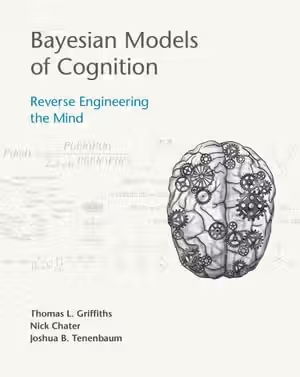
Griffiths, T. L., Chater, N., & Tenenbaum, J. B. (Eds.). (2024). Bayesian Models of Cognition: Reverse Engineering the Mind. The MIT Press.
Chapter Summary
The book runs to 648 pages in two parts, a preface and a short concluding section. It is a multi-author volume: the three editors write or co-write many chapters, and specialists contribute the chapters on particular topics. The publisher describes Part I as covering the key mathematical ideas, illustrated with examples from the psychological literature and with detailed derivations of specific models, and Part II as advanced topics and their applications, followed by critiques of the reverse-engineering approach.
Part I: The Basics
Chapter 1: Introducing the Bayesian Approach to Cognitive Science. The opening chapter, by all three editors, sets out the framework that the title calls reverse engineering the mind: treating cognition as a solution to problems of inference under uncertainty.
Chapter 2: Probabilistic Models of Cognition in Historical Context. Places the probabilistic approach within the longer history of ideas about the mind, so that readers see where the approach came from before the mathematics begins.
Chapter 3: Bayesian Inference. The foundational chapter, written by Griffiths and Tenenbaum, on the core logic of Bayesian inference that the rest of the book relies on.
Chapter 4: Graphical Models and Chapter 5: Building Complex Generative Models. Both are written by Griffiths and Alan Yuille. They move from basic inference to structured probabilistic representations: graphical models first, then ways of composing richer generative models of the world.
Chapter 6: Approximate Probabilistic Inference. Written by Griffiths and Adam Sanborn, this chapter addresses what to do when exact Bayesian computation is impractical, a topic that returns in the Part II chapters on sampling and resource-rational analysis.
Chapter 7: From Probabilities to Actions. Written by Chater, Griffiths and Mark Ho, it extends inference to decision-making, closing the first part by connecting beliefs to choices.
Part II: Advanced Topics
The second part opens with a short interlude and then consists of fifteen chapters, most by teams of researchers working on the topic in question.
Chapters 8–9: Learning Inductive Bias with Hierarchical Bayesian Models; Capturing the Growth of Knowledge with Nonparametric Bayesian Models. Two chapters on how models can learn their own constraints and grow in complexity as data arrive.
Chapters 10–11: Estimating Subjective Probability Distributions; Sampling as a Bridge Across Levels of Analysis. The first concerns measuring the beliefs people hold; the second connects computational-level models with sampling as a process-level account.
Chapters 12–13: Bayesian Models and Neural Networks; Resource-Rational Analysis. These chapters place Bayesian models next to neural-network models and ask how the limits of computation should shape models of rational behaviour.
Chapters 14–15: Theory of Mind and Inverse Planning; Intuitive Physics as Probabilistic Inference. Applications to reasoning about other people's goals and to everyday understanding of physical events.
Chapters 16–17: Language Processing and Language Learning; Bayesian Inference over Logical Representations. Applications to language and to inference over structured, symbolic hypotheses.
Chapters 18–19: Probabilistic Programs as a Unifying Language of Thought; Learning as Bayesian Inference over Programs. Probabilistic programs as a representation for thought and for learning.
Chapter 20: Bayesian Models of Cognitive Development, by Elizabeth Bonawitz and Tomer Ullman, applies the framework to children's learning.
Chapter 21: The Limits of Inference and Algorithmic Probability, by Chater, and Chapter 22: A Bayesian Conversation, by the three editors, turn to the limits of the approach and to discussion of it. A short Conclusion, acknowledgments, a long reference list and an index follow.
Key Concepts
Part I
- Bayesian inference: updating the probability of hypotheses in light of evidence, the logic on which every later chapter builds.
- Graphical models and generative models: structured ways to describe how observed data arise from hidden causes.
- Approximate inference: methods for estimating Bayesian answers when exact calculation is not feasible.
- Decision-making: turning beliefs into actions.
Part II
- Hierarchical and nonparametric models: models that learn inductive biases and whose complexity can grow with data.
- Sampling and resource-rational analysis: accounts of how limited minds might approximate rational inference.
- Inverse planning and intuitive physics: inferring goals from behaviour, and inferring physical events from observation.
- Probabilistic programs: programs used as hypotheses and as a language for thought.
Critical Analysis
Strengths
- Authorship by the approach's proponents. The three editors are described by the publisher as pioneers of the field, and they write or co-write the framing chapters; the publisher describes the contributors as experts at the forefront of new research, and each Part II chapter lists its own specialist authors.
- A deliberate on-ramp. Part I takes seven chapters, about 225 pages, to build from the basic logic of inference to graphical models, approximation and decisions before any specialised application. The publisher says it includes detailed derivations and references for readers who want the underlying principles, and short tutorials and case studies of specific models.
- Breadth of cognitive domains. Part II applies the framework to learning, social reasoning, physical reasoning, language, logical and program-like representations and development, so the book doubles as a map of where the approach has been used.
- Place for critique. The publisher states that the book engages with critiques of the reverse-engineering approach, and the closing chapters include one on the limits of inference and one titled as a conversation among the editors.
Limitations
- Mathematical demands. The book presents derivations and probabilistic models in detail, so readers who have not met probability and calculus will find even Part I slow. The publisher suggests advanced undergraduates and graduate students as the audience.
- Edited-volume unevenness. Many chapters have different author teams, so notation, depth and pace may vary across Part II. Readers should expect to treat chapters as semi-independent essays.
- Length and scope. At 648 pages, the book is not a single-semester read from cover to cover; courses need to choose among the Part II chapters.
- One framework, not a survey. The book is organised around the Bayesian approach, with a chapter on its relation to neural networks; a reader wanting a neutral survey of cognitive theory will need a general cognitive psychology text alongside.
Where It Fits in the Course
In this course list the book is the most specialised: it is about one theoretical approach rather than the whole of cognitive psychology. The general textbooks come first. Taylor and Workman's Cognitive Psychology: The Basics and Eysenck and Brysbaert's Fundamentals of Cognition are written for readers meeting the subject for the first time; Reisberg's Cognition is a mid-length undergraduate text with accessible writing; and Eysenck and Keane's Cognitive Psychology: A Student's Handbook is a comprehensive text that includes computational modelling. Any of these gives the empirical background on perception, memory, language and reasoning that Part II of this book assumes.
Gazzaniga and colleagues' Cognitive Neuroscience approaches cognition from the biology of the brain; it complements this book, which works at the level of computational problems rather than neural mechanisms, though the chapter on sampling as a bridge across levels of analysis discusses how the two relate.
How to Use This Book
The book suits advanced undergraduates and graduate students who have completed a cognitive psychology course and are comfortable with basic probability, calculus and linear algebra. A reader who wants to build or run models will also need programming practice; the book does not replace a course in programming or statistics.
A practical reading plan:
- Core: Chapters 1–3 for the framework and the logic of inference; this is enough for a reader who wants only to understand what a Bayesian model of cognition claims.
- For modelling: Chapters 4–7 add graphical models, generative models, approximate inference and decisions. Work through the derivations by hand or in code before moving on.
- By interest: choose Part II chapters by topic. Chapters 8–9 suit readers interested in learning and development, Chapters 14–15 social and physical reasoning, Chapter 16 language, and Chapters 18–19 symbolic or program-based representations.
- For critical perspective: read Chapters 12, 13, 21 and 22 together, since they ask how Bayesian models relate to neural networks, to limited computation and to the limits of inference.
Read the chapter on historical context (Chapter 2) alongside Chapter 1 if the philosophical background is unfamiliar. Pair each Part II chapter with one empirical article from its reference list to see how the models are tested against data.