01 / Reading Guide
Reading Guide
Citation
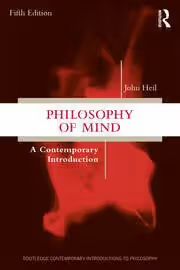
Heil, J. (2026). Philosophy of Mind: A Contemporary Introduction (5th ed.). Routledge.
Chapter Summary
The fifth edition has fourteen chapters and, according to Routledge, 352 pages with 36 black-and-white illustrations (Google Books lists 324 pages). It belongs to the Routledge Contemporary Introductions to Philosophy series. The publisher says that each chapter now ends with a chapter summary and five discussion questions, and that the suggested readings and the reference list have been updated. The summaries below follow the chapter titles and the publisher's description, which names the problems and the "-isms" the book covers; the contents list gives no sections within chapters.
Chapter 1: Introduction
The opening chapter introduces the field. The mind–body problem is the first topic on the publisher's list.
Chapters 2–3: Cartesian Dualism; Descartes's Legacy
Two chapters begin with Descartes. The first treats Cartesian dualism, and the second its legacy, that is, the problems and positions that follow from it. A description of the fourth edition says Chapter 3 includes a discussion of E. J. Lowe's "non-Cartesian dualism".
Chapter 4: Mind and Behavior
The behaviourist approach, which the publisher lists among the "-isms" covered, takes up this chapter.
Chapters 5–6: The Identity Theory; Functionalism
Two of the best-known twentieth-century theories follow: the identity theory, and functionalism, both on the publisher's list.
Chapters 7–8: The Representational Theory of Mind; Artificial Intelligence
The representational theory connects with the publisher's "computational models of thought". Chapter 8, on artificial intelligence, is new in the fifth edition: it replaces the earlier chapter on Davidson's radical interpretation.
Chapter 9: The Intentional Stance
The title refers to Daniel Dennett's approach to explaining behaviour by attributing beliefs and desires; the contents list gives no more detail about the chapter.
Chapter 10: Eliminativism, Externalism, and Extended Minds
This chapter was revised for the fifth edition. The publisher says it now includes new sections on content externalism and the extended mind alongside eliminativism.
Chapters 11–12: Non-Reductive Physicalism; Consciousness
Chapter 11 takes up non-reductive physicalism, and Chapter 12 consciousness. The two are placed together after the theories of mental content, so that the question of what consciousness is arrives late in the book.
Chapters 13–14: Emergence and Panpsychism; The Mind's Place in Nature
Chapter 13 covers emergence and panpsychism, both on the publisher's list of "-isms". Chapter 14 is the closing chapter. A description of the previous edition says that the final chapter draws together the earlier material and sketches an account of the mind's place in nature.
Key Concepts
Chapters 1–6
- The mind–body problem: the question of how mental and physical things are related, the first topic on the publisher's list.
- Cartesian dualism: the view that mind and body are distinct kinds of substance (Chapters 2–3).
- Behaviourism: the view that mental states are tied to behaviour (Chapter 4).
- The identity theory: the view that mental states are identical with states of the brain (Chapter 5).
- Functionalism: the view that mental states are defined by what they do (Chapter 6).
Chapters 7–10
- The representational theory of mind: thought understood in computational and representational terms (Chapter 7).
- Artificial intelligence: the new chapter, on machines and mind (Chapter 8).
- The intentional stance: explaining behaviour by attributing beliefs and desires (Chapter 9).
- Eliminativism, content externalism and the extended mind: the topics of Chapter 10.
Chapters 11–14
- Non-reductive physicalism: a physicalist view that does not reduce the mental to the physical (Chapter 11).
- Consciousness: the topic of Chapter 12.
- Emergence and panpsychism: two of the views on which the book ends (Chapter 13).
Critical Analysis
Strengths
- Wide range of positions. The publisher lists behaviourism, dualism, eliminativism, emergentism, functionalism, materialism, neutral monism and panpsychism, and the fourteen chapter titles confirm that the classical theories are followed through to recent ones such as the extended mind, artificial intelligence and panpsychism.
- Teaching apparatus. The fifth edition adds chapter summaries and five discussion questions at the end of each chapter, and the publisher lists updated suggested readings. For a self-taught reader the summaries give a quick check on each chapter's main claims.
- Stated metaphysical orientation. The publisher describes the aim as a clear, engaging and "metaphysically grounded" introduction. The descriptions of earlier editions also stress arguments and explanations free of formalisms and technical vocabulary, which fits a reader without a technical background.
- Reception. A review of the previous edition by Henry Taylor, quoted on the publisher's page, calls the book wide-ranging, accessible and "fun to read", and recommends it for advanced undergraduates, graduate students and professionals. This is an excerpt chosen by the publisher.
Limitations
- Heavy revision in this edition. The previous edition's chapter on Davidson was replaced by the chapter on artificial intelligence, and other chapters were revised, with "less relevant material" removed according to the publisher. Readers who move between editions should check the contents.
- Metaphysics rather than science of the mind. The publisher stresses that the book is metaphysically grounded; the contents list has no chapter devoted to psychology or neuroscience as such.
- Audience. The publisher addresses philosophy majors and other advanced undergraduates, so a reader looking for a first book with no philosophy behind it may prefer one of the shorter introductions below.
Where It Fits in the Course
Heil's textbook is an introduction that covers a broad set of theories, with a stated metaphysical orientation. Ian Ravenscroft's Philosophy of Mind: A Beginner's Guide and Amy Kind's Philosophy of Mind: The Basics are gentler first books: Ravenscroft explains the main theories from dualism to functionalism and eliminativism in stages, and Kind is a concise introduction that ends each chapter with a summary and further reading. Jaegwon Kim's Philosophy of Mind is the nearest comparison in this course, a rigorous textbook organised around the mind–body problem. Its chapter titles are arranged around what the mind is taken to be (immaterial substance, behaviour, brain, computing machine, causal system) before turning to mental causation, mental content and consciousness. Heil's list is wider in its recent topics.
For further reading, Heil's Chapter 11 on non-reductive physicalism leads towards Kim's Mind in a Physical World, which argues that this view cannot explain how mental properties make a causal difference. Chapters 12 and 13, on consciousness and panpsychism, lead towards David Chalmers's The Conscious Mind, which argues that consciousness cannot be explained reductively and defends a naturalistic dualism.
How to Use This Book
The publisher aims the book at philosophy majors and other advanced undergraduates, and says that readers finish it with a solid grasp of the field's central problems and a sense of where to turn next. A first philosophy course will help.
For a one-semester course, read the chapters in order, since the sequence from Cartesian dualism to behaviourism, the identity theory and functionalism sets up the vocabulary that later chapters use. Chapters 2–6 are the core for anyone who wants a grounding in the standard theories. Chapters 7–10 can then be read as a block on representation, artificial intelligence, the intentional stance and externalism. Chapters 11–14 return to the physicalism question and to consciousness and end with the chapter on the mind's place in nature, which in the previous edition drew the earlier material together.
Use the five discussion questions at the end of each chapter for seminar preparation, and the suggested reading to reach primary texts. Readers with a specific interest in artificial intelligence or the extended mind can go straight to Chapters 8 and 10 after Chapter 6.