01 / Reading Guide
Reading Guide
Citation
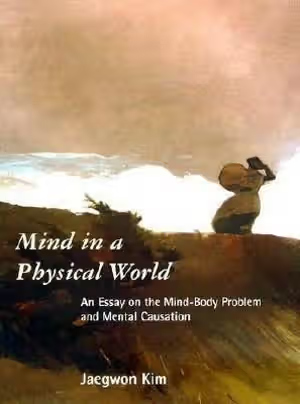
Kim, J. (2000). Mind in a Physical World: An Essay on the Mind-Body Problem and Mental Causation. MIT Press (Bradford Books).
Chapter Summary
The book is based on Kim's 1996 Townsend Lectures and keeps the informal tone of that format. It has a preface and four chapters of about thirty pages each, followed by about fourteen pages of notes, a short list of references and an index, about 120 pages of text in all. The publisher's description puts its subject as the mind-body problem, mental causation and reductionism, with the mind-body problem understood as the task of finding a place for the mind in a world that is fundamentally physical.
Chapter 1: The Mind-Body Problem: Where We Now Are
Takes stock of the debate and sets the vocabulary for the rest of the book. Its sections cover supervenience, realization and emergence, the claim that supervenience is not itself a mind-body theory, the layered model of the world and mereological supervenience, and "physical realizationism," which is then said to explain mind-body supervenience. According to the publisher, Kim redefines the roles that supervenience and emergence play in the discussion.
Chapter 2: The Many Problems of Mental Causation
Distinguishes three problems of mental causation, then turns to the "supervenience argument, or Descartes's revenge," which Chapter 4 revisits at its end. The chapter then discusses how Searle and Fodor stand on the argument and considers Block's worries about second-order properties.
Chapter 3: Mental Causation: The Backlash and Free Lunches
Examines replies to the problem of mental causation. Its sections address the exclusion problem, whether counterfactuals help, program explanation and supervenient causation, whether the problem of mental causation generalizes beyond the mental, and the idea of levels and orders. The publisher says Kim argues that various contemporary accounts of mental causation are inadequate.
Chapter 4: Reduction and Reductionism: A New Look
Develops the positive proposal. The chapter reviews the troubles with bridge laws, presents a functional model of reduction, distinguishes functional properties from functional concepts, returns to multiple realization, and revisits the supervenience argument. It ends with a section titled "Good News and Bad News." According to the publisher, the outcome is a partially reductionist solution based on a novel model of reduction.
Key Concepts
Chapters 1–2: The problem
- Mind-body supervenience: the claim that mental properties depend on physical ones, which Kim argues is not by itself a theory of the relation.
- Physical realizationism: the view, named in the chapter's headings, that mental properties are physically realized; it is presented as explaining mind-body supervenience.
- Supervenience argument: the argument, nicknamed "Descartes's revenge," that raises the problem of how mental properties can cause anything.
Chapters 3–4: Responses and a proposal
- Exclusion problem: the difficulty that a physical cause seems to leave no causal work for a mental one.
- Bridge laws: the laws linking the vocabulary of a reduced theory to that of the reducing theory in classical models of reduction.
- Functional model of reduction: a model on which a mental property is reduced by being given a functional definition and its physical realizers are identified.
- Multiple realization: the claim that one mental property may be realized by many physical ones, which Kim reconsiders.
Critical Analysis
Strengths
- A compact, argued case. With four chapters and about 120 pages of text, the book states a problem, tests competing solutions and offers its own. The publisher calls it clear yet sophisticated.
- A defined structure. The chapter and section headings show a sequence from stock-taking, through the supervenience argument and responses to it, to a model of reduction, so each chapter prepares the next.
- Engagement with named positions. The headings name Searle, Fodor and Block, and examine counterfactuals, program explanation and the exclusion problem, so the book is a way into the main non-reductive replies as well as Kim's own view.
- A lecture-based tone. The informal style of the lecture format is retained, which makes the argument approachable for readers who already have the background.
Limitations
- Condensed. The book is short and assumes familiarity with supervenience, realization and functionalism, which is why it works best after a course in the philosophy of mind.
- A single line of argument. The aim is to defend one position, a partially reductionist one, so readers need other sources for the full range of replies.
- Partial reduction. The publisher describes the solution as partially reductionist, so readers should check carefully which parts of the mental it leaves unreduced and compare the proposal with positions that resist reduction.
Where It Fits in the Course
Within the philosophy of mind list, this is the advanced monograph. Ravenscroft's Philosophy of Mind: A Beginner's Guide, Kind's Philosophy of Mind: The Basics and Heil's Philosophy of Mind: A Contemporary Introduction cover the main theories from dualism to functionalism and are the natural preparation. Kim's own textbook, Philosophy of Mind, follows the mind-body problem through the main positions of the twentieth century and ends with how much of the mental can be accommodated in a physical world; it covers the ground this book assumes.
Chalmers's The Conscious Mind is a useful contrast: it argues that conscious experience cannot be reductively explained in physical terms, whereas Kim proposes a partially reductionist solution. Read together, the two show where reductive and anti-reductive approaches to the mind part ways.
How to Use This Book
The book is for graduate students and advanced undergraduates who have taken an intermediate philosophy of mind course covering functionalism, supervenience and the problem of mental causation.
A practical reading plan:
- First pass: read Chapters 1 and 2 to learn the vocabulary and the supervenience argument; these chapters repay careful rereading, because the later chapters build on them.
- Responses: Chapter 3 gives the responses to the argument, so read it with a view of which one you would defend.
- Proposal: Chapter 4 gives Kim's own solution, so read it last and compare it to the replies.
- Alongside: read Kim's textbook for background or Chalmers for the opposing view.
State the supervenience argument in your own words as a numbered argument and mark which premise each reply in Chapter 3 denies; then check whether the functional model of reduction in Chapter 4 avoids the problem.