01 / Reading Guide
Reading Guide
Citation
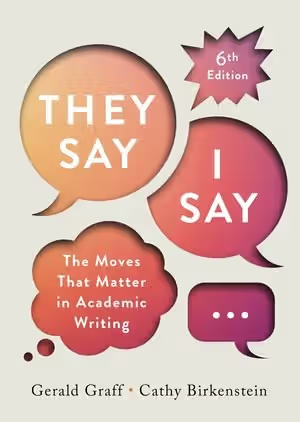
Graff, G., & Birkenstein, C. (2024). "They Say / I Say": The Moves That Matter in Academic Writing (6th ed.). W. W. Norton & Company.
Chapter Summary
The sixth edition (January 2024, 448 pages in paperback) keeps the book's familiar structure: a preface, an introduction, nineteen short chapters in four parts, a small set of readings, an appendix on citation, an index of templates and an index of authors and titles. Each chapter is named after a phrase that signals a "move" in academic writing and offers templates, sentence frames that students adapt in their own prose, followed by exercises. New in this edition, according to Norton, are a chapter on using personal stories, a chapter on generative AI, a section on citing sources, more than fifteen new examples and new readings; the paperback comes with access to an ebook, online tutorials and videos.
Preface and Introduction: Demystifying Academic Conversation; Entering the Conversation
The preface explains the book's aim of demystifying academic writing by returning it to its conversational roots. The introduction presents the central idea: good academic writing responds to what others have said, and the "they say / I say" pattern, together with templates for it, can be learned. Reviewers note that the introduction also addresses the objection that templates stifle originality, arguing that creativity lies in the imaginative use of established forms.
Part One, Chapters 1–3: "They Say": Starting with What Others Are Saying; "Her Point Is": The Art of Summarizing; "As He Himself Puts It": The Art of Quoting
The first part teaches how to open an argument by presenting the views it responds to, how to summarise others fairly (the "believing game", in which the writer temporarily inhabits another's worldview), and how to frame quotations so that they are introduced and explained rather than left to speak for themselves.
Part Two, Chapters 4–8: "Yes / No / OK, But": Three Ways to Respond; "And Yet": Distinguishing What You Say from What They Say; "Skeptics May Object": Planting a Naysayer in Your Text; "In My Experience": Using Personal Stories to Energize Your Argument; "So What? Who Cares?": Saying Why It Matters
The second part moves to the writer's own position: agreeing, disagreeing or both at once; marking clearly where one's view begins; anticipating objections; and explaining why the argument matters. The new Chapter 7 shows how anecdotes, observations and lived experience can establish credibility and connect a personal story to a public conversation, with examples from writers such as Michelle Alexander and Mike Rose.
Part Three, Chapters 9–12: "As a Result": Connecting the Parts; "You Mean I Can Just Say It That Way?": Academic Writing Doesn't Mean Setting Aside Your Own Voice; "But Don't Get Me Wrong": The Art of Metacommentary; "What I Really Want to Say Is": Revising Substantially
Part Three covers coherence (transitions and connecting devices), mixing academic and everyday language, metacommentary (commentary on one's own text that guides readers' interpretation) and substantial revision.
Part Four, Chapters 13–19: "I Take Your Point": Entering Class Discussions; What's Motivating This Writer?: Reading for the Conversation; "But as Several Sources Suggest": Research as Conversation; "On Closer Examination": Entering Conversations about Literature; "The Data Suggest": Writing in the Sciences; "Analyze This": Writing in the Social Sciences; "Help Me Understand . . .": When Your "They Say" Is a Bot
The final part applies the moves to specific settings: class discussion, reading assigned texts as contributions to a debate, research, literary criticism, and writing in the sciences and social sciences. The new Chapter 19 treats a chatbot as one more "they say": Norton describes it as advice on using generative AI tools transparently, telling fact from fiction and prompting chatbots in a they say / I say direction, including to find naysayers and answer "so what?".
Readings and Appendix
The readings include Graff's own "Hidden Intellectualism", an excerpt from Michelle Alexander's The New Jim Crow and short essays on disability in higher education, the phrase "All Lives Matter", internet access in prisons, time spent online and artificial intelligence and jobs. The new appendix, "Citing What They Say", is a quick-start guide to MLA and APA styles.
Key Concepts
Parts One–Two: "They say" and "I say"
- Entering the conversation: framing one's argument as a response to what others have said about a topic.
- Templates: adaptable sentence frames (for example for summarising, agreeing with a difference or conceding a point) that make rhetorical moves explicit.
- The believing game: summarising a view as its holders would, before responding to it.
- Naysayer: an anticipated objection planted in one's own text and answered.
- "So what? Who cares?": stating why an argument matters and to whom.
Parts Three–Four: Tying it together
- Metacommentary: sentences in which writers comment on their own claims to guide readers' interpretation.
- Mixing registers: combining academic and everyday language without giving up one's voice.
- Research as conversation: treating sources as participants in a debate the writer joins.
- AI as a "they say": treating chatbot output as a view to summarise, test and respond to, not as an authority.
Critical Analysis
Strengths
- One idea, consistently applied. A review of the fourth edition in the Journal of Biblical and Theological Studies notes that the thesis—that academic writing always occurs within a larger conversation—runs through every chapter, and that the templates are a contribution other guides lack.
- Short and practical. The chapters are brief and organised by move, so students can turn to the one they need while drafting; Norton calls it a "do this with me" kind of book, and the index of templates makes the frames easy to find.
- Fair representation of opponents. The emphasis on summarising before responding, and on planting naysayers, builds the habit of engaging seriously with views that differ from one's own, an ethical dimension the authors stress in their preface according to the same review.
- Kept current. The sixth edition adds chapters on personal narrative and on generative AI, and applies the moves to discussion, reading, research and several disciplines.
Limitations
- Templates can become formulas. Jason Arthur and Anne Case-Halferty, reviewing the first edition in Composition Forum (2008), argued that a sequence of filled-in templates can still produce a weak or incoherent argument, and that framing debates as two-sided clashes risks oversimplifying conversations with many voices. Students should treat the frames as starting points.
- Not a guide to logic or evidence. The same reviewers note that the preface explicitly does not teach the logical principles of argument; students need other resources for evaluating reasoning and evidence.
- Little on genres and the writing process as a whole. Apart from the revision chapter and discipline chapters, the book does not take students through planning, drafting or specific genres; it complements rather than replaces a full rhetoric or handbook.
- The new AI chapter will date quickly, as tools and institutional policies change.
Where It Fits in the Course
In this course it is the compact companion for any writing-intensive class. The open textbook Writing Guide with Handbook covers the writing process, genres, grammar and documentation in far more detail, while Reading Literature and Writing Argument teaches argument through literary texts; They Say / I Say can sit alongside either, supplying the sentence-level moves for summarising and responding to sources. Chapter 16 is directly useful to students writing literary arguments.
For more advanced work, The Craft of Research by Booth and colleagues develops the idea of research as a conversation into a full guide to questions, problems, claims and evidence, and Stephen Toulmin's The Uses of Argument supplies the analysis of reasoning that this book deliberately leaves out.
How to Use This Book
No prior coursework is needed; the book is aimed at student writers, especially in first-year composition. Its chapters are short enough to read alongside assignments.
- Read the Introduction and Part One first: they set out the conversation model and the skills of summary and quotation that every later chapter assumes.
- Work through Part Two before a first argumentative essay, and use Chapter 6 on naysayers and Chapter 8 on "so what?" when revising.
- Use Part Three during revision, especially Chapter 11 on metacommentary and Chapter 12 on substantial revision.
- Pick from Part Four as needed: Chapter 14 for reading assignments, Chapter 15 for research papers, Chapters 16–18 for writing in a particular discipline, Chapter 19 if a course allows AI tools.
- Practise with the exercises and the readings, identifying the moves other writers make before using the templates in your own work, and adapt the wording rather than copying it.
The index of templates and the citation appendix make the book useful as a quick reference throughout a degree.