01 / Reading Guide
Reading Guide
Citation
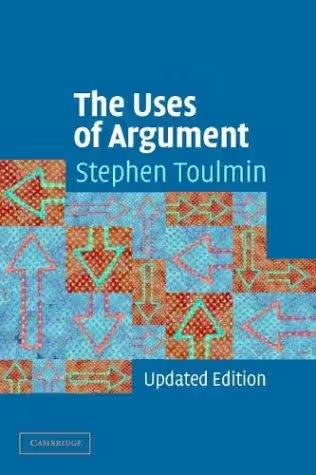
Toulmin, S. E. (2003). The Uses of Argument (updated ed.). Cambridge University Press.
Chapter Summary
First published in 1958, the book runs to 262 pages in the Cambridge University Press edition, which Cambridge lists as the second edition. It carries three prefaces: one to the first edition, one to the paperback edition and one to the updated edition. After a short introduction come five chapters and a brief conclusion, followed by references and an index. Toulmin's central question, as Cambridge puts it, is whether there is one universal system of norms by which arguments in every field must be judged, or whether each sort of argument is to be judged by its own norms.
Introduction
The introduction states the problem and the plan of the book: to compare arguments in different fields and ask what in their assessment varies and what stays constant. It is about ten pages long.
I. Fields of Argument and Modals
The first chapter introduces the idea of fields of argument. Some features of an argument are field-dependent and others field-invariant, and Toulmin argues that this difference has been neglected by accounts that treat every argument by a single standard. The chapter also turns to modal terms, the words by which we qualify how strongly a claim is put.
II. Probability
The second chapter studies the vocabulary of probability and related terms. It follows from the first chapter's interest in modals and asks what it means to describe a claim as probable, and how such terms work in practice.
III. The Layout of Arguments
This is the chapter on which the book's reputation as a tool for rhetoric and composition rests. Toulmin proposes a layout for practical arguments consisting of a claim, the data (or grounds) on which it rests, the warrant that authorises the step from data to claim, the backing that supports the warrant, a qualifier showing the degree of force, and a possible rebuttal. The first three elements are the essential ones, and the other three may be left out in simple cases.
IV. Working Logic and Idealised Logic
The longest chapter, at about sixty pages, contrasts the logic by which people actually justify claims with the idealised formal logic of deduction. It develops the book's critique of the assumption that formal deductive logic is the only model of good reasoning.
V. The Origins of Epistemological Theory
The final chapter turns to the consequences for epistemology and the theory of knowledge, as its title, "The Origins of Epistemological Theory", indicates.
Conclusion
A brief closing chapter of about six pages draws the argument together.
Key Concepts
Chapters I–II
- Field-dependent and field-invariant standards: aspects of argument that vary between subject areas and aspects that do not.
- Modals and probability: the vocabulary by which claims are qualified in strength.
Chapter III
- Claim, data and warrant: the core of a practical argument, the claim, the facts offered for it and the statement that licenses moving from one to the other.
- Backing, qualifier and rebuttal: further parts of the layout that support the warrant, indicate force and acknowledge conditions of exception.
Chapters IV–V
- Working logic versus idealised logic: practical justification as against formal deduction.
- Epistemological theory: what the older model implies for philosophical accounts of knowledge.
Critical Analysis
Strengths
- A tool with wide uptake. According to the Cambridge description, the book has been an enduring source of inspiration and discussion for students of argumentation from many disciplines for more than forty years. Rhetoric and communication scholars adopted the layout, and it has since been used in computer science too.
- A clear central device. The layout gives students vocabulary for what is happening in an argument: what is claimed, what supports it, why the support counts, and where it might fail.
- A philosophical argument behind the model. Because the layout comes after chapters on fields, modals and probability and before a critique of formal logic, readers see why the model was proposed and not only how to use it.
- Manageable length. At 262 pages including prefaces, references and index, the book can be read in full alongside coursework.
Limitations
- Not a writing handbook. The layout takes only one chapter, roughly 48 of about 240 pages. Most of the book is philosophical argument about logic and knowledge, which is demanding for students who want practical advice.
- A contested position. The book was poorly received by philosophers in England and mocked as an "anti-logic book", while rhetoricians in the United States welcomed it. Readers should expect the argument to be disputed.
- A demanding second half. Chapters IV and V together take roughly 100 pages and are the most philosophical part of the book, so readers who come for the layout should be prepared for them.
- Dates from 1958. The updated edition adds a new preface to the older text, so later research on argumentation is not part of it.
Where It Fits in the Course
In the writing and composition course, this is the theoretical background to several practical books. Graff and Birkenstein's They Say / I Say is a short guide to the moves of academic argument with adaptable templates, and Missy James and colleagues' Reading Literature and Writing Argument and the open Writing Guide with Handbook teach argument in the first-year classroom. They are the place to begin.
Booth, Colomb, Williams, Bizup and FitzGerald's The Craft of Research treats research as a conversation and builds arguments from claims, reasons and evidence, which is close to Toulmin's thinking. Read Toulmin after one of these books if you want to know where such vocabulary comes from and what its limits are.
How to Use This Book
The book suits advanced undergraduates and graduate students in writing, rhetoric, philosophy, law and communication, and teachers who want the source of the model they use. A first course in academic writing is enough preparation; an introduction to logic helps but is not required.
For a practical reading, begin with the introduction and Chapter III, which gives the layout, then return to Chapters I and II for the reasons behind it. Chapters IV and V are the philosophical core and can be read more slowly, or skimmed by readers whose interest is mainly applied. Test the layout on a paragraph from your own writing: identify the claim, the data, the warrant and the backing, and then ask what qualifier or rebuttal the argument needs.