01 / Reading Guide
Reading Guide
Citation
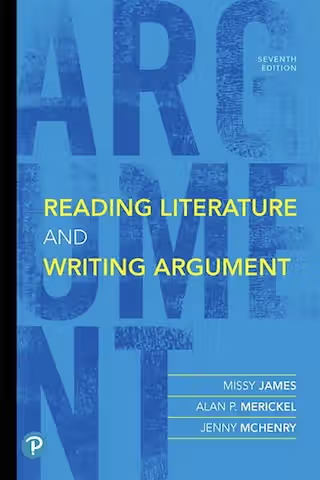
James, M., Merickel, A. P., & McHenry, J. (2019). Reading Literature and Writing Argument (7th ed.). Pearson.
Chapter Summary
The seventh edition joins two college courses that the authors taught for more than three decades at Tallahassee Community College: "Writing about Literature" and "Writing Argument and Persuasion". Its premise, stated in the preface, is that "literature liberates thinking, and argument disciplines it". The book has two parts: five Rhetoric chapters that teach reading and argument, and three Anthology chapters of fiction, poetry, drama and nonfiction grouped by theme. Every chapter ends with Chapter Activities, including a multimodal activity; the book closes with a glossary, biographical notes on the authors, and author/title and subject indexes. The edition was first issued in Pearson's Revel digital format (2019) and later as an eText (2021).
Part I, Chapter 1: Connecting Argument and Literature
The opening chapter distinguishes academic argument from confrontational argument and links argument to critical thinking. It then shows how reading literature expands thinking and opens up issues, using Mercedez Holtry's "Something out of Nothing", with David Brooks's "The Art of Thinking Well" and Beth Ann Fennelly's "We Are the Renters" in the activities.
Part I, Chapter 2: Reading Creatively and Reading Critically
Almost entirely new in this edition, the chapter offers tips on active and careful reading and then models two complementary ways of reading: creatively and critically. Dudley Randall's "Ballad of Birmingham" (with a student essay on it), Theodore Roethke's "My Papa's Waltz" and William Carlos Williams's "The Red Wheelbarrow" show how to synthesise the two readings; Browning's "Porphyria's Lover" closes the activities.
Part I, Chapter 3: Analyzing Argument
The components of an argument (claims, evidence, assumptions, and concessions and refutations), ten common logical fallacies, rhetorical context and Aristotle's model with its appeals to logos, pathos and ethos, and finally visual argument. Poems by Kenneth Rexroth, William Blake and Martín Espada, Shakespeare's Sonnet 18 and Jamaica Kincaid's "Girl" serve as examples; the activities set poems by Robert Hayden and Wilfred Owen beside prose arguments, an excerpt from Mein Kampf and Bret Stephens's "The Dying Art of Disagreement".
Part I, Chapter 4: Writing an Argument Essay
The process of planning and developing an argument essay: focusing the assignment by subject, purpose and audience, writing a claim statement, designing an argument strategy, and drafting and revising. The chapter also introduces Rogerian argument as creative problem solving and compromise, and includes three student essays.
Part I, Chapter 5: Researching and Documenting an Argument Essay
Researching to discover, locating credible sources, incorporating them, and documenting them, with preliminary and annotated bibliographies. An annotated student research essay serves as a model, and the activities include a critical essay on Louise Erdrich's "The Red Convertible" and a student essay on Sherlock Holmes, showing how to read secondary sources for bias and compare their perspectives.
Part II, Chapter 6: Individual and Community Identity
The first thematic anthology chapter opens with prewriting and discussion tasks, including one on a chapter-opening artwork. It collects stories (Chopin, O. Henry, Mansfield, Jackson, Erdrich and others), fifteen poems (from Dickinson and Hardy to Mary Oliver and Margarita Engle), two plays (Shakespeare's Twelfth Night and Sharon E. Cooper's Siriously) and nonfiction ranging from Major Sullivan Ballou's 1861 letter to essays on race, gender, testosterone testing and automation.
Part II, Chapter 7: Crime and Punishment
Stories by Hawthorne, Poe, Bierce, Conan Doyle, O'Connor and Brady Udall; poems by Housman, D. H. Lawrence, Langston Hughes, Marge Piercy, Etheridge Knight and others; Susan Glaspell's Trifles; and nonfiction from Francis Bacon's "Of Revenge" and Orwell's "A Hanging" to Barry Meier's report on Purdue Pharma and the opioid epidemic. The activities propose arguments on gun laws and on implicit-bias training for police.
Part II, Chapter 8: Power and Responsibility
Stories from Washington Irving and Alphonse Daudet to Tim O'Brien's "The Things They Carried" and Lucia Berlin; poems by Milton, Rilke, Frost, Claude McKay, Gwendolyn Brooks and Naomi Shihab Nye; Oscar Wilde's An Ideal Husband; and nonfiction including Lincoln's and Obama's second inaugural addresses, Chief Joseph's surrender speech, an excerpt from Richard Wright's Black Boy and recent essays on climate adaptation and bullying in youth sports.
Key Concepts
Part I: Reading and analysing
- Academic versus confrontational argument: academic argument aims at inquiry and understanding rather than at defeating an opponent.
- Creative and critical reading: reading imaginatively for experience and meaning, then evaluatively for claims and assumptions, and combining the two.
- Components of argument: claim, evidence, assumptions, and concessions and refutations of counterarguments.
- Rhetorical appeals: Aristotle's logos, pathos and ethos, within a rhetorical context of writer, audience and purpose.
Part I: Writing and research
- Claim statement: the sentence that states the position an argument essay will defend.
- Rogerian argument: a strategy that seeks common ground and a compromise between opposing positions.
- Credible sources and documentation: locating trustworthy sources, integrating them into one's own text and citing them in an annotated bibliography and works cited.
Part II: Themes for argument
- Implied argument in literature: the issues and positions that stories, poems and plays raise without stating them, which students turn into written arguments.
- Global perspective and collaboration: the end-of-chapter tasks asking for an argument on an issue of worldwide concern and a group Rogerian compromise.
Critical Analysis
Strengths
- A clear rationale for combining literature and argument. The preface argues that students write better arguments when they have ideas to argue about, and that imaginative literature supplies those ideas by presenting issues from several perspectives. Nonfiction pieces, which make explicit arguments, are placed beside the literary works so that students meet both implied and stated arguments.
- Structured practice in every chapter. Rhetoric chapters end with "Think About It" questions and "Read and Respond" activities; each anthology reading is followed by Critical Thinking Topics and Writing Topics, and each anthology chapter by writing topics, a global-perspective task, a collaborative Rogerian argument and "Arguing Themes from Literature". Journal tasks, "Look It Up" research prompts and "Take Note" summary boxes run through the chapters.
- Student models. The Rhetoric chapters include six student essays, among them a literary argument and an annotated research essay.
- Rogerian argument alongside the classical model. The book treats argument as problem solving as well as persuasion, which suits classes that discuss contested issues.
Limitations
- Breadth over depth on literary analysis. The Rhetoric chapters concentrate on argument; literary elements such as narrative point of view or meter are not given chapters of their own, so students who need instruction in the vocabulary of literary analysis will need another source.
- One classical model of argument. The table of contents names Aristotle's model and Rogerian strategy; other models taught in argument courses are not listed.
- Topical selections date. Several nonfiction pieces address issues that were current when the edition was prepared (the opioid crisis, automation, debates on disagreement), and the preface notes that the writing topics were updated to reflect recent events, which means they age with each edition.
- Format and edition. The ISBN listed on the site is a Revel access card; Revel content is fully digital and requires an instructor's course link, so students should check which format their course uses.
Where It Fits in the Course
Within this course list it is the book for a composition course that teaches argument through literature. Gerald Graff and Cathy Birkenstein's They Say / I Say is a short, template-based guide to the moves of academic writing and works well alongside it, especially for summarising and responding to sources. The open textbook Writing Guide with Handbook covers a wider range of genres with a grammar and documentation handbook, useful when a course is not centred on literature.
For students going further, The Craft of Research by Booth and colleagues is a fuller guide to planning and reporting research than Chapter 5, and Stephen Toulmin's The Uses of Argument is the philosophical study behind a widely taught model of argument, suitable for those who want to look beyond the Aristotelian and Rogerian approaches presented here.
How to Use This Book
The book is written for first-year college students; no background in literary study or rhetoric is assumed. The authors present the anthology themes as invitations to draw connections across chapters, so instructors can mix readings from Chapters 6–8 with the Rhetoric chapters from the start.
- Core sequence: Chapters 1–4 in order, early in the term; they provide the vocabulary (claims, assumptions, appeals, fallacies) used in every later writing topic.
- Chapter 5 when the research essay is assigned; work through the annotated student essay before drafting.
- Anthology chapters: choose one theme per unit, begin with its prewriting and discussion tasks, and use the Critical Thinking and Writing Topics after each reading as practice in turning an implied argument into a claim.
- Collaborative tasks: the Rogerian group activities at the end of each anthology chapter are useful practice for Chapter 4's strategy.
- Glossary and biographical notes support independent reading of the selections.
Students using Revel should note that the edition's content and activities are delivered online through a course link rather than in a printed book.