01 / Reading Guide
Reading Guide
Citation
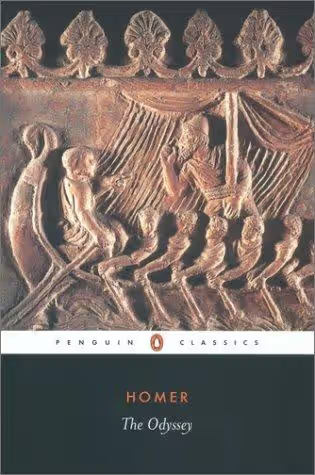
Homer. (2003). The Odyssey (E. V. Rieu, Trans.; D. C. H. Rieu, Rev.). Penguin Classics.
Chapter Summary
The Edition and the Poem
This Penguin Classics paperback (2003, about 416 pages) presents E. V. Rieu's prose translation of the Odyssey as revised by his son, D. C. H. Rieu, with an introduction by Peter V. Jones. Rieu's version first appeared in 1946 as the opening volume of the Penguin Classics series, and the edition includes a preface by the reviser, a bibliography and an index. The poem has twenty-four books and falls into four parts: the story of Odysseus's son Telemachus (Books 1 to 4), Odysseus's departure from Calypso and his stay among the Phaeacians (Books 5 to 8), Odysseus's own account of his wanderings (Books 9 to 12), and his return to Ithaca and revenge (Books 13 to 24).
Books 1–4: Telemachus
The gods meet, and Athena visits Ithaca to rouse Telemachus against the suitors who are consuming his absent father's household. After an assembly at which he is rebuffed, he sails to Pylos to ask Nestor for news, and on to Sparta, where Menelaus and Helen tell their own stories. Meanwhile, the suitors plot to ambush him on his way home.
Books 5–8: Calypso and the Phaeacians
On Hermes' message, Calypso lets Odysseus build a raft. He is wrecked by Poseidon and washes ashore on Scheria, where the princess Nausicaa finds him. He is received at the palace of her father Alcinous, and a banquet, games and the songs of the bard follow.
Books 9–12: The Wanderings
Odysseus names himself and tells the story of his voyage: the Cicones, the Lotus-eaters and the Cyclops Polyphemus (Book 9), Aeolus, the Laestrygonians and Circe (Book 10), the visit to the dead (Book 11), and the Sirens, Scylla and Charybdis and the cattle of the Sun (Book 12), after which he alone survives.
Books 13–16: Return to Ithaca
The Phaeacians carry Odysseus home asleep. Disguised as a beggar by Athena, he goes to the hut of the swineherd Eumaeus. Telemachus returns from Sparta and in Book 16 father and son recognise each other.
Books 17–20: In His Own House
Odysseus enters his house as a beggar. His old dog Argos knows him, he is insulted by the suitors, and he talks with Penelope. His old nurse Eurycleia recognises the scar on his leg (Book 19). The omens in Book 20 point to the suitors' doom.
Books 21–22: The Bow and the Killing of the Suitors
Penelope sets the trial of the bow and the axes. Only Odysseus can string the bow, and he turns it on the suitors. Book 22 is the slaughter of the suitors, after which the maids who had misconducted themselves are made to clean the hall and are hanged.
Books 23–24: Recognition and Settlement
Penelope finally accepts that the stranger is her husband. In Book 24 the suitors' ghosts arrive in Hades, Odysseus visits his father Laertes, and when the families of the dead suitors come out to fight, Athena brings about peace.
Key Concepts
Books 1–12
- Homecoming: the return of Odysseus to a household and kingdom that have changed without him is the poem's main line of action.
- Hospitality: welcome and gifts, or their violation, divide the Phaeacians and Menelaus from the Cyclops and the suitors.
- Cunning and storytelling: Odysseus survives by invention, and in Books 9 to 12 by telling his own story.
Books 13–24
- Disguise and recognition: Odysseus reveals himself in stages, to his son, his nurse, his servants and finally his wife.
- A household in crisis: the suitors' abuse of hospitality turns the second half into a test of loyalty in Odysseus's house.
- Divine support: Athena helps Odysseus and Telemachus throughout, and she closes the poem by imposing peace.
Critical Analysis
Strengths
- A prose that reads like a story. The translation has been praised for its smooth, original prose, and it opened Penguin's programme of readable translations of classics for the general reader.
- A revision by the translator's son. D. C. H. Rieu's revision amended some of the more idiosyncratic choices of the 1946 original.
- Introduction and bibliography. The edition has an introduction by Peter V. Jones, a bibliography and an index, which help a first-time reader orient themselves.
- Manageable length. At about 416 pages the whole poem fits in one compact volume.
Limitations
- A free rendering. E. V. Rieu worked on a principle of thought-for-thought translation. He rendered "rosy-fingered Dawn" as the "tender Dawn" showing "her roses in the East" and sometimes dropped Homer's anonymous gods, so the book is a poor guide to Homer's repeated epithets and formulae.
- No verse. The rhythm and the line of the Greek are lost, and anyone who wants a verse version should read it next to a verse translation.
- A mid-twentieth-century voice. The translation dates from 1946, and the original used colloquialisms of its day (for instance "the meeting adjourned"). The revision amended some of these, but readers should expect an English voice of that period.
Where It Fits in the Course
In the classical literature course this is Homer's second epic in a prose translation that the Penguin Classics series designed for the general reader, with a story told through one hero's journey and return. The Iliad on the list, in Emily Wilson's verse translation, is the poem that comes first in the tradition, and many readers choose to read it first. Wilson has also translated the Odyssey in verse, which makes a useful comparison for anyone studying how translators handle the opening lines and the epithets. Virgil's Aeneid (Fitzgerald translation) echoes the Odyssey in its first half, which follows a wanderer by sea. The short surveys by Rutherford and Allan and the longer history of Greek literature by Lesky are the companions for context.
How to Use This Book
No Greek is needed, and the prose makes the book suitable for a first reading of Homer. Start with the introduction, then read the books in order. A time-limited plan: Book 1 for the situation in Ithaca, Books 5 to 8 for Calypso and Phaeacia, Books 9 to 12 for the wanderings, Book 16 for the first recognition, and Books 19, 21, 22 and 23 for the end of the story. Books 2 to 4 and 14 to 18 add depth but can be read afterwards.
Keep a list of all the people who recognise Odysseus and how, and compare how he is welcomed by different hosts. If the course reads the Iliad too, trace the characters that appear in both poems, and compare one passage with a verse translation to see what Rieu's prose adds and leaves out.