01 / Reading Guide
Reading Guide
Citation
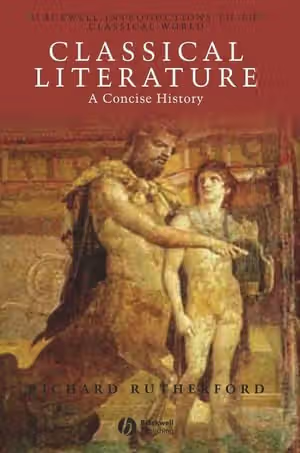
Rutherford, R. (2005). Classical Literature: A Concise History. Blackwell Publishing.
Chapter Summary
The book, in the Blackwell Introductions to the Classical World series, surveys Greek and Roman literature from Homer (around 700 BC) to Augustine (around AD 410) in about 350 pages. After an introduction come nine chapters, each devoted to a genre or area of literature rather than to a period; within each, as Carol Harding's review in Bryn Mawr Classical Review (2005) describes, the presentation runs broadly chronologically through Greek and then Roman writers, with frequent cross-references between chapters. Quotations are in English. The book opens with maps and ends with four appendices (translations of four longer passages, a timeline, a list of Roman emperors, and the major Greek and Roman gods), notes, chapter-by-chapter further reading and an index. Harding reports that the preface addresses general readers as well as university students.
Introduction
An introduction of about 18 pages that, according to the publisher, presents essential background concisely before the genre chapters begin.
Chapter 1: Epic
Harding calls the coverage of epic fairly predictable: after a brief discussion of the genre, the chapter treats Homer and Hesiod and Virgil's Aeneid, with shorter stops for the epyllion (the short epic), Apollonius, Lucan and Statius.
Chapter 2: Drama
Tragedy, comedy and satyr plays, and the Roman reworkings of these forms. Its closing pages refer to Webster's The Duchess of Malfi, Harding's example of a reference that may pass over many students' heads.
Chapter 3: Rhetoric
Both the practice and the theory of rhetoric, with discussion of rhetorical technique in epic and drama alongside orators and theorists such as Gorgias, Demosthenes and Cicero.
Chapter 4: History, Biography and Fiction
The longest chapter (about 40 pages). It concentrates on the style of historical writing (speeches and dialogue, selection of material, point of view) in Herodotus, Thucydides, Livy, Tacitus and Plutarch, and moves from history to the ancient novel, represented by Longus and Petronius.
Chapter 5: Erotic Literature
A cross-genre chapter covering elegy, erotic dialogues and other lyric forms.
Chapter 6: Literature and Power
Literature linked to politics, including "court" poetry. Harding notes that it sets minor genres and writers alongside better-known ones and explains the Roman patronage system and the narrowing of free speech under the Empire.
Chapter 7: Aspects of Wit
Parody, epigram, satire and word-play, with attention to the poses writers adopt and to the cultural assumptions they shared with an educated audience.
Chapters 8–9: Thinkers; Believers
The last two chapters consider philosophical and religious writing as literature: Plato's dialogues, Lucretius' poem on Epicurean philosophy, myth, and Christian rhetoric. Harding notes that Virgil's Georgics, Horace's Odes and Epistles and the Homeric hymns are also discussed here.
Key Concepts
Introduction and Chapters 1–4
- Genre-based literary history: organising a survey by kind of writing rather than by period, so that continuities across Greek and Roman literature stand out.
- Epic and epyllion: long heroic narrative poetry and its short, learned counterpart.
- Rhetoric: the art of persuasive speech, treated both as practice and as theory and traced in other genres.
- Historiography and the novel: history writing and its relationship to ancient prose fiction.
Chapters 5–9
- Elegy: personal and erotic poetry, one of the forms covered in Chapter 5.
- Patronage: the relations between poets and powerful patrons that shaped Roman literature.
- Satire and epigram: forms of literary wit.
- Philosophy and religion as literature: the literary form and influence of works by thinkers and Christian writers.
Critical Analysis
Strengths
- An organisation that shows continuities. Harding calls the genre-based arrangement unusual and very effective: each chapter gives a focused account of a genre's conventions, style and development, and the publisher notes that it lets readers move easily between the Greek and Roman worlds.
- Balanced, critically aware discussion. According to Harding, Rutherford sets out competing critical views, often disagreeing openly with some but presenting both sides, and credits the critics whose work changed how a text is read.
- Quotation without clutter. Harding found that the book avoids excessive notes while quoting enough primary text in English to illustrate the techniques discussed, and that its style is livelier than that of the standard introductory survey. Further reading is listed for each chapter.
- Proven in teaching. Vincent Hunink, reviewing William Allan's Classical Literature: A Very Short Introduction in Bryn Mawr Classical Review (2014), reports that his department had used Rutherford for years as a useful and reliable guide for newcomers, particularly non-classicists.
Limitations
- Long for a "concise" history. Hunink notes that at some 350 pages the book is a challenge for many students, who might prefer a shorter volume.
- Assumed literary knowledge. Harding's one caveat is that Rutherford sometimes assumes more general literary knowledge than most students have.
- Not a historical background. As Harding notes, the book deliberately avoids giving history lessons; the timeline gives only a basic outline, so readers new to antiquity need a separate historical introduction.
- Age. The book dates from 2004–05; more recent scholarship is not covered.
Where It Fits in the Course
Rutherford is the main survey textbook in this course. William Allan's Classical Literature: A Very Short Introduction follows similar generic lines in about 125 pages and makes a good first taste or a quick review; Hunink, who compared the two, saw Allan as a companion to larger textbooks such as Rutherford rather than a replacement, since it omits Christian texts, most writing after AD 200 and philosophical prose. Rutherford covers all of these.
For depth on one language, Albin Lesky's A History of Greek Literature is a comprehensive scholarly history of Greek literature, and Gian Biagio Conte's Latin Literature: A History is its Latin counterpart, arranged by period and author. Both are reference works to consult after Rutherford, when a particular author or period needs more detail. The course's translations of the Iliad, Odyssey and Aeneid are the primary texts that Rutherford's Epic chapter introduces; read the chapter before or alongside them.
How to Use This Book
The book suits students beginning classics, classical civilisation or comparative literature, students of other subjects taking a course on ancient literature, and general readers. No knowledge of Greek or Latin is needed, since all quotations are in English.
A reading plan:
- Start with the Introduction, then read Chapters 1–2 (epic and drama), which cover the works most courses read first.
- Read Chapters 3–4 together: rhetoric and history share techniques such as speeches and point of view, and Chapter 4 also introduces the novel.
- Chapters 5–9 can be read in any order to match a syllabus; the cross-references between chapters help with locating authors who appear in several genres.
- Use the back matter actively: the timeline and list of emperors to place authors in time, the appendix of translated passages for close reading, and the further reading for essays.
Read each chapter alongside at least one of the primary works it discusses, in translation. Because the book does not provide historical narrative, keep a short history of Greece and Rome at hand. For revision, use the genre chapters to trace one theme, such as patronage or wit, across both Greek and Roman literature.