01 / Reading Guide
Reading Guide
Citation
Homer. (2023). The Iliad (E. Wilson, Trans.). W. W. Norton & Company.
Chapter Summary
The Edition and the Poem
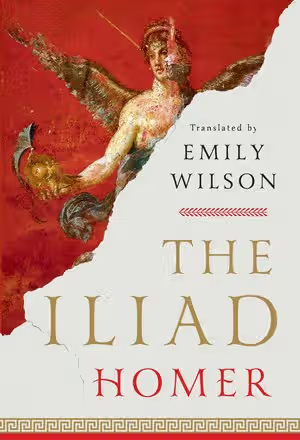
Emily Wilson's Iliad is a complete English verse translation of Homer's epic in twenty-four books, published by Norton in 2023 (hardcover) and 2024 (paperback), and listed at about 850 pages. It is the second of her Homer translations, after the Odyssey of 2017. Besides the poem, the volume includes an introduction, maps, family trees, a glossary and notes on the text, as the reviews of the book describe. The poem is not the whole Trojan War. It begins in the war's later phase with a quarrel between the Greek commander Agamemnon and the best Greek fighter, Achilles, and it ends with the burial of Hector, the Trojans' greatest warrior.
Book I: The Quarrel
After a plague forces Agamemnon to give up Chryseis, the daughter of Apollo's priest Chryses, he takes the captive Briseis from Achilles, and Achilles withdraws from the fighting. His mother Thetis asks Zeus to help the Trojans, and the book ends with a scene of discord among the gods on Olympus.
Books II–IV: Armies, Challenge and Broken Oath
A deceptive dream from Zeus leads Agamemnon to test his army, and the army rushes toward the ships. The long catalogue of the Greek and Trojan forces follows. In Book III Paris challenges Menelaus to single combat to settle the war, and Helen and Priam watch the Greek chiefs from the wall; Aphrodite rescues Paris when he is losing. In Book IV an arrow shot by the Trojan Pandarus breaks the truce, and the fighting begins.
Books V–VII: Diomedes, Hector and Andromache, and a Duel
Book V is the exploits of Diomedes, who wounds even gods. Book VI contains the exchange between Glaucus and Diomedes and the farewell of Hector to his wife Andromache and their infant son. In Book VII Hector and Ajax fight to a draw; the dead are burned and the Greeks build a wall around their ships.
Books VIII–X: Zeus Turns, the Embassy and a Night Raid
Zeus forbids the gods to interfere and begins to favour the Trojans, who drive the Greeks back behind their wall. Book IX is the embassy to Achilles, in which envoys offer gifts and Achilles refuses. Book X tells the night expedition of Odysseus and Diomedes, who capture and kill the Trojan spy Dolon.
Books XI–XV: The Fight at the Ships
Several Greek leaders are wounded, the Trojans break through the wall in Book XII, and Poseidon helps the Greeks in Book XIII. In Book XIV Hera beguiles Zeus, and in Book XV he wakes and restores the Trojan advantage.
Books XVI–XVII: Patroclus
When fire reaches the ships, Patroclus enters the battle in Achilles' armour and drives the Trojans back, but he is killed by Euphorbus and Hector. Book XVII is the struggle over his body.
Books XVIII–XX: Grief, New Armour and Return
Achilles learns of the death of his friend. Thetis obtains new armour from Hephaestus, including the shield. In Book XIX Achilles is reconciled with Agamemnon, and in Book XX the gods gather to watch as Achilles goes out to fight and kills many Trojans.
Books XXI–XXII: The River and Hector
Achilles fights the river Scamander, and the gods fight among themselves, until he drives the Trojans within their walls. Book XXII is the death of Hector.
Books XXIII–XXIV: Funeral and Ransom
Patroclus is buried with funeral games. In Book XXIV Priam comes to Achilles' hut to ransom Hector's body, and the poem ends with Hector's funeral.
Key Concepts
Books I–IX
- The anger of Achilles: the subject announced in the first lines, which sets the quarrel in motion and then shapes the whole plot.
- Honour and gifts: the dispute turns on who is owed a prize, and the embassy of Book IX answers it with gifts that Achilles rejects.
- The gods in the plot: Zeus, Hera, Athena and others act openly and take sides, so human events have a divine counterpart.
Books X–XXIV
- Grief and substitution: Patroclus fights in Achilles' armour, and his death turns Achilles' anger from Agamemnon to Hector.
- Fate and mortality: the poem returns again and again to the shortness of life, including Achilles' own.
- Ransom and supplication: the last book replaces the quarrel over a prize with a father's plea for his son's body.
Critical Analysis
Strengths
- A regular line meant to be heard. The translation is in unrhymed iambic pentameter, and reviewers describe it as fast and clear: Charlotte Higgins (The Guardian) says it "runs as swift as a bloody river", Rowan Williams (New Statesman) calls the metre unobtrusive over the less vivid passages, and Natalie Haynes (The New York Times) says it is meant to be read aloud.
- Short lines. Kirkus notes that Wilson's lines are shorter than those of other translators and are easy on the eye.
- Apparatus for newcomers. The introduction, maps, family trees and glossary give a first-time reader the tools to follow the many names.
- Attention to the human cost of war. Naoíse Mac Sweeney (The Washington Post) writes that Wilson avoids both glorifying violence and tedium and brings out the poem's human relationships.
Limitations
- Not line for line. Wilson's Odyssey kept the number of lines of the Greek, but for the Iliad she abandoned that aim, as she told Higgins, because of the many fixed names and places. A reader cannot expect lines in this translation to match the numbering of the Greek.
- Occasional register slips. Haynes points to places where the diction seems a little out of place.
- A recent translation. The book appeared in 2023, so it has less of a track record in classroom use than older translations, and most published assessments date from its first year.
Where It Fits in the Course
In the classical literature course the Iliad is the natural first epic: its story comes first in the tradition, and Virgil's Aeneid looks back to it in its second half. Read it before E. V. Rieu's Odyssey, which shares many characters and assumes the Trojan setting, and before Fitzgerald's Aeneid. Wilson has also translated the Odyssey, so readers who want the same translator across both poems can choose that route, though this course lists the Rieu version. For general background, Rutherford's Classical Literature: A Concise History and Allan's Classical Literature: A Very Short Introduction are short surveys, and Lesky's A History of Greek Literature treats the scholarly questions around Homer more fully.
How to Use This Book
No Greek is needed. Read the introduction and look at the maps first, then read the poem in order. If time is short, the core books are I, VI, IX, XVI, XVIII, XXII and XXIV: the quarrel, Hector and Andromache, the embassy, Patroclus, the shield and new armour, the death of Hector, and the ransom. The catalogue in Book II and the long battle sequences can be read faster on a first pass.
Keep the family trees and glossary at hand in the first few books. Reading some passages aloud makes use of the metre. For a seminar, compare one scene, for example the farewell in Book VI or the meeting in Book XXIV, with another translation to see how choices about names, epithets and line length change the effect.