01 / Reading Guide
Reading Guide
Citation
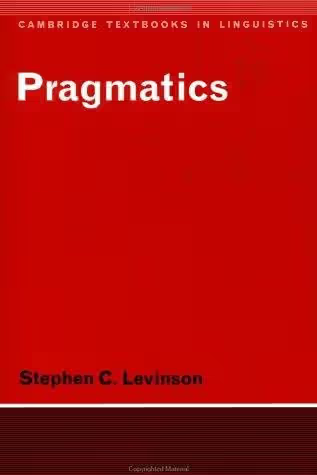
Levinson, S. C. (1983). Pragmatics. Cambridge University Press.
Chapter Summary
The book has seven chapters and runs to about 380 pages of text before its bibliography and indexes. It is a volume in the Cambridge Textbooks in Linguistics series, and the publisher describes it as a lucid and integrative analysis of the central topics in pragmatics: deixis, implicature, presupposition, speech acts and conversational structure. A recurring concern is the relation between pragmatics and semantics, and the publisher notes that the detailed analyses of selected topics are meant to show the empirical rigour the field demands.
Chapter 1: The Scope of Pragmatics
The opening chapter is about defining and delimiting the field. Its sections cover ways of defining pragmatics, the reasons for the current interest in it, and an extended example.
Chapter 2: Deixis
The chapter first sets out the philosophical approaches to deixis, then turns to descriptive approaches, with separate sections on person deixis, time deixis, place deixis, discourse deixis and social deixis, and closes with conclusions.
Chapter 3: Conversational Implicature
The chapter opens with Grice's theory of implicature and then turns to revisions, problems and applications. Its sections discuss implicature and logical form, kinds of implicature, generalized Quantity implicatures, a case of maxim exploitation, and implicature and language structure.
Chapter 4: Presupposition
After a historical background and initial observations, the chapter takes up the problematic properties of presupposition, among them defeasibility and the projection problem. It then compares kinds of explanation, including pragmatic theories of presupposition, and ends with conclusions.
Chapter 5: Speech Acts
The chapter begins with the philosophical background. Its later sections consider the thesis that speech acts are irreducible to matters of truth and falsity and the reduction of illocutionary force to ordinary syntax and semantics, and then the "collapse of antithesis", with syntactic problems and a problem for both positions. It also examines the context-change theory of speech acts and ends with a section on going beyond theories of speech acts.
Chapter 6: Conversational Structure
This chapter contrasts discourse analysis with conversation analysis, and then presents conversation analysis: some basic findings including adjacency pairs and overall organization, remarks on methodology, and some applications. Later sections cover preference organization and preferred sequences, and presequences, with preannouncements and a reanalysis of indirect speech acts. A note on transcription conventions follows.
Chapter 7: Conclusions
The final chapter relates pragmatics to core linguistics, to sociolinguistics and psycholinguistics, and to other fields.
Key Concepts
Chapters 1–2: Scope and deixis
- Defining pragmatics: the question of what belongs to pragmatics rather than semantics.
- Deixis: person, time, place, discourse and social deixis as ways in which language encodes features of the speech situation.
Chapters 3–4: Implicature and presupposition
- Conversational implicature: Grice's account of meaning that goes beyond what is said, with the kinds of implicature distinguished in the chapter.
- Generalized Quantity implicatures: a class of implicature treated in its own section.
- Defeasibility and the projection problem: two problematic properties of presupposition.
Chapters 5–7: Speech acts, conversation and conclusions
- Illocutionary force: the force of an utterance, and the debate over reducing it to syntax and semantics.
- Adjacency pairs and preference organization: basic findings of conversation analysis.
- Presequences: preannouncements and similar turns that prepare a later action.
Critical Analysis
Strengths
- Clear scope, stated aims. The publisher stresses that earlier work in the field had been written at an intimidating level of technicality and presents the book as an accessible alternative with helpful exemplification.
- Concentrated on a few problems. Five main topics, one chapter each, with detailed analysis of selected issues, give depth on the classic questions instead of a thin tour.
- The semantics–pragmatics boundary is the through-line. The book repeatedly asks what a pragmatic account can resolve for semantics, which gives the chapters a common argument.
- Breadth at the edges. The introduction and conclusion connect pragmatics to psychology, philosophy, anthropology and literature, and Chapter 6 brings in conversation analysis; its inclusion extends the book past sentence meaning into talk in interaction.
Limitations
- Dated by design. It appeared in 1983 and has not been revised; later developments in the field are not covered.
- Level. The publisher lists it as a textbook for senior undergraduates and first-year graduates. Readers new to the field may prefer a gentler first course.
Where It Fits in the Course
Levinson sits on the pragmatic side of the semantics and pragmatics books on this list. Birner's Introduction to Pragmatics and Cruse's Meaning in Language are first courses, the second covering semantics and pragmatics together; Hurford, Heasley and Smith's Semantics: A Coursebook is a workbook, and Saeed's Semantics is an introduction to meaning. Heim and Kratzer's Semantics in Generative Grammar is the formal, compositional counterpart.
Read Levinson after one of the introductions, when implicature, presupposition and speech acts are already familiar, and when the question of how they bear on semantic theory is the thing to understand.
How to Use This Book
The book suits advanced undergraduates and graduate students in linguistics and philosophy of language who have taken an introductory semantics and pragmatics course and know some elementary logic.
A reading plan:
- Core: Chapters 3 and 4, which carry the central arguments on implicature and presupposition; Chapter 1 first, to fix the definition of the field.
- Next: Chapter 5 on speech acts, for the debate about illocutionary force.
- Complement: Chapter 2 on deixis, which is more descriptive, and Chapter 6, which introduces conversation analysis and can be read as a separate unit.
- Close: Chapter 7, to relate pragmatics to other areas.
Treat the book as the grounding in the classic problems, and follow it with more recent literature on the topics you pursue.