01 / Reading Guide
Reading Guide
Citation
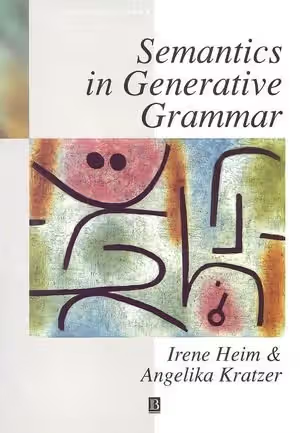
Heim, I., & Kratzer, A. (1998). Semantics in Generative Grammar. Blackwell.
Chapter Summary
The book has twelve chapters and an index, about 310 pages in all, in the Blackwell Textbooks in Linguistics series. Its contents show a steady build: the first three chapters set up a Fregean, truth-conditional framework and its link to syntax; Chapters 4 to 6 extend it to modifiers, relative clauses and quantifiers; and Chapters 7 to 12 concern quantification, binding, pronouns and a first step towards intensions. The publisher says it teaches students the craft of doing semantics and includes exercises that check understanding and point towards further projects.
Chapter 1: Truth-conditional Semantics and the Fregean Program
The chapter introduces truth-conditional semantics and Frege's idea of compositionality, and includes a tutorial on sets and functions: sets, the abstraction notation for sets, and functions.
Chapter 2: Executing the Fregean Program
A first example of a Fregean interpretation is worked through, with applications of the semantics to an example, derivations of truth conditions in an extensional semantics, and the distinction between object language and metalanguage. The chapter then covers sets and their characteristic functions, adding transitive verbs with semantic types and denotation domains, Schönfinkelization, and defining functions in the lambda notation.
Chapter 3: Semantics and Syntax
This chapter links the semantic machinery to syntactic structure: type-driven interpretation, the structure of the input to semantic interpretation, well-formedness and interpretability, the Theta-Criterion, and argument structure and linking.
Chapter 4: More of English: Nonverbal Predicates, Modifiers, Definite Descriptions
The chapter treats semantically vacuous words and nonverbal predicates, then predicates as restrictive modifiers, with a new composition rule, modification as functional application and the question of nonintersective adjectives. It also develops the definite article, including partial denotations, the presupposition/assertion distinction, and presupposition failure versus uninterpretability.
Chapter 5: Relative Clauses, Variables, Variable Binding
Relative clauses are analysed as predicates, with semantic composition inside the clause, variables and predicate abstraction. The chapter then handles multiple variables (such-that relatives, nested relatives, co-indexing) and asks what variable binding is, with definitions, theorems and syntactic constraints on indexing.
Chapter 6: Quantifiers: Their Semantic Type
The chapter shows why individuals as denotations of DPs cause problems and presents generalized quantifiers as the solution. It then covers quantifying determiners, relations between sets, the formal properties of relational determiner meanings, and presuppositional quantifier phrases, including controversial cases.
Chapter 7: Quantification and Grammar
The problem of quantifiers in object position is addressed by two repairs for the type mismatch: flexible types in situ, and movement. The chapter then compares quantifiers in natural language with predicate logic and weighs the standard arguments for quantifier movement: scope ambiguity, antecedent-contained deletion, and quantifiers that bind pronouns.
Chapter 8: Syntactic and Semantic Constraints on Quantifier Movement
Which DPs may move, how much moves along, and what the landing sites are. The chapter discusses quantifying into VP, PP, AP, NP and DP.
Chapters 9–11: Bound and Referential Pronouns and Ellipsis; Syntactic and Semantic Binding; E-Type Anaphora
Chapter 9 treats pronouns as free variables, co-reference versus binding, and the "sloppy identity" puzzle in ellipsis. Chapter 10 separates syntactic from semantic binding in relation to the Binding Principle and weak crossover. Chapter 11 turns to E-type pronouns with quantifier antecedents and pronouns that are neither bound variables nor referential, including Cooper's analysis.
Chapter 12: First Steps Towards an Intensional Semantics
The last chapter explains where extensional semantics breaks down, introduces intensions, sketches an intensional semantics and ends with limitations and prospects.
Key Concepts
Chapters 1–3: The framework
- Compositionality: the meaning of a sentence is computed from the meanings of its parts and their syntactic arrangement.
- Semantic types and denotation domains: the classification that governs how meanings combine.
- Schönfinkelization and lambda notation: the functional representation of relations.
- Type-driven interpretation: interpretation steered by the semantic types of the parts being combined.
Chapters 4–6: Modification, binding and quantifiers
- Predicate abstraction: how relative clauses create predicates from sentences with traces.
- Presupposition versus assertion: the distinction as applied to definite descriptions.
- Generalized quantifiers: DPs denoting sets of sets, with determiners as relations between sets.
Chapters 7–12: Quantification, anaphora and intensions
- Quantifier movement and flexible types: two solutions to the type mismatch of object quantifiers.
- Binding versus co-reference: the distinction behind sloppy identity in ellipsis.
- E-type pronouns: pronouns interpreted as descriptions.
- Intensions: meanings that vary with the circumstance of evaluation.
Critical Analysis
Strengths
- A gradual, cumulative build. The contents run from sets and functions through a minimal grammar to quantifier movement and anaphora, with each chapter adding one extension.
- Teaches derivation as a skill. The publisher emphasises doing semantics, and the contents stress proofs, theorems and methodological remarks alongside analysis.
- Connected to syntax throughout. The chapters on the Theta-Criterion, quantifier movement and binding relate the semantic analysis to generative syntactic structure.
- Engages with controversy. Sections on controversial cases of presuppositional quantifier phrases and on nonintersective adjectives set out competing analyses.
Limitations
- Prior knowledge is assumed. Familiarity with generative syntactic trees, basic logic and set theory is needed from the first chapters.
- Extensional core, short intensional coda. Intensions arrive only in the last chapter, called "first steps", so intensional topics receive only an introduction.
- A snapshot of the 1990s framework. The book is a 1998 text and reflects the analyses and syntactic assumptions of its time.
Where It Fits in the Course
Among the semantics and pragmatics books on this list, Heim and Kratzer is the formal one. Cruse's Meaning in Language, Saeed's Semantics and Hurford, Heasley and Smith's Semantics: A Coursebook are introductions that present meaning without a full formal system. Levinson's Pragmatics and Birner's Introduction to Pragmatics cover meaning in context.
Read Heim and Kratzer after one of the introductions, when you want precise derivations. It pairs with Levinson as the compositional counterpart to his context-dependent topics.
How to Use This Book
The book suits graduate students and advanced undergraduates with an introductory semantics course, some set theory and logic and familiarity with syntactic trees.
A reading plan:
- Core: Chapters 1 to 3 in order, working the exercises, since everything later rests on the type system.
- Next: Chapters 4 to 6, then Chapters 7 and 8 on quantification.
- Branches: Chapters 9 to 11 for pronouns and ellipsis; Chapter 12 for intensions.
Do the exercises. The publisher says they check understanding and point towards projects, and the book's method depends on reproducing derivations.