01 / Reading Guide
Reading Guide
Citation
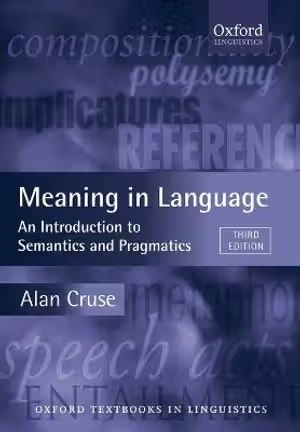
Cruse, A. (2011). Meaning in Language: An Introduction to Semantics and Pragmatics (3rd ed.). Oxford University Press.
Chapter Summary
The third edition, in the Oxford Textbooks in Linguistics series, runs to about 510 pages in twenty chapters grouped in four parts, followed by an epilogue, answers to questions, references and author and subject indexes. The publisher describes it as a comprehensive introduction that covers semantics together with topics usually assigned to pragmatics, explains the richness and subtlety of meaning through numerous examples and exercises, and is not bound to any particular theory. For this edition the text and exercises were updated and two chapters were added, on the semantics of prepositions and of derivational affixes. Part 1 was also reorganised: in the second edition (2004) it had four chapters, and the third edition has three.
Part 1: Fundamental Notions (Chapters 1–3: Introduction; Logic and Meaning; Concepts and Meaning)
The foundations. In the second edition, Sanjukta Ghosh's review describes the corresponding chapters as setting language in the context of communication and of the different disciplines that study meaning, reviewing the logical notions a linguist needs (propositions, logical relations, sense and reference, quantification), and presenting word meaning as conceptual, with classical and prototype approaches to categories.
Part 2: Words and Their Meanings (Chapters 4–8: Lexical Units; Contextual Variability of Word Meaning; Paradigmatic Relations of Inclusion and Identity; Paradigmatic Relations of Exclusion and Opposition; Lexical Hierarchies)
The largest part, on lexical semantics. It identifies the units that carry word meaning and examines how a word's meaning varies with context (the territory of ambiguity, homonymy and polysemy). Two chapters treat paradigmatic sense relations: inclusion and identity (hyponymy, meronymy, synonymy) and exclusion and opposition (incompatibility and the kinds of opposites). A chapter on lexical hierarchies looks at how such relations structure the vocabulary.
Part 2 continued (Chapters 9–12: Syntagmatic Semantic Relations; Describing Lexical Senses 1: Dimensions and Structures; Describing Lexical Senses 2: Approaches to the Specification of Word Meanings; Extensions of Meaning)
The rest of Part 2 turns to how words combine (syntagmatic relations; in the second edition this covered normal and abnormal co-occurrence), to two chapters on describing a word's sense, first by its dimensions and structure and then by comparing approaches to specifying word meaning, and to extensions of meaning such as metaphor and metonymy.
Part 3: Grammatical Meaning (Chapters 13–17: Grammatical Meaning: Nouns and Noun Phrases; Argument Structure and Transitivity; Grammatical Meaning: Verbs and Adjectives; The Semantics of Prepositions; The Semantics of Derivational Affixes)
In the second edition, grammatical meaning took a single chapter; here it fills five. They cover the meaning of nominal categories, argument structure and transitivity, the meaning carried by verbs and adjectives, and the two new chapters on prepositions and derivational affixes.
Part 4: Pragmatics (Chapters 18–20: Speech Acts; Reference and Deixis; Conversational Implicatures)
Three chapters on core topics in pragmatics: speech acts, reference and deixis, and conversational implicature. In the second edition, the review describes these chapters as covering Austin and Searle's speech act theory, direct, indirect and generic reference and five kinds of deixis, and Grice's theory of implicature with later developments including Leech's politeness principle and Sperber and Wilson's relevance theory.
Key Concepts
Part 1: Fundamental notions
- Sense and reference: the distinction between what an expression means and what it picks out in the world.
- Logical relations: relations such as entailment between propositions, the logical toolkit introduced in Chapter 2.
- Concepts: the view that word meanings are linked to mental concepts, the subject of Chapter 3.
Part 2: Words and their meanings
- Lexical units: the form–meaning pairings that lexical semantics studies.
- Contextual variability: how far a word's meaning shifts between contexts, and when that amounts to distinct senses.
- Paradigmatic relations: relations of inclusion, identity, exclusion and opposition between word senses, such as hyponymy, synonymy and antonymy.
- Syntagmatic relations: semantic relations between words that occur together.
- Extensions of meaning: ways in which words acquire new uses, such as metaphor and metonymy.
Part 3: Grammatical meaning
- Argument structure and transitivity: how a verb's meaning relates to the participants it takes.
- Derivational affixes: the meaning contributed by word-forming prefixes and suffixes.
Part 4: Pragmatics
- Speech acts: utterances considered as actions, such as promising or requesting.
- Deixis: expressions whose interpretation depends on the context of utterance, such as person, place and time.
- Conversational implicature: meaning conveyed beyond what is literally said.
Critical Analysis
Strengths
- Not tied to one theory. Both the publisher and the LINGUIST List announcement stress that the book aims to show the richness of meaning phenomena rather than expound a particular theory, introducing theoretical approaches as they become relevant. Reviewing the second edition, Sanjukta Ghosh noted that the author acknowledges a leaning towards the cognitive position where any bias exists.
- Unusually strong on word meaning. Part 2 has nine of the twenty chapters. Ghosh singled out the coverage of lexical semantics as more extensive than introductory semantics textbooks generally offer, and the third edition keeps that emphasis while adding a chapter on derivational affixes.
- Exercises with answers. The publisher describes numerous examples and exercises throughout the text, and the book ends with answers to questions, which suits self-study. Ghosh judged the exercises in the second edition very useful and the language simple and clear.
- Semantics and pragmatics in one volume. Part 4 gives a concise introduction to the main topics of pragmatics, so one book can serve a course that covers both.
Limitations
- Length and level. At about 510 pages the book is long for a first course. The series addresses advanced undergraduate and postgraduate students, as Ghosh notes, so beginners may find it demanding as a sole text.
- Pragmatics is the smallest part. Only three chapters treat pragmatics, and topics such as presupposition and discourse structure do not have chapters of their own; a pragmatics course will need another book.
- Formal semantics is light. Logic is introduced in a single chapter and the approach is descriptive rather than formal, so the book does not prepare readers for compositional, truth-conditional semantics.
- Age. The third edition dates from 2010–11; work published since then is not covered.
Where It Fits in the Course
Cruse sits between the gentle and the formal ends of this course. James Hurford, Brendan Heasley and Michael Smith's Semantics: A Coursebook is a workbook for complete beginners that teaches basic ideas step by step with practice and feedback; it makes a good first book, with Cruse as the fuller text to follow. John Saeed's Semantics is the closest alternative to Cruse: a student-friendly introduction that moves from core concepts through lexical and sentence meaning to theoretical approaches. Cruse offers more on word meaning and grammatical meaning, Saeed a fuller survey of theories.
For pragmatics, Betty Birner's Introduction to Pragmatics covers implicature, presupposition, reference, speech acts and discourse structure in more depth than Cruse's three chapters, and Stephen Levinson's Pragmatics is the systematic, more advanced treatment to read after both. Irene Heim and Angelika Kratzer's Semantics in Generative Grammar is a graduate textbook of compositional, truth-conditional semantics, a different tradition from Cruse's descriptive approach; Chapter 2 here is only a first step towards it.
How to Use This Book
The book suits undergraduates who have taken an introductory linguistics course and want a thorough grounding in meaning, especially word meaning, and graduate students who need a broad, theory-neutral reference. No prior study of semantics is required, but students with no linguistics at all may prefer to start with a coursebook.
A reading plan:
- Core for any course: Part 1 (Chapters 1–3), then Chapters 4–9 for lexical semantics.
- Lexical semantics in depth: Chapters 10–12 on describing senses and extensions of meaning.
- Grammatical meaning: Chapters 13–15 for a general course; Chapters 16–17 (prepositions, derivational affixes) are optional unless the course covers them.
- Pragmatics: in a combined semantics and pragmatics course that is short of time, Part 4 can be taken earlier, after Part 1 and the core lexical chapters.
Do the exercises as you go and check them against the answers at the back. The epilogue is a natural point to review the whole book. Students continuing in pragmatics should move on to Birner; those heading for formal semantics should add a logic-based text.