01 / Reading Guide
Reading Guide
Citation
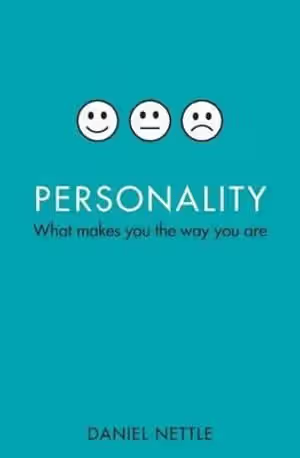
Nettle, D. (2007). Personality: What Makes You the Way You Are. Oxford University Press.
Chapter Summary
The book has an introduction and nine chapters, followed by a questionnaire called "The Newcastle Personality Assessor", notes, references and an index. Oxford's description presents it as a tour of what modern science says about human personality for general readers, asking why some people are worriers and others wanderers, and why some are easy-going while others look for a fight. It says personalities stem from our biological makeup, draws on genetics and brain science and on the evolutionary origins and consequences of different personalities, and puts at its heart the "big five" traits: Extraversion, Neuroticism, Conscientiousness, Agreeableness and Openness. The five middle chapter titles (Wanderers, Worriers, Controllers, Empathizers, Poets) follow that order, so each very probably corresponds to one trait, in the order listed. Comments below rest on the contents list, the publisher's description and the terms the book uses most often.
Introduction
An introduction of about fourteen pages opens the book before Chapter 1.
Chapter 1: Character Matters
The first chapter, about forty pages, is the longest chapter and sets up the framework. Its title and the book's frequent terms (correlation, measure, personality dimensions, the five-factor model, Galton, Costa and McCrae) suggest that it introduces how personality is described and measured.
Chapter 2: The Beak of the Finch
The title points to evolution by natural selection. Natural selection, mutations, predators, guppies and population are among the terms the book uses repeatedly, and the publisher says the book considers the evolutionary origins and consequences of different personalities.
Chapter 3: Wanderers
By the order of the description, this is the chapter on Extraversion. Reward, dopamine and the nucleus accumbens are among the terms the book uses repeatedly, and "addictions" and "gambling" appear in the same list.
Chapter 4: Worriers
The fourth chapter, by the same order, is on Neuroticism: worry, anxiety, depression and negative emotions are among the book's repeated terms.
Chapter 5: Controllers
By the same order, Chapter 5 is on Conscientiousness. Obsessive-compulsive personality disorder, the frontal lobe and the Iowa gambling task are among the recurring terms.
Chapter 6: Empathizers
Chapter 6 corresponds to Agreeableness. Empathy, "theory of mind", psychopaths and antisocial personality disorder appear in the repeated terms.
Chapter 7: Poets
The seventh chapter corresponds to Openness. Schizotypy, schizophrenia and artists are among the repeated terms, which fits a chapter about creativity and unusual experience.
Chapter 8: The Other Half
The title and the publisher's question about why members of the same family differ so markedly suggest a chapter on the environment's share. Shared environment, siblings, identical twins and behaviour genetics are among the repeated terms.
Chapter 9: Singing with Your Own Voice
The final chapter addresses the practical questions in the publisher's description: what is the best personality to have, whether you are stuck with yours or can change it, and the idea that life is partly a matter of finding a niche where your personality works for you.
The Newcastle Personality Assessor
A questionnaire, about five pages, lets readers assess themselves.
Key Concepts
Introduction and Chapters 1–2: Description, measurement and origins
- The Big Five: Extraversion, Neuroticism, Conscientiousness, Agreeableness and Openness, the book's organising framework.
- Personality dimensions: traits as continuous dimensions on which people differ.
- Natural selection and personality: evolutionary thinking about why variation persists (Chapter 2).
Chapters 3–7: The five traits
- Extraversion: the "wanderers" of Chapter 3.
- Neuroticism: the "worriers" of Chapter 4.
- Conscientiousness: the "controllers" of Chapter 5.
- Agreeableness: the "empathizers" of Chapter 6.
- Openness: the "poets" of Chapter 7.
Chapters 8–9: Nature, nurture and living with a personality
- Genes and environment: how much of personality is inherited (Chapter 8).
- Niche-finding: matching one's life to one's personality (Chapter 9).
Critical Analysis
Strengths
- A single organising idea. Building the middle of the book around the Big Five gives the reader one consistent framework and a clear one-trait-per-chapter structure.
- Biology and evolution in plain language. The publisher says the book explains genetics, brain science and evolutionary thinking for a general reader, and uses a mix of true-life stories and scientific research.
- Practical questions answered. The publisher's description lists questions many readers ask, such as which personality is best and whether it can change, and the final chapter is aimed at them.
- Self-assessment included. The Newcastle Personality Assessor lets readers place themselves on the traits the book describes.
- Documentation. About forty pages of notes and references follow the text, so a reader can trace claims to sources.
Limitations
- Focused on one model. The Big Five dominate the structure. Psychodynamic, behaviourist and humanistic approaches are not named in the publisher's description, so readers wanting the full range of personality theories need another book.
- Written for general readers. The book is billed as a brief, popular tour. It is not organised as a course text, and the description mentions no exercises or review questions.
- Dated findings. The book was published in 2007 and its research claims reflect the science of that time, so readers should check newer work on genetics and brain imaging.
Where It Fits in the Course
This is the more focused and more trait-centred of the two beginner books in the personality list. Gaines's Personality Psychology: The Basics covers psychodynamic, behaviourist, humanistic, trait, cognitive and biological perspectives in eight chapters and suits a general course; Nettle suits readers who want to understand one influential model in depth and see what genetics and evolution say about it.
For a full course the usual textbooks are Funder's The Personality Puzzle, organised around the major approaches, and Larsen and Buss's Personality Psychology: Domains of Knowledge About Human Nature, organised by six domains. Matthews, Deary and Whiteman's Personality Traits is a research-based account of traits for advanced readers, and Jung's Psychological Types offers a very different, primary-source view of personality types. Nettle's book works well as a lead-in to the trait chapters of the textbooks.
How to Use This Book
The book is for general readers and first-year students who want an accessible, research-based account of why people differ. No background is needed.
A practical plan:
- Start with the Newcastle Personality Assessor, then read the introduction and Chapter 1 to see how traits are described.
- Read Chapters 3 to 7 as the core, one chapter per trait; a reader curious about one trait can begin with its chapter, and the sequence follows the order in which the publisher lists the traits.
- Read Chapters 2, 8 and 9 for the explanations: evolution, genes and environment, and the question of change and fit.
- Alongside a textbook, use the book to supplement the trait and biological chapters, and check any claims you rely on against the notes and references.