01 / Reading Guide
Reading Guide
Citation
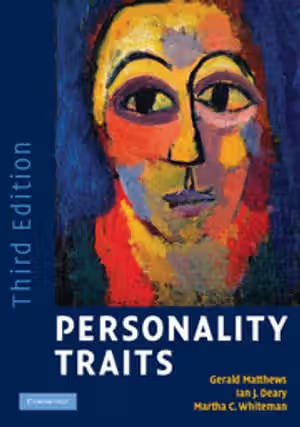
Matthews, G., Deary, I. J., & Whiteman, M. C. (2009). Personality Traits (3rd ed.). Cambridge University Press.
Chapter Summary
The book has fourteen chapters in three parts and about 450 pages of text, followed by references and indexes. The authors' position, stated in the preface to the third edition, is that the science of personality can be built on a foundation of traits. The third edition reaches out to revisionary critics, to the fast-growing sciences that explain trait differences, and to applied fields, while keeping the structure of earlier editions: first the distinctive characteristics of traits, then their biological and social foundations, then how they play out in human life. The publisher adds that this edition has improved student features, new research from behavioural genetics, neuroscience, social psychology and cognitive science, and additional content on positive aspects of traits and practical uses of assessment.
Part I (Chapters 1–5): The Nature of Personality Traits
Chapter 1, "The Trait Concept and Personality Theory", begins with everyday conceptions of traits, from Aristotle and Theophrastus to the thousands of English personality terms identified by Allport and Odbert, and introduces trait theory and the psychometric tools used to identify trait dimensions. Chapter 2, "Persons, Situations and Interactionism", discusses the unreliability of predicting behaviour in a single situation, interactionism between traits and situations, and the cross-cultural generality of trait structure. Chapter 3, "Personality across the Life Span", asks how stable traits are from childhood to adulthood and how temperament relates to adult traits. Chapter 4, "Stable Traits and Transient States", distinguishes enduring dispositions from moods and other states, and Chapter 5, "Alternative Views of Personality: Challenges to Trait Theory", sets trait theory beside psychoanalysis, humanistic psychology and other approaches and argues for the trait approach's advantages.
Part II (Chapters 6–8): Causes of Personality Traits
Chapter 6, "Genes, Environments and Personality Traits", introduces twin and adoption designs and molecular genetics in a non-technical way, including their contribution to the study of personality change. Chapter 7, "The Psychobiology of Traits", considers whether personality expresses individual differences in brain function, drawing on behaviour genetics, brain damage and imaging and EEG correlations. Chapter 8, "The Social Psychology of Traits", discusses the social-learning approaches of Bandura and Mischel and the possibility of a new unity between social and trait perspectives.
Part III (Chapters 9–14): Consequences and Applications
Chapter 9, "Stress", relates traits, especially neuroticism, to stress reactions, appraisal, coping and emotional problems. Chapter 10, "Traits and Health", examines models of personality and physical health, including stress and heart disease. Chapter 11, "Abnormal Personality Traits?", asks whether personality disorder differs in kind from variation in normal traits. Chapter 12, "Personality, Performance and Information Processing", uses laboratory performance tasks and applied settings to test what traits predict. Chapter 13, "Applications of Personality Assessment", covers clinical, educational and occupational uses. Chapter 14, "Conclusions", reviews achievements of trait research in psychometrics, biological bases, integration with mainstream psychology and applications.
Key Concepts
Chapters 1–5
- Trait: an enduring disposition on which people differ, measured by questionnaires and structured by factor analysis.
- Interactionism: behaviour depends jointly on traits and situations.
- Traits and states: enduring dispositions versus transient moods.
- Temperament: childhood dispositions linked to adult traits.
Chapters 6–8
- Behaviour genetics: twin and adoption studies that apportion genetic and environmental influence.
- Psychobiological theories of traits: links between trait differences and brain function.
- Social-learning critiques: Bandura's and Mischel's emphasis on situations and dynamic interaction.
Chapters 9–14
- Neuroticism and stress: association of high neuroticism with stress symptoms.
- Personality disorder versus normal variation: whether abnormality is qualitative or statistical.
- Idiographic and nomothetic assessment: understanding the individual case versus predicting from trait scores.
Critical Analysis
Strengths
- Clear arc. The three parts move from what traits are, to what causes them, to what they predict, and the preface announces this plan.
- Chapters that locate themselves. The chapter openings recap earlier chapters and state what comes next, as in Chapters 2, 3 and 9, which helps students follow a cumulative argument.
- Breadth of evidence. Chapters cover genetics, brain function, social psychology, health, clinical, performance and occupational settings, so the book works as a survey of trait research.
- Non-technical treatment of hard topics. The genetics chapter introduces designs and findings, as it says, in a non-technical way.
Limitations
- One viewpoint. The authors argue that the trait approach is becoming the dominant paradigm, so psychoanalytic, humanistic and social-learning views are treated mainly as challenges or comparisons; readers wanting equal coverage of all major perspectives will need a general personality text.
- Length and density. The book runs to about 450 pages of text and more than 100 further pages of references and indexes, so it is a substantial commitment for a single course.
- Date. The third edition appeared in 2009 and does not include later developments.
Where It Fits in the Course
Personality Traits is a research-oriented text for students who already have a general course in personality. Funder's The Personality Puzzle and Larsen and Buss's Personality Psychology: Domains of Knowledge About Human Nature are broad textbooks organized around several approaches or domains of knowledge, including trait and biological perspectives; Gaines's Personality Psychology: The Basics is a brief first introduction. Nettle's Personality: What Makes You the Way You Are is a readable introduction to the Big Five for a general audience.
Matthews, Deary and Whiteman concentrate on the trait approach and treat it in more depth, with chapters on stability, genetics, psychobiology, stress, health and assessment. Jung's Psychological Types is a historical classic on introversion, extraversion and the psychological functions, and offers a contrast with the psychometric tradition in this book.
How to Use This Book
The book is aimed at students on courses in personality and individual differences, and the publisher also presents it for researchers and practitioners. A general introduction to psychology and some familiarity with statistics help, especially for the psychometric and genetics material.
For a course, read Part I in order, because Chapters 1 and 2 supply the trait concept and the evidence for consistency that the rest relies on. Then choose among Part II chapters by interest: Chapter 6 for genetics, Chapter 7 for the brain, Chapter 8 for social psychology. In Part III, Chapters 9 and 10 suit health and stress courses, Chapter 11 clinical interests, Chapters 12 and 13 applied work. Read Chapter 14 last, as a synthesis. Use the chapter openings to review what came before, and use the reference list as a source of primary studies for essays.