01 / Reading Guide
Reading Guide
Citation
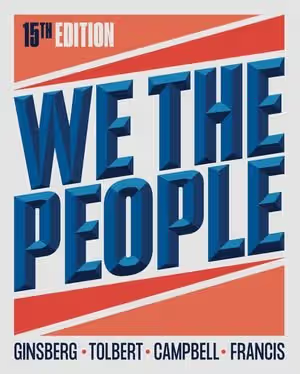
Ginsberg, B., Tolbert, C. J., Campbell, A. L., Francis, M. M., Lowi, T. J., & Weir, M. (2025). We the People (15th ed.). W. W. Norton & Company.
Chapter Summary
The Fifteenth Edition (Full Edition) runs to about 824 pages in four parts and eighteen chapters, followed by an appendix of founding documents. The publisher describes the book's organising emphasis as the citizen's role in American politics: who participates, why participation matters, and how gender, class, race and ethnicity shape political life. Each chapter opens with a story, written by Andrea Campbell, about a real person affected by government or taking part in politics; thirteen of these stories are new to this edition. The publisher also states that coverage of the 2024 election runs through the book.
Part I: Foundations (Chapters 1–5)
Chapter 1: Americans and Their Political Values; Chapter 2: The Founding and the Constitution; Chapter 3: Federalism; Chapter 4: Civil Liberties; Chapter 5: Civil Rights. The first part sets out the framework within which everything else operates. It begins with the political values Americans hold before turning to the founding period and the Constitution, the division of power between national and state governments, and the two chapters on rights: civil liberties (protections of individuals against government) and civil rights (equal treatment and the struggles to secure it). The appendix reproduces the Declaration of Independence, the Articles of Confederation, the Constitution and its amendments, and selections from the Federalist and Anti-Federalist Papers, which makes these chapters easy to read alongside the original texts.
Part II: Politics (Chapters 6–11)
Chapter 6: Public Opinion; Chapter 7: The Media and Political Information; Chapter 8: Political Participation and Voting; Chapter 9: Political Parties; Chapter 10: Campaigns and Elections; Chapter 11: Groups and Interests. The second part covers the channels that connect citizens to government. It moves from what citizens think (public opinion) and where they get political information (the media) to how they act (participation and voting), and then to the organisations that aggregate and mobilise them: parties, campaigns and interest groups. Placing the politics chapters before the institutions chapters is a structural signal of the book's participation-centred approach.
Part III: Institutions (Chapters 12–15)
Chapter 12: Congress; Chapter 13: The Presidency; Chapter 14: The Bureaucracy; Chapter 15: The Federal Courts. The third part treats the four main institutions of national government in the conventional order: the legislature, the executive, the administrative agencies that carry out policy, and the federal judiciary.
Part IV: Policy (Chapters 16–18)
Chapter 16: Economic Policy; Chapter 17: Social Policy; Chapter 18: Foreign Policy. The book ends with three policy chapters that show what government does with the authority described in the earlier parts.
Key Concepts
Part I: Foundations
- Political values: the beliefs Americans hold about politics and government; the book starts from them rather than from institutions.
- Constitutional founding: the choices made in writing the Constitution, read alongside the Articles of Confederation and the Federalist and Anti-Federalist arguments in the appendix.
- Federalism: the division of authority between the national government and the states.
- Civil liberties and civil rights: the distinction between limits on government power over individuals and guarantees of equal treatment.
Part II: Politics
- Public opinion and political information: what citizens believe about politics and how the media shape the information they receive.
- Political participation: voting and other forms of involvement, and the question of who participates; the publisher's "Who Participates?" infographics are built around this question.
- Parties, campaigns and interest groups: the organisations through which citizens' preferences are aggregated and brought to bear on government.
Parts III–IV: Institutions and Policy
- Separation of powers in practice: Congress, the presidency, the bureaucracy and the federal courts treated as distinct institutions with their own chapters.
- Public policy: economic, social and foreign policy as the outputs of the political process described earlier in the book.
Critical Analysis
Strengths
- A clear organising theme. The publisher describes the book as built around the citizen's role and why participation matters, and the structure bears this out: six of the eighteen chapters (Part II) deal with opinion, information, participation, parties, elections and groups before the book turns to institutions. Students who want to understand how ordinary people connect to government will find that thread throughout.
- Attention to group differences. The book's description highlights sustained attention to how gender, class, race and ethnicity shape American politics, and the publisher notes that Megan Ming Francis, whose expertise is in race and ethnicity politics, contributes examples throughout each chapter.
- Complete coverage including policy. With eighteen chapters and a policy part covering economic, social and foreign policy, the Full Edition spans the whole standard syllabus of an introductory American government course and more.
- Primary documents included. The appendix reproduces the founding documents, selections from the Federalist and Anti-Federalist Papers, and a list of presidents and vice presidents, so a separate document reader is not needed for the founding unit.
- Current material. The publisher states that the 2024 election is covered throughout and that a digital election supplement provides more extensive coverage and data.
Limitations
- Length. At about 824 pages it holds more than most one-semester courses can assign; instructors and independent readers must choose. Norton's categories list the book under full-length texts.
- Digital features are separate from the print text. Several of the features the publisher emphasises (author videos, interactive infographics, Dynamic Data Figures, Check Your Understanding questions at the end of each section, InQuizitive) belong to the Norton Illumine Ebook and online tools. Readers of a used or library print copy will not have them.
- United States only. Like any American government textbook, it describes one political system; comparison with other democracies is not part of the chapter plan.
- Recency cuts both ways. Material tied to the 2024 election is useful now but will date, and later printings or editions may differ.
Where It Fits in the Course
Among the books for this course, We the People and Kernell, Jacobson, Kousser, Vavreck and Johnson's The Logic of American Politics are the two full commercial textbooks covering the same ground. They differ in their organising idea: The Logic of American Politics explains institutions as solutions to collective action problems, while We the People is organised around participation and around how social groups experience government. A student who has to choose can read the first chapter of each; a student assigned one can use the other's chapters on Congress or parties as a second explanation.
Glen Krutz and Sylvie Waskiewicz's American Government (OpenStax) is a free, openly licensed textbook for the same introductory course and covers much of the same sequence, so it is a practical substitute or supplement where cost matters. Richard Valelly's American Politics: A Very Short Introduction is a compact historical overview that can be read in an afternoon before starting a full textbook. The two monographs in the list go deeper on topics this book surveys: David Mayhew's Congress: The Electoral Connection develops an argument about reelection-seeking legislators that is best read after Chapter 12, and John Aldrich's Why Parties? A Second Look explains why politicians build parties, which pairs naturally with Chapters 9 and 10.
How to Use This Book
The book assumes no prior political science; a general awareness of current American public affairs helps. It suits a first-year American government course and anyone who wants a complete map of the American political system with attention to who takes part and who does not.
A practical plan for a one-semester course:
- Core: Part I in full (Chapters 1–5), since every later chapter assumes the constitutional framework and the distinction between liberties and rights. Read the relevant appendix documents alongside Chapter 2: the Articles of Confederation, the Constitution and at least one Federalist and one Anti-Federalist paper.
- Participation: Chapters 6–11 in order. If time is short, Chapters 8 (participation and voting), 9 (parties) and 10 (campaigns and elections) carry the book's central theme most directly.
- Institutions: Chapters 12–15. Congress and the presidency are usually essential; the bureaucracy and courts chapters can be shortened if the course has a separate unit on constitutional law.
- Policy: choose one or two of Chapters 16–18 to match the course, or assign one as the basis for a short policy paper.
Use each chapter-opening story as a prompt: before reading the chapter, note what the story suggests about how government affected that person, then check the explanation after reading. If the ebook and online tools are available, the end-of-section questions and InQuizitive are designed for retrieval practice; with a print copy only, write a one-paragraph summary of each major section instead. Because the book covers a recent election, follow up one or two chapters with current news or data on the same topic to see how the patterns it describes have developed since publication.