01 / Reading Guide
Reading Guide
Citation
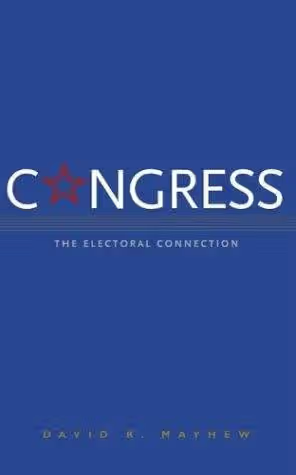
Mayhew, D. R. (2004). Congress: The Electoral Connection (2nd ed.). Yale University Press. Foreword by R. Douglas Arnold.
Chapter Summary
This is a short book of roughly 200 pages that makes one argument and follows it through. David Mayhew proposes that the principal motivation of members of Congress is reelection, and that the pursuit of this goal shapes both how legislators behave and what policy they make. The second edition, published thirty years after the original of 1974, adds a foreword by R. Douglas Arnold, who discusses why the book changed the study of Congress and how it has held up, and a new preface by the author. Apart from this front matter and a few opening pages, the text consists of two long chapters.
Opening Pages
The opening pages set out the method. The book is a theoretical exercise: it adopts the simplifying assumption that members of Congress are single-minded seekers of reelection, and it then explores what follows from that assumption. The aim is to see how far the electoral incentive explains congressional behavior, not to claim that no other motive exists.
Chapter 1: The Electoral Incentive
The first chapter starts from the electoral position of individual legislators and asks what a member who wants to be reelected will do. It treats the activities through which members try to build and protect electoral support. Mayhew sorts these activities into three categories: advertising, credit claiming and position taking. The chapter also compares the American arrangements, in which candidates must win support largely independently of their party, with systems in which party label does more of the work.
Chapter 2: Processes and Policies
The second chapter turns from the individual member to the collective institution. Its question is what happens when legislators who are engaged in these activities assemble to act together. It examines the main structural units of Congress, offices, committees and parties, and the ways they are arranged to meet members' electoral needs. It then considers the functions Congress performs, the arrangements that maintain it as an institution, its place in governance, and efforts to reform it.
Key Concepts
Opening Pages and Chapter 1: The Electoral Incentive
- Single-minded seekers of reelection: the assumption that every member's first goal is to be reelected, adopted as a modelling device because reelection is the condition for achieving any other aim.
- Advertising: any effort to disseminate a member's name among constituents.
- Credit claiming: acting so that relevant actors believe the member is personally responsible for something government has done that they value.
- Position taking: publicly stating a judgment on a matter of interest to political actors, so that the member is rewarded for positions rather than for effects.
Chapter 2: Processes and Policies
- Electoral logic of congressional structure: the idea that offices, committees and party arrangements are organized to serve members' electoral needs.
- Institutional maintenance: the arrangements through which Congress sustains itself as an institution while its members pursue individual goals.
Critical Analysis
Strengths
- A compact, testable argument. The book states its assumption openly and then derives consequences, which is why it became a model of how to build a theory of an institution from individual incentives. Fred Greenstein's endorsement on the publisher's page places it on any short list of major analyses of Congress, and Richard Fenno calls it a classic in legislative studies.
- Evidence and scholarship. Robert Dahl's comment, also quoted by the publisher, stresses the extraordinary range and depth of scholarship behind the interpretation. The book won the Washington Monthly Political Book Award for 1974.
- Brevity. At about 200 pages the book can be read in a few sittings and used as the centerpiece of a week of a course on Congress or American politics.
- A framing foreword. Arnold's foreword for the second edition places the book in the development of congressional studies, which helps new readers see why its approach was influential.
Limitations
- The text belongs to its period. The second edition adds a foreword and a preface to the 1974 book rather than a revision, so the evidence and examples date from the early 1970s. Readers need to bring later work on parties and polarization to test its conclusions.
- A deliberate simplification. Reelection is posited as the single goal in order to explore its implications. The book does not claim that members have no other motives, and readers should treat the argument as a model whose usefulness is judged by what it explains.
- Focus on one institution. The book is about the United States Congress, and its comparisons with other systems are used to illuminate American arrangements rather than to build a comparative theory.
Where It Fits in the Course
Mayhew is the course's most compact account of why American legislators behave as they do. The introductory books supply the setting. Krutz and Waskiewicz's American Government is a free, openly licensed textbook on the constitutional foundations, institutions and processes. Ginsberg and colleagues' We the People stresses political participation, Kernell and colleagues' The Logic of American Politics treats institutions as designed solutions to collective action problems, and Valelly's American Politics: A Very Short Introduction is a brief primer on how the system works and developed. These are best read before Mayhew.
John Aldrich's Why Parties? is the natural next step. It is a rational-choice account of why ambitious politicians create and sustain parties, and it takes up the question that Mayhew leaves in the background by treating party as an arrangement serving members. Reading the two together shows how a theory of individual incentives can be extended to the party system.
How to Use This Book
The book suits upper-level undergraduates and graduate students who know the basic structure of Congress and the American electoral system. It also rewards readers from other fields who want to see how a rational-choice argument is built.
A practical plan:
- Start with the front matter: Read Arnold's foreword and Mayhew's preface to see how the author and a later scholar assess the book.
- Core: Read the opening pages and Chapter 1 closely, and make sure you can define advertising, credit claiming and position taking and give a present-day example of each.
- Then Chapter 2: Follow how each structural feature of Congress is explained by the electoral incentive, and ask where the explanation is strong and where other factors would be needed.
- Afterwards: Read a modern study of congressional parties or elections and compare it with Mayhew's account. Writing a short critique of the single-minded-seeker assumption is a good exercise.