01 / Reading Guide
Reading Guide
Citation
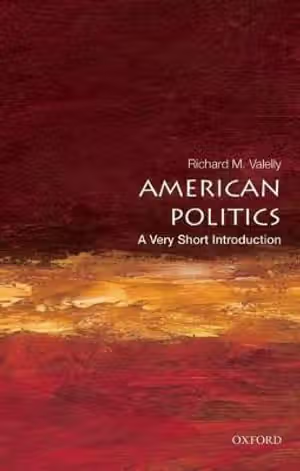
Valelly, R. M. (2013). American Politics: A Very Short Introduction. Oxford University Press.
Chapter Summary
The book is a pocket-sized volume of about 150 pages in the Very Short Introductions series, with ten chapters followed by references, further reading and an index. According to the publisher, it gives an impartial overview of the vital elements of American democracy, with the emphasis on how they function, where they come from historically and how they evolved into their present forms. The publisher also says it offers the author's own analysis of the evolution of the presidency and a chapter on the effects of public polling on political decision-making and representation. The chapter titles run through the main institutions in turn, then through public opinion and parties, and end with the economy.
Chapter 1: Elements of American democracy
The framing chapter. The publisher says the book treats the American political system as always a work in progress, operating within and constantly updating an eighteenth-century constitutional framework, and this chapter sets out the basic elements of that system.
Chapter 2: The presidency
The place where the author's original analysis appears: the publisher singles out an original account of how the presidency has evolved.
Chapter 3: Congress and its bicameralism
The legislative branch and its two chambers. The publisher's description mentions the bicameral Congress and the place of the filibuster among the topics covered.
Chapter 4: The legislative-executive process
How Congress and the executive interact in making law, as the title states. It follows the two chapters on the branches themselves and links them.
Chapter 5: The Supreme Court
The judicial branch. The publisher lists the role of the Supreme Court among the topics covered.
Chapter 6: Bureaucracy
The administrative state, one of the facets of the political system the description names.
Chapter 7: Public opinion
The chapter the publisher describes as dealing with the effects of public polling on political decision-making and on voter representation.
Chapter 8: Political parties and democratic choices
Parties and the choices voters have. The description lists political parties and democratic choice among the topics.
Chapter 9: The partisan revival
The strengthening of party competition. The publisher's description names "the partisan revival" among the topics but gives no further detail, so this chapter is best read together with Chapter 8.
Chapter 10: Political economy
The publisher lists the political economy as part of the system the book covers, and says the book addresses increasing income inequality and gaps in representation as sources of protest and public discussion. Open Library's catalogue record gives this chapter's title as "Politics in the new gilded age", so the chapter title may vary between sources or printings.
Key Concepts
Chapters 1-2: Democracy and the presidency
- A system that is a work in progress: the publisher's framing, that American politics is constantly updating an eighteenth-century constitutional framework.
- The evolution of the presidency: the book's original analysis.
Chapters 3-6: The institutions
- Bicameralism and the filibuster: named in the description with Congress.
- The legislative-executive process: how law is made between branches.
- The Supreme Court and the bureaucracy: the judicial and administrative parts of the system.
Chapters 7-10: Opinion, parties and the economy
- Public opinion and polling: their effect on decision-making and representation.
- Political parties and democratic choice: how parties structure choices.
- The partisan revival: the strengthening of party conflict.
- Political economy and inequality: gaps in representation and income inequality.
Critical Analysis
Strengths
- Origins as well as operation. The publisher stresses that each element is explained through its historical origins and evolution, not only its current rules, so the reader sees why the system is as it is.
- Short and ordered. Ten brief chapters in a book of about 150 pages go through the institutions in a sequence that is easy to follow and easy to use as a revision aid.
- An authorial argument. Valelly offers his own analysis of the presidency and a chapter on polling, so the book is more than a catalogue of institutions.
- Balanced aim. The publisher describes the assessment of American democracy as balanced and judicious, and the Political Studies Review is quoted in the publisher's listing as finding the book well written and of use to a lay audience interested in the basic facts and a brief discussion of contemporary government.
Limitations
- Brief by design. The Political Studies Review comment quoted by the publisher points to a book for lay readers wanting a few basic facts, and a book this size cannot treat the Constitution, elections, federalism or civil rights at the length of a textbook; the contents have no separate chapters on federalism, elections or interest groups.
- A snapshot of 2013. It predates later developments in American politics, so readers who want the current situation need additional sources.
- Publisher-sourced description. The assessments here rest on the publisher's description, the contents and one quoted review, and have not been checked against the text.
Where It Fits in the Course
This is the shortest and most general entry in the American politics list. The OpenStax textbook American Government is a free, full-length introductory course text covering the constitutional foundations, institutions and political processes, and it fills in what a pocket-sized book cannot. Two other textbooks organise American government around one idea: The Logic of American Politics frames institutions as solutions to collective action problems, and We the People emphasises participation and the effects of gender, class, race and ethnicity.
Mayhew's Congress: The Electoral Connection and Aldrich's Why Parties? A Second Look are scholarly works on, respectively, members of Congress as seekers of reelection and the rational choice origins of parties. They relate to the subjects of Valelly's Chapters 3 and 8 and are better read after the overview. Starting with Valelly and then choosing a full textbook is a sensible sequence.
How to Use This Book
The book is for readers who want a quick, even-handed orientation to how American government works, such as students beginning a course in American politics and general readers following the news. No background in politics or American history is required.
A practical plan:
- One sitting per two chapters. The book can be read in a week. Read Chapter 1 first, since it frames the rest.
- Core. Chapters 2-5 on the presidency, Congress, the legislative-executive process and the Supreme Court give the working institutions. Chapters 7-9 add opinion and parties.
- Selective. Chapters 6 and 10 on bureaucracy and political economy can be read in connection with a course unit on policy or inequality.
- Alongside the book. After each chapter, make a short note on how the topic has changed over time, then compare it with the corresponding chapter of a full textbook. Use the book's further-reading list for a deeper source on whichever institution interests you.