01 / Reading Guide
Reading Guide
Citation
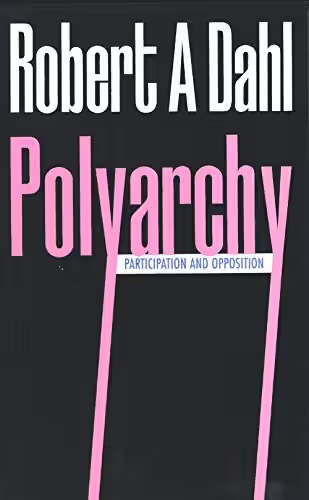
Dahl, R. A. (1971). Polyarchy: Participation and Opposition. Yale University Press.
Chapter Summary
Polyarchy is a short book: about 260 pages in the first edition of 1971 (Yale's paperback, issued in 1972, runs to 272 pages), consisting of ten chapters, a long postscript and two appendixes. Its central question is put in a phrase the publisher quotes from Foreign Affairs: the conditions under which societies that do not tolerate political opposition may be transformed into societies that do. As the Norwegian encyclopedia Store norske leksikon summarises it, the book places regimes along two dimensions, which Dahl called public contestation and participation: how far competition for power is allowed, and how widely the right to take part in politics extends. "Polyarchy" is his name for regimes that rank high on both. Chapter titles and page extents below follow the published table of contents.
Chapter 1: Democratization and Public Opposition
The opening chapter (pp. 1–16) sets out the problem announced in the title: democratization on the one hand, and the toleration of public opposition on the other, as the two things whose growth the book seeks to explain.
Chapter 2: Does Polyarchy Matter?
Before asking how polyarchies arise, Dahl asks whether the difference between polyarchy and other regimes is significant at all (pp. 17–32).
Chapter 3: Historical Sequences
The first of the explanatory chapters (pp. 33–47) considers the historical paths by which regimes have moved towards greater contestation and participation, and the order in which these changes came.
Chapters 4–5: The Socioeconomic Order: Concentration or Dispersion?; The Socioeconomic Order: Level of Development
Two chapters (pp. 48–80) examine the social and economic order: first whether economic and social resources are concentrated or dispersed, then the level of socioeconomic development.
Chapter 6: Equalities and Inequalities
The relation between social and economic inequality and the prospects for polyarchy (pp. 81–104).
Chapter 7: Subcultures, Cleavage Patterns, and Governmental Effectiveness
How divisions within a society, and the effectiveness of its government, bear on the chances of contestation and participation (pp. 105–123).
Chapter 8: The Beliefs of Political Activists
By far the longest chapter (pp. 124–188, about a quarter of the main text) concerns the beliefs held by politically active people, whose length suggests how much weight Dahl gives to this condition.
Chapter 9: Foreign Control
The influence of foreign domination on a country's regime (pp. 189–201).
Chapter 10: The Theory: Summary and Qualifications
A short chapter (pp. 202–207) that draws the preceding conditions together into a summary of the theory and states its qualifications.
Postscript and Appendixes
"Postscript: Some Implications for Strategies of Change" (pp. 208–250) turns from explanation to what the theory implies for those who would bring about change. Appendix A classifies 114 countries by eligibility to participate in elections and by the degree of opportunity for public opposition; Appendix B lists the contemporary polyarchies of about 1969.
Key Concepts
Chapters 1–2: The Framework
- Public contestation (opposition): the extent to which a regime permits opponents to compete for power, one of the book's two dimensions.
- Participation (inclusiveness): how widely the right to take part in politics is extended, the second dimension.
- Polyarchy: Dahl's term for real-world regimes that are high on both dimensions, distinguished from democracy as an ideal.
Chapters 3–9: Conditions
- Historical sequences: the order in which contestation and participation have expanded.
- Concentration or dispersion of resources: whether economic and social power is held by few or spread widely.
- Level of development: the socioeconomic level of a society as a condition of polyarchy.
- Subcultural cleavages: divisions within a society and their effect on governmental effectiveness.
- Beliefs of political activists: the ideas of the politically active as a condition for tolerating opposition.
- Foreign control: the effect of external domination on regime type.
Chapter 10 and Postscript
- Strategies of change: the practical implications of the theory for those seeking to transform a regime.
Critical Analysis
Strengths
- A precise, usable concept. By separating contestation from participation, the book gives readers a way to describe regimes that are neither fully democratic nor fully closed, and a vocabulary that the Store norske leksikon entry credits with opening a broad literature on the historical, social, cultural and economic preconditions of democratic government.
- Comparative scope. Appendix A classifies 114 countries and Appendix B lists the polyarchies of about 1969, so the argument is tied to a classification of the world's regimes at the time.
- Systematic structure. After the framework, each chapter takes one candidate condition (historical sequence, socioeconomic order, inequality, cleavages, beliefs, foreign control) before Chapter 10 draws them together. This makes the argument easy to follow and to test one condition at a time.
- Clarity. The publisher quotes the Times Literary Supplement calling the analysis "lucid, perceptive, and thorough".
Limitations
- Dated evidence. The classification of regimes dates from around 1969, before the later waves of democratization and the collapse of communist regimes. Readers need later work to see how the argument has fared.
- Brief theory chapter. The summary of the theory occupies only six pages, so readers must assemble much of the argument from the long chapters themselves.
- Criticism from the left. Critics of polyarchy as a concept, such as William I. Robinson, argue that it describes rule by elites who compete for votes, with mass participation confined to choosing among them; students should read the concept alongside such critiques.
Where It Fits in the Course
Polyarchy is the conceptual foundation of this course list on democracy and authoritarianism. Read it early, after (or alongside) a short primer. Frantz's Authoritarianism: What Everyone Needs to Know and Levitsky and Ziblatt's How Democracies Die are accessible introductions to non-democratic rule and to democratic erosion respectively; Dahl's two dimensions give a precise language for the regimes and changes they describe.
Haerpfer and colleagues' edited textbook Democratization explains how scholars define and measure democracy and examines the long-term waves of democratization and the recent period of democratic decline; it is the natural way to bring Polyarchy up to date. Linz's Totalitarian and Authoritarian Regimes complements Dahl from the other side, developing a typology of non-democratic regimes, and Arendt's The Origins of Totalitarianism is a historical and philosophical study of the extreme case. Reading Dahl first gives a clear statement of what non-democratic regimes lack, which is useful background when Linz distinguishes among them.
How to Use This Book
The book suits undergraduates with an introductory course in politics, and needs no specialist background.
A practical plan:
- Read Chapters 1–2 closely. They define the dimensions and the concept on which everything else depends; it helps to sketch the two dimensions as axes and place a few regimes on them.
- Take Chapters 3–9 one condition at a time. For each chapter, note the condition and whether it favours or impedes polyarchy, then test it against a country you know.
- Read Chapter 8 with care. It is the longest chapter by far.
- Use Chapter 10 to check your notes, since it summarises the theory and its qualifications.
- Read the Postscript if the course deals with democratization as a practical project.
Compare Appendix B's list of polyarchies circa 1969 with a current index of democracy, and follow with Haerpfer's Democratization to see how the conditions Dahl identified have been tested since.