01 / Reading Guide
Reading Guide
Citation
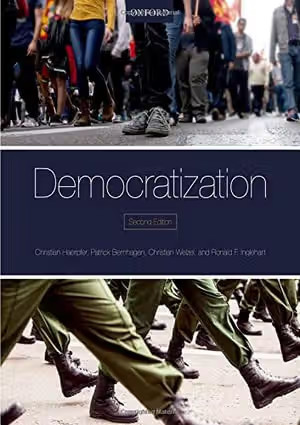
Haerpfer, C. W., Bernhagen, P., Welzel, C., & Inglehart, R. F. (Eds.). (2019). Democratization (2nd ed.). Oxford University Press.
Chapter Summary
The second edition has twenty-six chapters by specialists, 520 pages in all, with the chapters running to page 431. An introduction opens the book and a conclusion closes it; between them, four parts cover theoretical and historical perspectives, causes and dimensions, actors and institutions, and seven world regions. Oxford's description frames the book around the global wave of democratization since the early 1970s and adds, for this edition, a chapter on social media and attention to the resilience of authoritarian tendencies.
Chapter 1: Introduction
Sets the book against a new pessimism about democracy, previews its themes (the culture-bound character of democracy and its societal preconditions) and names economic inequality as a major threat while defending democracy's value.
Part One, Chapters 2–6: Theories of Democratization; Democratic and Undemocratic States; Measuring Democracy and Democratization; Long Waves and Conjunctures of Democratization; The Global Wave of Democratization
Chapter 2 surveys factors proposed as determinants, from modernization to elite pacts and colonial legacies, and builds a framework around human empowerment and a typology of democratization processes. Chapter 3 separates democratic from undemocratic states by free elections and the rule of law and describes three kinds of undemocratic state. Chapter 4 discusses how to measure democracy, using public indices to illustrate problems and asking whether democracy is present or absent or a matter of degree. Chapter 5 gives the history since the late eighteenth century as long waves and shorter conjunctures; Chapter 6 reviews regional change between 1972 and 2004.
Part Two, Chapters 7–12: The International Context; The Political Economy of Democracy; Political Culture, Mass Beliefs, and Value Change; Gender and Democratization; Social Capital and Civil Society; Social Movements and Contention in Democratization Processes
Six chapters on causes. They cover diffusion and democracy promotion by the United States and the European Union, the relation between capitalism and democracy, mass beliefs and regime legitimacy, women's formal, descriptive and substantive representation, civil society and trust, and the roles of social movements and protest at each stage of a transition.
Part Three, Chapters 13–18: Conventional Citizen Participation; Political Parties; Institutional Design in New Democracies; The Media; Social Media; A Decade of Democratic Decline and Stagnation
Six chapters on actors and institutions: voter turnout and its institutional and socioeconomic influences, parties in transition and consolidation, electoral systems and consociational design, traditional media, the new chapter on social media as a tool of protest and of authoritarian control, and the reasons democratizers slid back, using Freedom House data.
Part Four, Chapters 19–25: Southern Europe; Latin America; Post-Communist Central and Eastern Europe; Post-Soviet Eurasia; The Middle East and North Africa; Sub-Saharan Africa; East Asia
Seven regional chapters. Southern Europe compares transitions through elite pacts and through mass mobilisation in Portugal, Greece and Spain, and the Latin American chapter examines Argentina, Chile, Mexico and Venezuela. The post-communist chapter describes three stages from failed reform to new democracies; the Middle East and North Africa chapter asks why democratic openings failed to consolidate; the African chapter stresses structural conditions and political action in the 1990s transitions; and the East Asia chapter uses Asian Barometer survey evidence.
Chapter 26: Conclusion: The Future of Democratization
Draws together the book's insights and sets out the challenges ahead: varieties of autocracy, external threats, group hostilities and the prospects for spreading, consolidating and deepening democracy.
Key Concepts
Part One: Theory, Measurement and History (Chapters 2–6)
- Human empowerment: the evolutionary force that Chapter 2 treats as channelling actors' strategies toward democratic outcomes.
- Waves and conjunctures: long-term trends and shorter turmoils, the concepts of Chapter 5.
- Hybrid regimes: the intermediate categories discussed in Chapter 4 when classifying political regimes.
Part Two: Causes (Chapters 7–12)
- Congruence thesis: the political-culture assumption, in Chapter 9, that mass beliefs shape a country's chances to become and remain democratic.
- Conditionality: the democracy-promotion strategy of the European Union in Chapter 7.
- Social capital and civil society: the context-specific resources examined in Chapter 11.
Parts Three and Four: Actors and Regions (Chapters 13–25)
- Consociational democracy and electoral design: institutional tools for managing ethnic conflict, in Chapter 15.
- Elite pacts versus mass mobilisation: the two routes of transition compared in the Southern Europe chapter.
- Failed democratization: the category of countries that slid backwards, in Chapter 18.
Critical Analysis
Strengths
- A full arc, from concepts to regions. The parts move from definition and measurement through causes and actors to regional experience, so one volume can serve a course on democratization.
- Attention to measurement and decline. Chapter 4 lays out the problems of translating concepts into indices, and Chapter 18 on a decade of decline uses the Freedom House Index to explain why some democratizers slid back.
- Current topics added. The edition includes a dedicated chapter on social media and democratization alongside the chapter on traditional media.
- Support materials. Oxford lists a flashcard glossary, additional case studies and links to reliable web content for students, with seminar questions and slides for adopters. Yosef Kamal Ibssa (University of Copenhagen) calls it an important book for students and scholars of democracy.
Limitations
- Date of publication. The book appeared in December 2018, so developments of the 2020s are not covered, although the introduction opens with a new pessimism about democracy.
- Edited-volume unevenness. Twenty-six chapters by many authors will differ in style and framing; the regional chapters, for example, differ in method, with the Latin American chapter organised around four country cases and the East Asia chapter around survey and index data.
- Regional map. The seven regional chapters name Southern Europe, Latin America, post-communist Europe, post-Soviet Eurasia, the Middle East and North Africa, Sub-Saharan Africa and East Asia; no chapter is titled for South Asia.
- Length and breadth. At 520 pages with chapters of roughly 10 to 25 pages, a theme such as gender gets a single chapter.
Where It Fits in the Course
Among the books on democracy and authoritarianism this is the comprehensive textbook: it explains how scholars define, measure and explain democratization, region by region. Levitsky and Ziblatt's How Democracies Die is a short argument about gradual erosion through elected leaders, drawing on Europe and Latin America, and fits as a sequel to Chapter 18. Frantz's Authoritarianism: What Everyone Needs to Know is a concise primer on how authoritarian regimes differ, begin and end, which complements the book's treatment of autocracy.
Classic works supply the older theory. Dahl's Polyarchy sets out the conditions under which regimes tolerate contestation and participation, and Linz's Totalitarian and Authoritarian Regimes develops a typology of non-democratic regimes; Arendt's The Origins of Totalitarianism examines the historical conditions behind Nazi and Stalinist rule. Haerpfer et al. gives the wider survey of recent comparative research in which these works sit.
How to Use This Book
The book is aimed at undergraduates, although Sarah Birch's comment on the previous edition sees it serving students at all levels. An introductory comparative politics course helps, and no statistical background is needed.
- Core: Chapters 1–4 for the introduction, theories, the distinction between democratic and undemocratic states and measurement, then Chapter 18 on decline.
- Choose by interest: from Part Two take the chapters that match the course (international context, political economy, culture, gender, civil society, movements).
- Regional case work: read the regional chapter for the case under study together with Chapter 6, which surveys regions between 1972 and 2004.
- Actors and institutions: Chapters 14 and 15 on parties and institutional design suit courses on constitutions and elections; Chapters 16 and 17 on media suit courses on communication.
- Online resources: use the flashcard glossary for key terms and the additional case studies for exercises.