01 / Reading Guide
Reading Guide
Citation
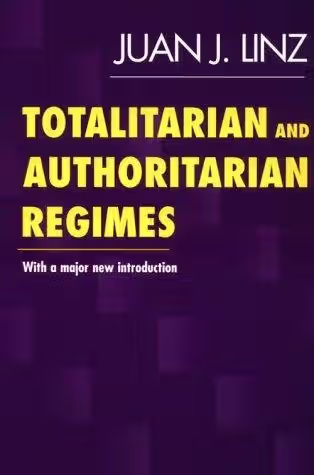
Linz, J. J. (2000). Totalitarian and Authoritarian Regimes. Lynne Rienner Publishers.
Chapter Summary
The book runs to 343 pages, and it has six divisions: the new introduction and five parts of the original study. It is the republication of a study that first appeared in 1975 as a chapter in the Handbook of Political Science (long out of print by 2000). The author chose to leave the original text unchanged, including a bibliography of about forty pages, and added an extensive new introduction reflecting on contributions to the literature and on the changes in world politics and in the nature of regimes since the 1970s. The publisher describes the core argument as a fundamental distinction between totalitarian and authoritarian systems, together with a discussion of a personalistic, lawless, nonideological kind of authoritarian rule that Linz, following Max Weber, calls the "sultanistic regime."
Introduction
The new introduction written for the 2000 edition. It is the only part of the book that is not the 1975 study. In it Linz comments on some of the later literature and on how regimes and world politics have changed since the 1970s, so it should be read as a note from the author to readers a quarter of a century after the original.
Totalitarian Systems
The first part of the 1975 study takes up the totalitarian type. It is the first of the two categories whose separation the publisher calls the fundamental distinction of the book.
Traditional Authority and Personal Rulership
This chapter moves to rule that rests on traditional authority and the person of the ruler. The publisher's summary links the book's discussion of sultanistic rule, a personalistic, lawless and nonideological form of rulership named after Weber's categories, to this part of the argument.
Authoritarian Regimes
The chapter devoted to authoritarian regimes is the counterpart to the discussion of totalitarian systems. Together with the earlier chapters, it supplies the distinction between totalitarian and authoritarian systems on which the book rests.
The Place of the World's States in the Typology: An Attempt and its Difficulties
The title announces an effort to place the states of the world within the typology and to deal openly with the difficulty of doing so. It is the section where the categories are tested against cases.
Concluding Comments
A closing section that draws the study together.
Key Concepts
The Introduction and the Typology
- Totalitarian system: one pole of the main distinction, given its own chapter.
- Authoritarian regime: the other pole, also given its own chapter.
- Sultanistic regime: the publisher's term for personalistic, lawless and nonideological rule, following Weber.
- Traditional authority and personal rulership: the subject of the third chapter.
- Typology: the scheme into which the book tries to place the world's states, with the difficulties noted in the title of the fourth section.
Critical Analysis
Strengths
- A founding text on non-democratic regimes. The publisher calls it a classic study by a leading political sociologist, and reviewers quoted on the publisher's page support the claim. Gianfranco Pasquino, writing in West European Politics, judged that what Linz wrote a quarter of a century earlier "has withstood the test of time beautifully"; Choice described the volume as renewed access to an important work in comparative politics.
- Original text plus author's reflection. Because Linz left the 1975 text unchanged and added a new introduction, readers can see the original argument in full and the author's own later assessment of it in the same volume.
- A typology that can be reused. The book is organised around the distinction between totalitarian and authoritarian systems and the separate case of sultanistic rule, which gives later comparative work a vocabulary for classifying non-democratic regimes.
- A large bibliography. Roughly forty pages of the core text are bibliography, useful as a guide to the literature as it stood in the mid-1970s.
Limitations
- The argument is from the 1970s. The core text was left as written in 1975, so developments after the 1970s appear only in the new introduction. Dovile Budryte, in Bridges, called the book a good start for students of democratic transitions.
- Difficult to place cases. The title of the fourth section itself points to difficulties in assigning the world's states to the types, and readers should expect the categories to leave some cases awkward.
- A single long essay. The book is a monograph of six divisions without the guides, summaries or exercises of a textbook. Readers who want worked examples or a survey of regimes will need other books.
Where It Fits in the Course
In the course on democracy and authoritarianism, this is the typological reference for non-democratic rule. Erica Frantz's Authoritarianism: What Everyone Needs to Know is a concise primer in question-and-answer form that draws on recent comparative research, and Levitsky and Ziblatt's How Democracies Die is a more accessible account of how democratic regimes erode; either is a gentler way into the subject. Haerpfer and colleagues' Democratization is an edited textbook on how regimes are defined, measured and changed.
Robert Dahl's Polyarchy is the classic account of the institutional guarantees of democratic regimes, which Linz's study complements from the non-democratic side. Hannah Arendt's The Origins of Totalitarianism is a historical and philosophical analysis of the conditions behind Nazi and Stalinist totalitarianism, and a reader interested in the totalitarian side of Linz's distinction can read the two together.
How to Use This Book
The book is for advanced undergraduates, graduate students and researchers in comparative politics who want the classic statement of the totalitarian–authoritarian distinction. A course in comparative politics, or on democracy and authoritarianism, is the useful preparation, and some knowledge of twentieth-century European history helps with the examples.
A practical plan:
- Begin with the new introduction, treating it as the author's own guide to what has changed since the 1970s and which parts of the literature he considers important.
- Read the three central chapters in order: totalitarian systems, traditional authority and personal rulership, and authoritarian regimes. This is the core of the typology.
- Use the section on placing the world's states as a guide to the difficulties of classification, and try the categories on regimes you know.
- Read the concluding comments, then use the bibliography selectively as a guide to the older literature.
- Pair it with a recent book on authoritarian rule to see which parts of the typology later research has kept.