01 / Reading Guide
Reading Guide
Citation
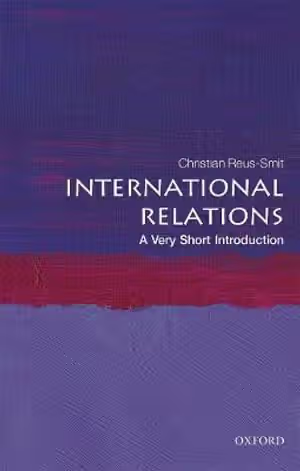
Reus-Smit, C. (2020). International Relations: A Very Short Introduction. Oxford University Press.
Chapter Summary
The book is a pocket-sized volume in the Oxford Very Short Introductions series (volume 164) of about 150 pages. Catalogues give between 147 and 176 pages depending on the printing. It has eight chapters, followed by references, further reading, a glossary and an index. The publisher's description supplies the book's organizing idea: international relations is presented through the global organization of political authority, from a world of empires to today's sovereign states embedded in international institutions. The notes below follow the chapter titles and page ranges in the contents and the publisher's description, and go no further.
Chapter 1: What is international relations?
The opening chapter (pages 1 to 10) introduces the field. The publisher's description says that international relations affects everyone's security, economic well-being, rights and freedoms and shared environment.
Chapter 2: The global organization of political authority
This chapter (pages 11 to 28) takes up the book's central theme. According to the publisher, the book follows the transformation from a world of empires to sovereign states enmeshed in a complex array of international institutions that all exercise degrees of political authority, and this chapter sets out that framework.
Chapter 3: Theory is your friend
The chapter on theory (pages 29 to 46) treats theory, in the publisher's words, as an indispensable tool for grasping international relations and presents theorizing as an everyday human practice rather than something mysterious. It surveys a range of theories from realism to feminism, read as contrasting perspectives on the global organization of political authority.
Chapters 4–7: War; Economy; Rights; Culture
These four chapters examine the social forces that the publisher says have shaped the organization of political authority: shifting patterns of warfare, changing economic conditions, struggles for rights, and the politics of culture. Each is between seventeen and nineteen pages long (War, pages 47 to 63; Economy, 64 to 82; Rights, 83 to 101; Culture, 102 to 118).
Chapter 8: An essential political science
The last chapter (pages 119 to 128) is a concluding reflection. The publisher says Reus-Smit concludes with a reflection on the future of international relations in an era of profound global change. Another catalogue listing gives this chapter's title as "Conclusion"; the title above is the one shown in the book's contents page preview on Google Books.
Key Concepts
Chapters 1–3: Framework and theory
- Global organization of political authority: the book's central idea, covering empires, sovereign states and international institutions.
- Theory as a practice: a way of seeing the world that everyone uses, which the book makes explicit.
- Contrasting theoretical perspectives: from realism to feminism, each reading the same organization of authority differently.
Chapters 4–7: Forces of change
- War, economy, rights and culture: the four social forces that shape how authority is organized.
Chapter 8
- Future of international relations: considered in the concluding chapter.
Critical Analysis
Strengths
- A single organizing idea. The publisher says the whole book is built around how political authority is organized globally.
- Theory made approachable. The chapter title "Theory is your friend" and the publisher's account of theorizing as an everyday practice show that the book aims to demystify theory and uses it to connect the empirical chapters.
- Very short. At roughly 150 pages the book can be read in a few sittings, and the eight-chapter contents makes the route clear.
- Reading aids. The book ends with further reading, a glossary and references, which the contents list.
Limitations
- Selective rather than comprehensive. The contents show four themes (war, economy, rights, culture); a course that expects chapters on topics such as the environment, migration or international law will need a larger text.
- Theory is brief. The survey of theories from realism to feminism shares a chapter of about eighteen pages, so it is an overview.
- No published review was located, so the points above rest on the contents and the publisher's description.
Where It Fits in the Course
Reus-Smit is the shortest entry on the international-relations list and the best fit for a reader who wants an overview before choosing a longer text. Baylis, Smith and Owens's The Globalization of World Politics is a large edited introductory textbook with specialist chapters on history, theory, structures and global issues. Frieden, Lake, Schultz, Hyde and Rickard's World Politics organizes the field around interests, interactions and institutions and applies this framework to war, trade, finance, migration, law, rights and the environment. Sørensen and Møller's Introduction to International Relations and Global Politics concentrates on the theoretical traditions and how each would analyse current problems. Waltz's Theory of International Politics and Wendt's Social Theory of International Politics are the primary works of structural realism and constructivism, to be read after an introduction like this one.
How to Use This Book
No previous study of politics or international relations is needed, so the book suits first-year students, general readers and anyone preparing for a longer course.
A practical plan: read the book in order, since Chapter 2 sets up the idea that the rest develops and Chapter 3 provides the vocabulary of theories. Chapters 4 to 7 can then be read in any order, matched to the topics of a course. Use the further reading to pick the next book, and the glossary to check terms. Because the theoretical chapter is brief, readers who want depth on one tradition can move on to a theory-focused textbook or to the primary works.