01 / Reading Guide
Reading Guide
Citation
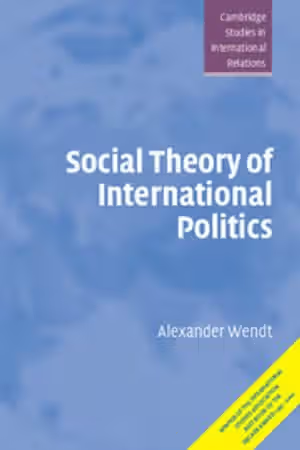
Wendt, A. (1999). Social Theory of International Politics. Cambridge University Press.
Chapter Summary
The book has eight chapters in about 380 pages of text, followed by a bibliography of about forty pages and an index. Chapter 1 is an opening survey; Part I (Chapters 2–4) is devoted to social theory; Part II (Chapters 5–8) turns to international politics, and ends with a short conclusion. The title echoes Kenneth Waltz's Theory of International Politics of 1979, and the book is a foundational statement of the constructivist approach.
Chapter 1: Four Sociologies of International Politics
The opening chapter, about forty-five pages. According to the publisher, Wendt presents a structural and idealist worldview in contrast to the individualism and materialism that underpin much mainstream international relations theory. The title points to four sociologies, that is, four positions in the sociology of international theory, within which the later argument locates itself.
Chapter 2: Scientific Realism and Social Kinds
The first chapter of Part I turns to the philosophy of social science. The title shows that it draws on scientific realism to ask about the nature of social kinds.
Chapter 3: "Ideas All the Way Down?": On the Constitution of Power and Interest
Takes up the question in its title: whether ideas go all the way down in the constitution of power and interest. It sits between the philosophical groundwork of Chapter 2 and the account of structure and culture in Chapter 4.
Chapter 4: Structure, Agency, and Culture
Completes Part I by setting out how structures, agents and culture relate. Together with Chapters 2 and 3 it gives the theoretical basis for the claim that the structure of the international system is social as well as material.
Chapter 5: The State and the Problem of Corporate Agency
The first chapter of Part II, about fifty pages, moves to the state. The title shows that it addresses how states can be treated as agents, and the publisher's description lists states' identities and interests as the things shaped by shared ideas.
Chapter 6: Three Cultures of Anarchy
The longest chapter, at about seventy pages, and the centre of the book. The publisher describes a cultural theory in which whether states view each other as enemies, rivals or friends is a fundamental determinant. These roles are called "cultures of anarchy": Hobbesian, Lockean and Kantian. They are shared ideas that shape state interests and capabilities and generate tendencies in the international system.
Chapter 7: Process and Structural Change
Asks how one culture of anarchy can give way to another. The publisher lists four factors that can drive structural change, namely interdependence, common fate, homogenization and self-restraint, and says the chapter examines the effects of capitalism and democracy on the emergence of a Kantian culture in the West.
Chapter 8: Conclusion
A short closing chapter of nine pages.
Key Concepts
Chapters 1–4: Social theory
- Structural and idealist worldview: the position the publisher contrasts with the individualism and materialism underlying much mainstream international relations theory.
- Scientific realism: the philosophy of social science that the second chapter draws on.
- Structure, agency and culture: the terms in which the book describes how the international system is constituted.
Chapters 5–8: International politics
- Corporate agency: the idea that the state can be treated as an agent with its own identity and interests.
- Cultures of anarchy: Hobbesian, Lockean and Kantian, depending on whether states see each other as enemies, rivals or friends.
- Four drivers of structural change: interdependence, common fate, homogenization and self-restraint.
Critical Analysis
Strengths
- A clear architecture. Chapter 1 sets the terms, Part I supplies the social theory, and Part II applies it to the international system. A reader can see where each argument is built and used.
- A typology that can be applied. The three cultures of anarchy give students a concrete way to describe how relations between states differ, and the four drivers of change give a way to ask how they might move.
- Direct engagement with the field's standard theory. The book takes on materialist and individualist approaches to international relations, including the structural theory it echoes in its title, and so gives constructivism a position within the existing debates.
- Reception. It won the International Studies Association's Best Book of the Decade award for 1991–2000.
Limitations
- A demanding first half. Part I and Chapter 1 together run to about 190 pages of philosophy and social theory before international politics is reached. Ikenberry's review calls the first section a "winding tour" of constructivism's foundations, and readers whose interest is in international relations itself can find it slow.
- A work of theory. The chapters are organised by concepts, such as structure, agency and culture, not by historical cases, so students who want case studies must find them elsewhere.
- Published in 1999. Later debates and applications are not covered, and the book is best read together with later constructivist work.
- Built in dialogue with existing theory. The argument responds to materialist and individualist approaches, and the title echoes Waltz, so a reader new to international relations theory will miss part of its point.
Where It Fits in the Course
This is one of two theory monographs in the international relations list, the other being Waltz's. International Relations: A Very Short Introduction is a brief account organised around how political authority is arranged globally, and Introduction to International Relations and Global Politics explains the main theoretical traditions and how they developed. The Globalization of World Politics and World Politics are broad textbooks. Any of them supplies the background in the main schools of thought that Wendt takes for granted.
Theory of International Politics by Waltz is the closest companion, since Wendt's title and argument respond to it. Waltz explains recurring patterns from the anarchic structure of the system and the distribution of capabilities. Wendt keeps a systemic focus but argues that the structure is social and that anarchy can take different cultural forms. Read the two in sequence, Waltz first, to see how the argument changes.
How to Use This Book
It suits advanced undergraduates and graduate students who have studied international relations theory and want a sustained, foundational statement of constructivism. A background in the philosophy of social science helps for Chapters 2–4.
A practical plan:
- Core: Chapters 1, 6 and 7. Chapter 1 gives the map, Chapter 6 the main theory and Chapter 7 the account of change.
- Philosophical foundations: Chapters 2–4, which can be read more slowly or deferred. Readers primarily interested in international politics can start with Chapter 5.
- Pair with Waltz. Read Waltz first, then compare the two systemic theories: the role of material capabilities against shared ideas.
- Test it. Choose a relationship between two states, decide whether it looks Hobbesian, Lockean or Kantian, and ask which of the four drivers might change it.