01 / Reading Guide
Reading Guide
International relations: distinguish trade exposure from costly dependence
Compare a free global history and two IR surveys, then solve an original interruption-and-adaptation packet without turning trade flows into a leverage claim.
Study route and exercise: University Reading List editorial project.
Citation
Baylis, J., Smith, S., & Owens, P. (Eds.). (2026). The Globalization of World Politics: An Introduction to International Relations (10th ed.). Oxford University Press.
Chapter Summary
This is an edited textbook of about 670 pages in 33 chapters. Each chapter is written by a different specialist, and the chapters are arranged in five parts: international relations in a global era, the historical context, theories of world politics, structures and processes, and international issues. A glossary and references close the volume.
The publisher calls the tenth edition a milestone edition. It adds three new chapters: on the rise of the modern international order, on Marxist theories and on ecological thought. It also expands coverage of non-Western approaches and the Global South and updates its discussion of the crisis of the liberal international order. The case studies it names include the UN and the conflict in Gaza, ending plastics pollution, and the Russia-Ukraine war. Chapters are given below with their authors, as the publisher lists them.
Part One, Chapters 1-2: Introduction; Globalization and global politics
The framing part. Chapter 1 is a joint introduction by the three editors, Owens, Baylis and Smith. Chapter 2, by Anthony McGrew, takes up globalisation and global politics.
Part Two, Chapters 3-6: The historical context
Four chapters on history:
- "The rise of the modern international order" (Ayse Zarakol, new)
- "International history of the twentieth century" (Len Scott)
- "From the end of the Cold War to the crisis of the liberal order" (Michael Cox)
- "Emerging powers and the Global South" (Andrew Hurrell)
Together they run from the formation of the modern order to the present contest over it.
Part Three, Chapters 7-14: Theories of world politics
Eight theory chapters:
- Liberal internationalism (Tim Dunne)
- Marxist theories of international relations (Maïa Pal, new)
- Realism (Or Rosenboim)
- Feminism (Helen M. Kinsella)
- Postcolonial and decolonial approaches (Meera Sabaratnam)
- Poststructuralism (Lene Hansen)
- Ecological thought in International Relations (Andrea Brock, new)
- Social constructivism (Michael Barnett)
This part begins at page 115 and ends before page 257, about 140 pages.
Part Four, Chapters 15-24: Structures and processes
Ten chapters:
- War and world politics (Tarak Barkawi)
- International and global security (John Baylis)
- Global political economy (Nicola Phillips and Danielle F. S. Cohen)
- Gender (Paul Kirby)
- Race in world politics (Robbie Shilliam)
- International law (Christian Reus-Smit)
- International organizations in world politics (Susan Park)
- The United Nations (Devon E. A. Curtis and Paul Taylor)
- NGOs in world politics (Jutta Joachim)
- Regionalism in international affairs (Edward Best and Thomas Christiansen)
It is the largest part and runs from about page 257 to page 437.
Part Five, Chapters 25-33: International issues
Nine chapters on issues:
- Environmental issues (John Vogler)
- Global health (Sophie Harman)
- Refugees and forced migration (Ariadna Estevez and Danielle F. S. Cohen)
- Poverty, hunger and development (Tony Evans)
- Global trade and global finance (Matthew Watson)
- Terrorism and globalization (James D. Kiras)
- Proliferation of weapons of mass destruction (Sheena Chestnut Greitens)
- Nationalism, national self-determination, and international relations (John Breuilly)
- Human rights (Ratna Kapur)
The part starts at about page 437 and ends before the glossary at page 597.
Key Concepts
Parts One and Two: Globalisation and history
- Globalisation: the organising theme of the book, introduced in Chapter 2.
- The modern international order and its crisis: from its rise in Chapter 3 to the liberal order's crisis in Chapter 5.
- Emerging powers and the Global South: a perspective that the publisher says is woven through all chapters.
Part Three: Theories
- Liberal internationalism, realism, constructivism: the established approaches.
- Marxist, feminist, postcolonial and decolonial, poststructuralist and ecological approaches: critical approaches given their own chapters.
Parts Four and Five: Structures, processes and issues
- Global political economy, international law, international organisations, regionalism: the structures and processes through which world politics is organised.
- Security issues: war, international and global security, terrorism and the proliferation of weapons of mass destruction.
- Global issues: the environment, health, migration, poverty, trade and finance, nationalism and human rights.
Critical Analysis
Strengths
- Breadth in one volume. Thirty-three chapters cover history, eight approaches, ten structures and processes, and nine issues. The book can serve as a first course text and, as the publisher says, as a reference for the rest of an IR degree. The previous (ninth) edition has been used this way: one introductory course schedules 30 of its chapters across a single session (see the course example below).
- Specialist authors. Each chapter is written by a scholar working in the area, and the publisher says the editors work to keep a coherent style throughout. The author list also shows who works on what in the field.
- Theory is not limited to the mainstream. Marxism, feminism, postcolonial and decolonial thought, poststructuralism and ecological thought stand beside liberalism, realism and constructivism. Gender and race have their own chapters in Part Four.
- Teaching features. The publisher lists opposing-opinions features, end-of-section multiple-choice questions, author videos and a flashcard glossary. The interactive items are in the e-book and Trove editions.
Limitations
- Size and uneven depth. At about 670 pages the book is more than a one-term reading load. Because each topic gets one chapter, each subject stays at the survey level.
- Edited-volume unevenness. Different authors write each chapter. The editors aim for a coherent style, but chapters will differ in difficulty and slant.
- Timeliness. The tenth edition engages with recent events, including the US presidential elections and the second Trump administration, so some of its discussion will date quickly.
- Chapter numbers shift between editions. The tenth edition adds three new chapters, so course schedules written for the ninth edition cannot be followed by number alone.
- No independent review located. The assessment rests on the publisher's description and contents.
Where It Fits in the Course
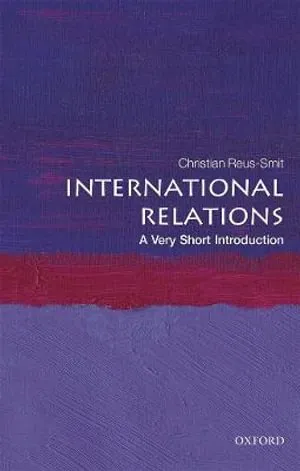
This is the largest introductory text in the international relations list and works as a reference. Christian Reus-Smit's International Relations: A Very Short Introduction is a short, plain-language account organised around political authority. It is the quick way in before this book.
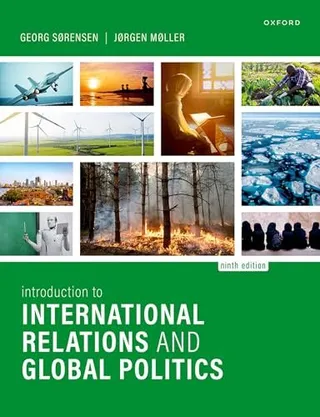
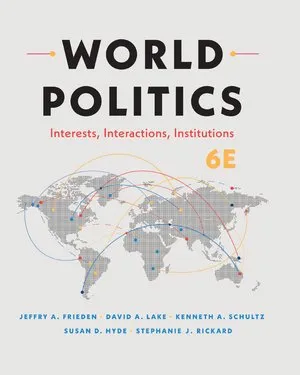
World Politics: Interests, Interactions, Institutions and Sørensen and Møller's Introduction to International Relations and Global Politics are course textbooks built around a single framework or focused on theory. Baylis, Smith and Owens is instead a multi-author survey covering many perspectives.
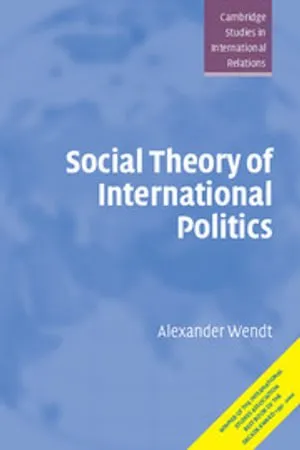
Waltz's Theory of International Politics and Wendt's Social Theory of International Politics are the original statements of structural realism and constructivism. Chapters 9 and 14 here are compact introductions to those approaches, and reading them first makes the originals easier to approach.
How to Use This Book
The book is for first- and second-year students in international relations, politics or history degrees, and for those preparing for more specialised study. No prior study of IR is assumed.
A practical plan:
- Start with Part One and Part Two. Chapters 1-6 supply the vocabulary and the history that the later chapters assume.
- Theory, then issues. Read the approaches in Part Three. Then take two or three Part Five issues and apply different approaches to each.
- Be selective. Part Four is a set of reference chapters. Pick those that match your course, such as the UN or international law.
- Alongside the book. Use the opposing-opinions and multiple-choice features if you have the e-book. Follow each chapter's references into a longer reading for essays.
Course example: University of Florida (ninth edition)
The University of Florida's online INR2001: Introduction to International Relations (Summer B 2025; syllabus) makes the book its required text. It specifies the ninth edition (2023), not the tenth edition described in this guide. Its chapter numbers therefore refer to the ninth edition. The course gives no concordance to the tenth, so do not map its numbers onto the contents above.
The syllabus is a dated calendar of chapter assignments, with no page ranges. It schedules chapters 1–16, 19–29 and 31–33, which is 30 chapters. Chapters 17, 18 and 30 are not listed. The course uses the book heavily as its backbone rather than as a source of excerpts, though it does not assign the whole book.
Two features are worth copying:
- Order by topic, not by chapter number.
- The course moves from global politics and the history of international order (ninth-edition chapters 1–6) to the theories.
- The theories come in the course's own order: realism, then liberal internationalism, social constructivism, Marxism, feminism, post/decolonialism and poststructuralism.
- It then turns to security and war, the global economy, international organizations, and regionalism and NGOs.
- It ends with issues: nationalism, law and rights, intervention, refugees, terrorism, the environment, global health and poverty.
- Pair chapters with other material. Interviews, E-IR materials and other readings, supplied through Canvas, supplement several theory and issue sessions. The textbook alone was not the course's full reading programme.
With the tenth edition, you can reproduce this sequence by matching chapter titles and topics rather than numbers. The tenth edition's new chapter on ecological thought has no counterpart in that schedule.
Focused reading and edition boundary
The trial below uses the guide's companion problem. Open its assumptions and data before answering.
Reading route: In the tenth edition (2026), read the relevant theory chapters and the discussions of global political economy or institutions, chosen by topic.
Try before continuing: Write two distinct explanations for a trade interruption, then list the evidence each would require. Checkpoint: The worksheet computes consequences under stated assumptions. It does not supply the interruption's cause, and it does not supply a test for choosing between theories.
Edition and access: An edited survey offers multiple voices, so keep your reading focused with a comparison question. Use the tenth edition's own chapter numbering rather than an older edition's.