01 / Reading Guide
Reading Guide
Citation
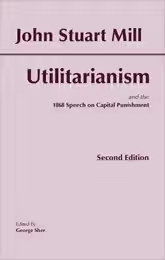
Mill, J. S. (2002). Utilitarianism (G. Sher, Ed.; 2nd ed.). Hackett Publishing Company. (Original work published 1861.) Free official edition: https://www.gutenberg.org/ebooks/11224
Chapter Summary
Context and Argument
Utilitarianism first appeared in Fraser's Magazine in 1861 and was then reprinted as a short book. It is Mill's attempt to state the "Greatest Happiness Principle" inherited from Bentham, to clear it of popular misunderstandings and to give it the kind of support a first principle can have. The essay has five chapters, and almost every paragraph answers an objection. The Hackett second edition edited by George Sher reprints the essay and adds Mill's April 1868 speech in the House of Commons against the abolition of capital punishment.
Chapter I: General Remarks
Mill observes that after two thousand years philosophers still disagree about the foundation of morality, the summum bonum. Both the intuitive school and the inductive school agree that morality must be deduced from general principles, but neither has reduced its principles to one first principle. He claims that utility has quietly shaped even the doctrines of its critics, and that Kant's universal law, applied to actual duties, ends up appealing to the consequences of everyone acting on a rule. Ultimate ends cannot be proved in the ordinary sense, but considerations can be offered that move a rational mind to accept or reject them. The chapter closes by setting the plan: first explain what the doctrine is, then ask what proof it admits.
Chapter II: What Utilitarianism Is
The longest chapter but one defines the creed: actions are right in proportion as they tend to promote happiness, understood as pleasure and the absence of pain. Mill then answers a series of objections. To the charge that the doctrine is "worthy only of swine", he replies that pleasures differ in quality as well as quantity, and that quality is settled by the preference of those competently acquainted with both kinds: hence "better to be Socrates dissatisfied than a fool satisfied". To the claims that happiness is unattainable and that noble people learn to do without it, he answers that a happiness of tranquillity and active interest is widely possible, and that self-sacrifice is valuable only when it increases others' happiness. He insists that the standard is the happiness of all concerned, judged impartially, and that utilitarianism does not ask people to act from a motive of general benevolence: motive bears on the worth of the agent, not the rightness of the act. Replies follow to the charges that the doctrine is godless, mere "expediency", and impossible to apply for lack of time to calculate; to the last, Mill answers that mankind has inherited the experience of actions' tendencies as secondary rules, like a sailor's nautical almanac.
Chapter III: Of the Ultimate Sanction of the Principle of Utility
Why should anyone feel bound by the principle? Mill argues that utility can draw on every sanction available to other moralities: external ones (hope of favour, fear of displeasure from others or from God) and the internal one, the feeling of conscience. He holds that moral feelings are acquired rather than innate, but no less natural for that, and that utilitarian morality has a natural basis in the social feelings, the desire to be in unity with others. These feelings grow stronger as civilisation and equality advance; Comte's Système de Politique Positive is cited as showing how a service of humanity could gain the force of a religion, at some risk to liberty.
Chapter IV: Of What Sort of Proof the Principle of Utility Is Susceptible
This brief chapter contains the notorious "proof". The only evidence that something is visible is that people see it; likewise the only evidence that something is desirable is that people desire it. Each person desires his own happiness, so the general happiness is a good to the aggregate of persons. Mill then argues that happiness is the only thing desired: things such as virtue, money, power and fame, first wanted as means, come to be desired as parts of happiness. Conceding that habit can detach will from desire, he leaves the verdict "to the consideration of the thoughtful reader".
Chapter V: On the Connexion between Justice and Utility
The longest chapter takes on what Mill calls the only real difficulty for the theory: the feeling that justice is absolute and independent of expediency. He surveys the things commonly called unjust (violating legal and moral rights, giving people what they do not deserve, breaking faith, partiality, inequality) and traces the idea back through etymology to conformity with law. Justice is distinguished from the rest of morality as the duties of "perfect obligation", which correspond to a right in some assignable person. The sentiment of justice is the natural desire to retaliate, widened by sympathy and intelligence to cover harms to anyone; its special intensity comes from the vital interest it protects, security. Mill shows that rival maxims of justice in punishment, wages and taxation conflict and can only be settled by social utility. He concludes that justice names the class of moral rules most essential to human well-being, more binding than others as a class, though even these can be overridden in particular cases, as when stealing food or medicine is needed to save a life.
The 1868 Speech on Capital Punishment
Speaking against an amendment to abolish the death penalty, Mill defends it for aggravated murder on grounds of humanity: penal servitude for life is crueller in reality while seeming milder, whereas death deters through its hold on the imagination. He concedes the weight of the argument from irreversible error but holds that English courts give the accused every benefit of doubt, and ends by calling for stronger penalties for crimes against the person.
Key Concepts
Chapters I–II: General Remarks; What Utilitarianism Is
- Greatest Happiness Principle: actions are right as they tend to promote happiness and wrong as they tend to produce its reverse.
- Higher and lower pleasures: pleasures differ in quality, ranked by the preferences of competent judges who have experienced both.
- Impartiality: the standard is the happiness of everyone affected, with the agent counting as one among others.
- Secondary principles: inherited moral rules that summarise experience of actions' tendencies and guide ordinary choices.
Chapter III: Of the Ultimate Sanction
- External and internal sanctions: rewards and penalties from others or God, versus the pain of violating one's own conscience.
- Social feelings: the natural desire for unity with others, which Mill sees as the foundation for utilitarian conscience.
Chapter IV: Of What Sort of Proof
- Proof from desire: the only evidence that something is desirable is that it is actually desired.
- Parts of happiness: virtue and other goods first sought as means can come to be desired for their own sake as components of happiness.
Chapter V: Justice and Utility
- Perfect and imperfect obligation: duties that correspond to someone's right (justice) versus duties, such as charity, that do not.
- Right: a valid claim on society to be protected in possessing something, justified by general utility.
- Security: the interest, "the most vital of all", that gives the sentiment of justice its special strength.
Critical Analysis
Strengths
- Brevity with range. In five chapters Mill gives a statement of the theory, replies to many objections, an account of moral motivation, an argument for the principle and a theory of justice and rights.
- Objections stated before answered. Chapter II is organised largely around the common charges against utilitarianism, so the reader learns the classic objections and the classic replies together.
- More than Bentham. The qualitative distinction among pleasures, the role of secondary rules, the separation of motive from rightness and the analysis of justice in Chapter V show Mill revising the doctrine he inherited rather than simply restating it.
- Justice treated seriously. Chapter V's account of rights as claims grounded in security, and its examples of conflicting maxims in punishment, pay and taxation, speak directly to the question of whether utilitarianism can accommodate rights.
Limitations
- The proof is contested. The inference from "desired" to "desirable", and from each person's happiness being good for that person to the general happiness being good for all, are among the most criticised passages in ethics. Mill himself presents them only as considerations, not strict proof.
- Competent judges. The test for higher pleasures relies on the preferences of experienced judges, and Mill does not say how to settle disagreement among them beyond appealing to the majority.
- Act or rule? Passages on secondary rules, abstinences and justice can be read in either an act-utilitarian or a rule-utilitarian way, and the text does not settle the question.
- Victorian assumptions. References to "savage independence", the stages of civilisation and the moral role of religion need historical context, and the 1868 speech argues for harsher punishments, including flogging, that many readers will find hard to square with the essay's humanity.
Where It Fits in the Course
This is the course's classic statement of consequentialism and pairs naturally with Kant's Grounding for the Metaphysics of Morals in James Ellington's translation. Mill criticises Kant directly in Chapters I and V, so reading the two side by side lets students test whether his claim that Kant relies on consequences is fair. The textbooks in the course, James and Stuart Rachels's The Elements of Moral Philosophy, a set of independent chapters on each major theory, and Russ Shafer-Landau's The Fundamentals of Ethics, which reconstructs arguments step by step, set out the standard objections to utilitarianism against which Mill's replies can be weighed.
Read Mill early, after or alongside the textbook chapters on hedonism and utilitarianism, and before Kant. Bernard Williams's Ethics and the Limits of Philosophy, a critical examination of systematic moral theory, belongs at the end of the course: its doubts about theories such as utilitarianism are easier to appreciate once Mill's version is familiar.
How to Use This Book
No background is needed, though some familiarity with the idea of hedonism helps. Read Chapter I quickly for the plan, then Chapter II slowly: list each objection Mill takes up and summarise his reply in one sentence. Chapter III can be read more lightly unless your course covers moral motivation. Chapter IV is short but central; write out the structure of the proof as numbered premises and mark where critics say it fails. Give Chapter V the most time, since its account of justice and rights is where Mill confronts the strongest objection to his view.
Read the 1868 speech last, as a case study. Ask which parts of the argument appeal to the general happiness, how Mill weighs the suffering of the criminal against deterrence, and whether his concession about irreversible error is consistent with the rest of his reasoning.
The free text is fine for study, but cite the Hackett edition's page numbers in coursework if your course uses it.
Edition and Sources
This guide is based on the full text of Utilitarianism in Project Gutenberg eBook #11224 (https://www.gutenberg.org/ebooks/11224), which reproduces the seventh edition (Longmans, Green, and Co., 1879). All five chapters and Mill's footnotes were read in full. The 1868 speech was read in the official Hansard record of the House of Commons debate of 21 April 1868 (https://api.parliament.uk/historic-hansard/commons/1868/apr/21/committee); the Hackett edition's own introduction and apparatus were not available and are not described here.