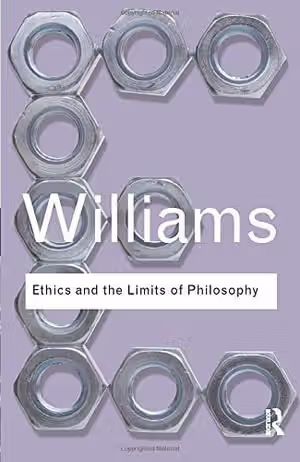
01 / Reading Guide
Reading Guide
Citation
Williams, B. (2011). Ethics and the Limits of Philosophy (Routledge Classics ed.). Routledge. With a foreword by Jonathan Lear and a commentary on the text by A. W. Moore.
Chapter Summary
The Routledge Classics edition runs to 296 pages. Besides the ten chapters and a postscript, it contains a foreword to the Routledge Classics edition by Jonathan Lear, the author's preface, a commentary on the text by A. W. Moore, notes and an index. The publisher describes the book as reorienting ethics away from a preoccupation with universal moral theories and towards "truth, truthfulness and the meaning of an individual life", drawing on the Greek philosophers and taking up relativism, objectivity and the possibility of ethical knowledge.
Chapter 1: Socrates' Question
The book begins with Socrates' question. A reviewer quoted by the publisher frames the book's concern as the question "How should I live, and how can I find out?", which sets the agenda of the later chapters.
Chapters 2–4: The Archimedean Point; Foundations: Well-Being; Foundations: Practical Reason
Three chapters on foundations. The title of Chapter 2 points to the search for a fixed point (the Archimedean point) from which ethical life could be assessed, and Chapters 3 and 4 are titled for two candidate foundations, well-being and practical reason.
Chapters 5–6: Styles of Ethical Theory; Theory and Prejudice
The two chapters on moral theory itself. The titles point to a survey of the different styles that ethical theories take and an examination of the relation between theory and the intuitions or prejudices it works with. The publisher's description presents the book as questioning the ambition of universal moral theories.
Chapters 7–9: The Linguistic Turn; Knowledge, Science, Convergence; Relativism and Reflection
The middle-to-late chapters turn to questions about language, ethical knowledge and objectivity. According to the publisher, the book takes up relativism, objectivity and the possibility of ethical knowledge, and these chapters are where those topics are treated.
Chapter 10: Morality, the Peculiar Institution
The last chapter of the main text is titled for morality as a "peculiar institution", and a postscript follows it.
Postscript and Commentary
The edition then adds a commentary on the text by A. W. Moore.
Key Concepts
Chapters 1–4
- Socrates' question: how one should live.
- The Archimedean point: a fixed standpoint outside ethical life from which it could be justified.
- Well-being and practical reason: the two foundations considered in Chapters 3 and 4.
Chapters 5–10
- Styles of ethical theory: the different forms that systematic moral theory takes.
- Theory and prejudice: the relation between systematic theory and the ethical views it starts from.
- Relativism and reflection: how reflection bears on ethical outlooks that differ.
- Ethical knowledge and convergence: whether ethical belief can be knowledge, and whether it tends to converge.
- Morality as a peculiar institution: the subject named in the title of the closing chapter.
Critical Analysis
Strengths
- Wide-ranging engagement with the field. Philippa Foot's review in the Times Literary Supplement, quoted by the publisher, praises its excellent descriptions of a variety of moral theories and its many observations on topics met on the way. Richard Norman, quoted in the same place, says it maps the tendencies and difficulties of the present state of the subject.
- Argumentative sharpness. John McDowell, in Mind, wrote that Williams's explicitness and argumentative ingenuity focus the issues more sharply, and at greater depth, than any comparable work he knew. Thomas Nagel in the Journal of Philosophy called it a superior book, glittering with intelligence and style.
- Added apparatus in this edition. A. W. Moore's commentary on the text and Jonathan Lear's foreword accompany the main text, which gives readers help with a demanding book.
- Clear chapter sequence. The ten chapters move from the question of how to live through foundations and theory to language, knowledge and relativism, and end with morality as an institution.
Limitations
- Not an introduction. Norman's review, quoted by the publisher, is explicit that the book is better read not as an introduction to ethics but as an attempt to take stock of the subject. Readers without a prior course will miss much of what the book engages with.
- Critical, not constructive. The publisher describes the book as questioning the ambition of systematic theories such as Kantianism and utilitarianism; readers hoping for a rival systematic theory will not find one.
- No applied topics. The ten chapter titles deal with foundations, theory, language, knowledge and relativism; readers looking for discussions of particular practical issues will not find chapters on them.
Where It Fits in the Course
The book is the most advanced ethics title on the list and is best read after the textbooks and primary texts it comments on. James and Stuart Rachels's The Elements of Moral Philosophy introduces the main approaches to ethics chapter by chapter and tests them against cases; Russ Shafer-Landau's The Fundamentals of Ethics covers theories of the good life, of right action and metaethics, reconstructing arguments step by step. Mill's Utilitarianism and Kant's Grounding for the Metaphysics of Morals are the classic statements of the two theories that Williams's description names as targets.
Williams is best read as a response to these: after the textbook survey and the two primary texts, it shows what a sceptic about systematic theory says to them.
How to Use This Book
The book suits advanced undergraduates and graduate students who know the main ethical theories, including Kantian ethics and utilitarianism.
A practical plan: read the preface and Chapter 1 first, since they state the question and the method. Then read Chapters 5 and 6, on moral theory, because they apply most directly to a student who has just read Mill and Kant. Return to Chapters 2–4 for the foundations, and take Chapters 7–9 together as the book's discussion of language, knowledge and relativism. Read Chapter 10 last. Consult Moore's commentary alongside each chapter to check your reading, and Lear's foreword for orientation. Compare Williams's arguments chapter by chapter with the standard replies from Kantian and utilitarian writers.