01 / Reading Guide
Reading Guide
Citation
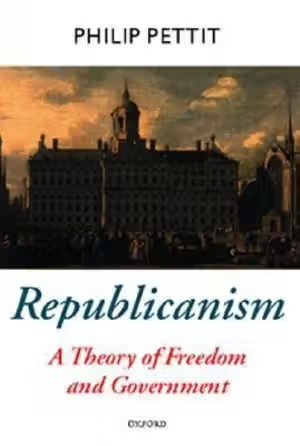
Pettit, P. (1999). Republicanism: A Theory of Freedom and Government. Oxford University Press.
Chapter Summary
The book is 328 pages and belongs to the Oxford Political Theory series. It consists of an introduction and two main parts, followed by two closing pieces. The first part traces the rise and decline of the republican conception of freedom and argues that it should again be a central political ideal; the second asks what realizing that ideal would require of policy, constitutional design, regulation and the relation between state and civil society. The listing here is the 1999 printing; the book was first published in 1997.
Introduction
The opening fourteen pages frame the project: contemporary political thought has been organized around the distinction between negative and positive liberty, and the book proposes a third, republican conception as an alternative to the liberal and communitarian theories that have dominated recent debate.
Before Negative and Positive Liberty
The chapter presents freedom as non-domination as the conception at the centre of the long republican tradition, set against freedom as non-interference and freedom as self-mastery. Republicans counted people subject to another's arbitrary will as unfree even if no interference occurred, and counted law that is not arbitrary as compatible with liberty. The chapter also describes how Hobbes introduced the non-interference conception against republican critics and how Bentham and Paley helped make it respectable.
Liberty as Non-Domination
Here the idea is defined. Interference is arbitrary when it is not forced to track the interests and ideas of those affected, and one party dominates another when it has the capacity to interfere on an arbitrary basis in some of the other's choices. Domination can exist without interference, and interference without domination. The chapter argues that the ideal is not confused, comes in degrees, and is not impossibly demanding.
Non-Domination as a Political Ideal
The chapter argues for the ideal's value by comparison with non-interference. Maximizing non-domination promotes the absence of uncertainty, of strategic deference to the powerful and of social subordination. It is treated as a primary good in Rawls's sense, best pursued by the state, and as a value to be promoted rather than a constraint, with its institutional character emphasized.
Liberty, Equality, Community
The part closes by showing that freedom as non-domination is an egalitarian good, supporting structural rather than material equality, and a communitarian good, since it can be realized for one person only in company with others in the same vulnerable groups.
Republican Aims: Causes and Policies
The second part opens with the policy content of the ideal. Republicanism offers a pluralistic language of grievance and has implications in five areas: external defence, internal protection, personal independence, economic prosperity and public life. The chapter presents it as a research programme for policy rather than a fixed blueprint.
Republican Forms: Constitutionalism and Democracy
The state must also guard against domination by government itself. The chapter treats the rule of law, the separation of powers and counter-majoritarian safeguards, then proposes a contestatory democracy, which is deliberative, inclusive and responsive, and rests on the people's ability to challenge what government does rather than on consent.
Checking the Republic
How can those who run the republic be checked, given imperfect human nature? The chapter contrasts a strategy built on controlling knaves with one built on screening for suitable agents and designing sanctions for non-knaves, and gives a central role to regard-based sanctioning through esteem and disesteem.
Civilizing the Republic
The legal republic needs republican civil norms. The chapter gives three reasons for widespread civility: people are secure in their non-domination only if others respect them for normative reasons; the republic must be sensitive to newly articulated interests; and authorities cannot detect every offence on their own.
Republicanism: A Propositional Summary; Republicanism: Once More With Hindsight
The book ends with a compact statement of the theory in propositional form (pp. 271–282) and a reflection on the argument looking back (pp. 283–305).
Key Concepts
Part I: freedom
- Freedom as non-domination: freedom understood as not being subject to another's capacity for arbitrary interference.
- Arbitrary interference: interference not forced to track the interests and ideas of those affected.
- Domination without interference: a master's mere capacity to interfere is enough to take away freedom.
- Primary good: a good that people have reason to want whatever else they want.
Part II: institutions
- Contestatory democracy: democracy defined by the people's ability to challenge government decisions, not by consent.
- Constitutionalist conditions: the rule of law, separation of powers and counter-majoritarian safeguards.
- Regard-based sanctioning: control of behaviour through esteem and disesteem working "as if by an intangible hand".
- Civility: the civic norms that make the legal republic a social reality.
Critical Analysis
Strengths
- A clear two-step design. The conceptual and historical first part is separated from the institutional second part, so a reader can assess the ideal before the policy programme built on it.
- Argument against named rivals. The chapters set non-domination against Berlin-style non-interference and self-mastery, against Hobbes, Bentham and Paley, and use Rawls's idea of a primary good; the ideal is defended by comparison.
- A worked institutional programme. The second part goes beyond the ideal to policy areas, constitutional conditions, a model of democracy, checks on officials and civic norms, and says openly that the policy results depend on empirical information.
- Aids for review. The propositional summary and the later reflection give a compact statement of the theses and a view of how the author reconsidered them.
Limitations
- The key distinction is contested. The Stanford Encyclopedia of Philosophy records the common objection that non-domination is only a more obscure way of talking about secure non-interference, with Goodin, Carter and Kramer among those cited, and arguments by Larmore and Wall that non-interference has independent value. The book should be read with that debate in view.
- A programme, not a blueprint. By its own description, the policy chapters give broad outlines that need empirical detail, so a reader wanting settled policy conclusions will find them only in outline.
- State-centred scope. The institutional account is framed around the state. Questions about global justice and migration are discussed in later work by Pettit (2010, 2012, 2014) that the Stanford Encyclopedia cites.
- Pitched against a specific debate. The opening pages take the negative/positive liberty distinction as their starting point, and the argument is conducted against liberal and communitarian theory, so readers new to those positions will need an introduction alongside.
Where It Fits in the Course
This is the course's full-length statement of a republican alternative, so it belongs after the introductions. David Miller's short introduction covers authority, democracy, freedom and social justice and gives the vocabulary; Jonathan Wolff's question-by-question introduction and Michael Sandel's case-based book give further preparation on the justification of state power and on theories of justice.
The natural partner is John Rawls's Political Liberalism, the main liberal alternative in the list: Pettit borrows the idea of a primary good from Rawls while arguing for a different ideal, so reading them together shows where republican and liberal approaches diverge. Zoopolis is a later book that extends political theory to the relation between humans and animals, and offers a contrast in subject rather than in method.
How to Use This Book
The book suits students who have completed an introductory political philosophy course and know the negative/positive liberty distinction. It is a monograph to read in order, at least through the first part.
A practical plan: read the Introduction and the next three chapters closely (about 100 pages), because everything else depends on the definition of domination and the comparison with non-interference. Then read Liberty, Equality, Community. In the second part, choose by interest: Republican Forms for democratic theory, Checking the Republic and Civilizing the Republic for institutional design. Read the propositional summary before the second part as a map and again at the end, and treat the final reflection as optional.
Useful exercises: give your own example of domination without interference and of interference without domination; state the Berlin-style non-interference reply and the chapter's answer to it; and compare the contestatory democracy with the account of democracy in a political philosophy introduction.