01 / Reading Guide
Reading Guide
Citation
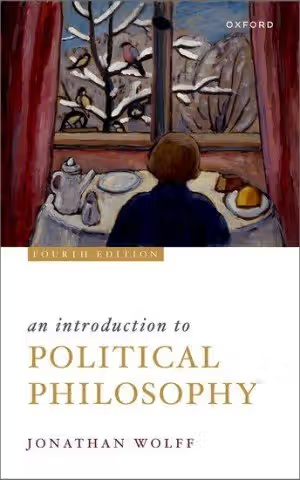
Wolff, J. (2022). An Introduction to Political Philosophy (4th ed.). Oxford University Press.
Chapter Summary
The fourth edition runs to about 256 pages: a short Introduction, six chapters, a Guide to Further Reading and an index. Each chapter is named for a question, not for a thinker. The publisher describes the book as structured around the main issues of political philosophy, introducing writings from a diverse range of thinkers. The chapter descriptions below rest on the contents list and on the publisher's blurbs for this edition and the previous one, which pose the questions each chapter takes up. The Google Books record shows that Plato, Hobbes, Locke, Rousseau, Mill, Marx, Rawls and Nozick are among the names that recur through the book, but how they are distributed among chapters is left to the reader to discover.
Introduction
About five pages (the Introduction starts on page 1 and Chapter 1 on page 6) that set up the questions the chapters take in turn.
Chapter 1: The State of Nature
Takes up the earlier-edition blurb's opening question: what would life be like without the state? It is the first chapter and one of the shorter ones, about 28 pages.
Chapter 2: Justifying the State
Asks what justifies the state. About 33 pages. The vocabulary that recurs in the book includes consent, hypothetical contract, political obligations and anarchist objections, which belong to this kind of question.
Chapter 3: Who Should Rule?
Moves from whether there should be a state to who should hold political power. The fourth-edition blurb adds the questions of what democracy is and whether it is really as attractive as it seems. At about 47 pages it is among the longest chapters.
Chapter 4: The Place of Liberty
Asks whether there are any justified limits to people's liberty and how much liberty a citizen should enjoy, about 34 pages.
Chapter 5: The Distribution of Property
Asks how property should be justly distributed. At about 48 pages it is the longest chapter. Terms in the book that fit this question include planned economy, free market, Difference Principle, maximin and original position.
Chapter 6: Justice for Everyone, Everywhere?
The last chapter, about 41 pages, was extended in the fourth edition to reflect current issues around gender identity, equal rights and oppression. In the earlier edition the corresponding chapter was titled "Individualism, Justice, Feminism" and looked at more recent issues, particularly feminist political theory. The title of this edition's chapter also points beyond a single state to justice across borders. The new edition's vocabulary adds race, disability, affirmative action and W. E. B. Du Bois.
Key Concepts
Chapters 1–2: The State and Its Justification
- State of nature: the condition imagined without political authority, used to test what a state is for.
- Hypothetical contract and consent: the idea that authority is justified if people would agree, or have agreed, to it.
- Political obligations: the question of why citizens should obey the law.
Chapters 3–4: Rule and Liberty
- Representative democracy: rule through elected representatives, one of the forms of democracy the book discusses.
- Liberty: the limits that may justifiably be placed on individual freedom.
Chapters 5–6: Property, Justice and Inclusion
- Distribution of property: how holdings should be shared out, with market, planned-economy and Rawlsian answers all in the book's vocabulary.
- Original position, Liberty Principle and Difference Principle: Rawls's device and principles for judging how a society's benefits are distributed.
- Oppression and equal rights: the themes added to the final chapter in the fourth edition.
Critical Analysis
Strengths
- A question-led structure. The six chapters correspond to six questions that a newcomer can understand without any history of ideas, and different thinkers are brought in as rival answers. The publisher presents this as the book's organising principle.
- Written to be read through. The Google Books blurb describes the combination of clarity and a conversational style, and the book is short enough, about 230 pages of main text, to be read continuously rather than dipped into.
- Revised for breadth. The publisher says the fourth edition was revised and updated to diversify the thinkers considered, the examples used and the further reading recommended, and that the final chapter was expanded to reflect current issues. The new vocabulary of race, disability and Du Bois fits that description.
- Digital study aids. The publisher notes that the digital edition includes tutorial-style videos by the author in each chapter, intended to help students understand the key questions and form their own opinions.
- A route to the primary texts. The closing Guide to Further Reading occupies about fourteen pages, which gives a path from this introduction into the writers it discusses.
Limitations
- Brief treatment of each topic. With six chapters of roughly 30 to 50 pages each, no topic is developed at length; the final chapter brings gender, race and justice across borders together in about 40 pages.
- Not a history of political thought. Because chapters are organised by question, thinkers appear where the question needs them. A reader who wants a chronological account of one thinker's whole system will need another source.
- Not a substitute for the originals. The book explains arguments; it does not replace reading Hobbes, Locke, Mill or Rawls, and the Guide to Further Reading is where the student must go next.
Where It Fits in the Course
Wolff is the continuous, single-author main text in the political philosophy course. David Miller's Political Philosophy: A Very Short Introduction is a shorter route into related questions, including why authority should be obeyed, what makes democracy valuable, how far government may limit freedom and what social justice requires. Michael Sandel's Justice starts from concrete moral and political dilemmas, presents rival theories through cases and ends by arguing for the author's own account; Wolff, by contrast, is organised around the central questions and the relation between rival answers.
Rawls's Political Liberalism and Pettit's Republicanism are specialist works that follow naturally from Wolff: Rawls's vocabulary of the original position and the Difference Principle already appears in Wolff, and Pettit's account of freedom as non-domination is a response to the debates about liberty. Zoopolis extends political theory to the status of animals and is best read after a general introduction such as Wolff's.
How to Use This Book
The book is aimed at first- and second-year students of philosophy, politics, law, economics or public policy. No prior study of philosophy is needed, though some familiarity with basic political vocabulary helps.
A practical plan:
- Read in order. The chapters build on each other: the state of nature and the justification of the state set up the questions about who should rule and how much liberty citizens should have.
- Core: Chapters 1–5, which cover the classical questions and the main theories of liberty and distribution.
- Then Chapter 6, which brings contemporary concerns into the picture and links the earlier arguments to gender, race and justice across borders.
- Use the Guide to Further Reading after each chapter to choose a primary text, for example by Hobbes, Locke, Mill or Rawls, and read a selection alongside Wolff's account.
- If the digital edition is available, use the author's videos after each chapter to check that the central question and the rival answers are clear before moving on.