01 / Reading Guide
Reading Guide
Citation
Wilkins, R., Meredith, D., & Megson, I. (Eds.). (2021). Oxford Handbook of Medical Sciences (3rd ed.). Oxford University Press.
Chapter Summary
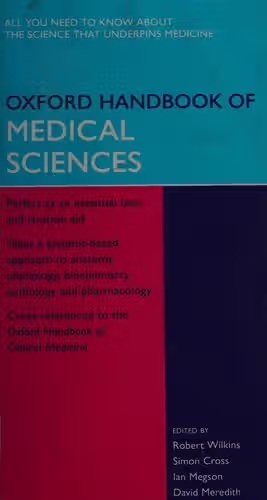
The third edition is a pocket-format handbook of about 1,000 pages (1,022 including the index, according to Harry Brown's review in Pavilion Health Today; OUP lists 1,040) in 15 chapters. Its editors, Robert Wilkins, David Meredith and Ian Megson, are biomedical scientists, and the publisher describes the book as written by biomedical scientists and clinicians to set out the scientific principles that underpin medicine. Unlike most Oxford Handbooks it is not primarily a clinical book. Chapter titles below follow the publisher's table of contents.
Chapters 1–2: Cellular structure and function; Cellular metabolism
The two opening chapters lay the groundwork: the structure and function of cells, then cellular metabolism. The publisher's description singles out this "basic cell physiology and biochemistry" as one of the book's two main components.
Chapter 3: Molecular and medical genetics
A chapter on genetics follows the cellular foundations, linking molecular genetics to its medical applications, before the book turns to the body systems.
Chapters 4–11: Nerve and muscle; Musculoskeletal system; Respiratory and cardiovascular systems; Urinary system; Digestive system; Endocrine organs; Reproduction and development; Neuroanatomy and neurophysiology
The core of the book is a systems approach. According to the publisher, each major system is treated by integrating what it calls the traditional pillars of medicine: anatomy, physiology, biochemistry, pathology and pharmacology. Nerve and muscle come first as excitable tissues; the respiratory and cardiovascular systems share a chapter; and the nervous system returns at the end of the sequence as neuroanatomy and neurophysiology.
Chapter 12: Infection and immunity
Brown's review describes this chapter, which begins on page 853, as an excellent review of infection and immunity, and notes how much immunology appears in clinical practice, from vaccination to autoimmune disease.
Chapters 13–15: Growth of tissues and organs; Medicine and society; Techniques of medical sciences
Three closing chapters widen the scope beyond the body systems: the growth of tissues and organs, medicine in its social setting, and the laboratory and investigative techniques of the medical sciences. The last of these has been part of the book since its first edition (2006).
Key Concepts
Chapters 1–3: Foundations
- Cell structure and function: the cellular basis on which the system chapters build.
- Cellular metabolism: the biochemistry of how cells obtain and use energy.
- Molecular and medical genetics: genetics from its molecular basis to its role in disease.
Chapters 4–12: Systems
- Integration of the "pillars" of medicine: anatomy, physiology, biochemistry, pathology and pharmacology studied together for each body system.
- Excitable tissues: nerve and muscle treated together before the systems that depend on them.
- Infection and immunity: host defence and its clinical relevance.
Chapters 13–15: Wider Context
- Growth of tissues and organs: how tissues and organs grow.
- Medicine and society: the social setting of medical practice.
- Techniques of medical sciences: the methods by which the medical sciences are investigated.
Critical Analysis
Strengths
- Integrated by system. The publisher's description stresses that anatomy, physiology, biochemistry, pathology and pharmacology are brought together for each system rather than taught as separate subjects. For students in integrated, systems-based curricula, this matches the way their teaching is organised.
- Cross-referenced to the clinical handbooks. The publisher states that the book is cross-referenced to the Oxford Handbook of Clinical Medicine, the Oxford Handbook of Clinical Specialities and the Oxford Handbook of Practical Drug Therapy, which makes it easy to move from a scientific principle to its clinical use.
- Useful beyond the preclinical years. Brown, a retired general practitioner, judged it useful to medical students in their preclinical and clinical years and an excellent refresher for doctors wishing to update half-remembered basic science. The publisher likewise presents it as an introduction for medical students and biomedical scientists and a refresher for junior doctors.
- Portable and illustrated. Brown notes that it has the size and vinyl cover of other Oxford Handbooks, and the publisher describes it as thoroughly illustrated.
Limitations
- Dense rather than short. Brown calls it fairly thick for a handbook. Fifteen chapters covering about 1,000 pages means each system chapter is long, and the handbook format favours compact presentation over extended explanation.
- A companion rather than a course text. As a handbook spanning every preclinical subject, it cannot give any one subject the depth of a dedicated textbook; a student learning physiology or biochemistry for the first time will need the main texts for those subjects.
- Scientific rather than clinical. Readers who want clinical diagnosis and management need the clinical handbooks to which it is cross-referenced, or the clinical texts in this course.
Where It Fits in the Course
The other books in this course list are clinical. Macleod's Clinical Examination teaches history-taking and physical examination, and Clinical Medicine: Lecture Notes is a concise guide for students starting on the wards. Davidson's Principles and Practice of Medicine is the one-volume textbook of internal medicine, while Harrison's Principles of Internal Medicine and Goldman-Cecil Medicine are large multi-volume references.
The Oxford Handbook of Medical Sciences sits underneath all of them: it covers the cellular, genetic and system-level science that those books assume. It is most useful in the preclinical years and at the transition to clinical study, when students begin to read Macleod or the Lecture Notes and need to look up the physiology or pharmacology behind a clinical finding. Davidson also opens with the scientific principles of medicine, so the handbook works well as a more detailed bridge between preclinical teaching and Davidson's clinical chapters. Later, the handbook remains a quick source for reviewing basic science behind a topic met in the large references.
How to Use This Book
The handbook is for medical students, biomedical science students and doctors who want the basic science of medicine in one portable volume. The publisher states no prerequisites; it is best used alongside, not instead of, the main textbooks of a preclinical course.
A practical plan:
- Start with Chapters 1–3. The cellular and genetic foundations are referred to throughout the system chapters, so read them early in a medical course.
- Read system chapters with the matching teaching block. Chapters 4–11 can be taken in the order of the curriculum: read the cardiovascular and respiratory material during that block, for example, and use the integrated presentation to connect what separate lectures teach.
- Use Chapter 12 with microbiology and immunology teaching, and as a revision source later, as Brown suggests.
- Dip into Chapters 13–15 as needed. They are useful for project work, laboratory practicals and courses on medicine in society.
On the wards and in revision, use the handbook as a reference: when a clinical book mentions a mechanism, look it up here, and follow the cross-references to the Oxford clinical handbooks to see how the science is applied. Keep the main subject textbooks for first learning and use the handbook for consolidation and quick review.