01 / Reading Guide
Reading Guide
Citation
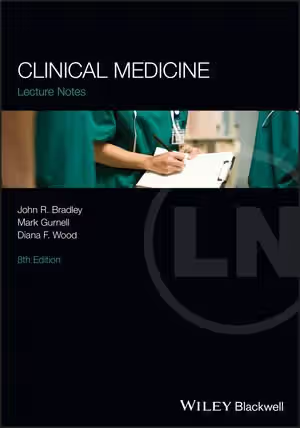
Bradley, J. R., Gurnell, M., & Wood, D. F. (2018). Clinical Medicine: Lecture Notes (8th ed.). Wiley-Blackwell.
Chapter Summary
The eighth edition has 464 pages in two parts: nine chapters on clinical examination (about 85 pages) and thirteen chapters on clinical medicine by specialty (about 330 pages), with prefaces to the eighth and first editions. The three authors are consultant physicians and medical educators at the University of Cambridge School of Clinical Medicine. Wiley describes summary boxes and evidence-based medicine boxes for revision, OSCE summaries and full-colour illustrations, and states that Part 2 concentrates on common diseases while also giving accounts of rare ones.
Part 1: Clinical Examination
Chapter 1: The medical interview
The sample chapter treats communication as a set of skills that can be taught, learned and assessed, grouped as content, process and perceptual skills. It follows the Calgary–Cambridge model of the consultation (initiating the session, gathering information from both biomedical and patient perspectives, physical examination, explanation and shared planning, closing), with boxed checklists for each stage and for breaking bad news. It ends with how communication is assessed in OSCEs, the MRCP PACES examination and workplace-based assessments, with practical advice for OSCE stations and Kolb's experiential learning cycle.
Chapters 2–8: General examination; Cardiovascular system; Respiratory system; The abdomen; Neurological system; Endocrinology and metabolism; Musculoskeletal system
A general examination chapter is followed by the examination of each system. The neurological chapter is the longest of the group, about twenty pages.
Chapter 9: Assessment
A ten-page chapter titled Assessment closes Part 1, after the examination of the individual systems.
Part 2: Clinical Medicine
Chapters 10–14: Cardiovascular disease; Respiratory disease; Gastroenterology; Liver disease; Renal disease
The specialty chapters begin with the heart, lungs, gut, liver and kidneys; cardiovascular disease is the longest of these at nearly forty pages.
Chapters 15–17: Neurology; Endocrine disorders; Metabolic disorders
Neurology (about forty pages) is followed by endocrine disorders and a long chapter, over forty pages, on metabolic disorders.
Chapters 18–22: Rheumatology; Dermatology; Haematology; Infectious diseases; Toxicology
Rheumatology (over forty pages) and dermatology (about thirty) are long chapters; haematology, infectious diseases and toxicology close the book in much shorter ones.
Key Concepts
Part 1: Clinical Examination
- Calgary–Cambridge model: a structured, patient-centred framework for the consultation, from initiating the session to closing it.
- Content, process and perceptual skills: what the doctor communicates, how, and what the doctor is thinking.
- Patient's perspective: the patient's own ideas about the illness, gathered alongside the biomedical history.
- Shared decision-making: planning management jointly with the patient.
- OSCE: the objective structured clinical examination used to assess clinical and communication skills.
Part 2: Clinical Medicine
- System-by-system medicine: the major diseases of each specialty, set out after the matching examination chapter.
- Common versus rare conditions: an emphasis on common diseases, with shorter accounts of rare ones.
- Evidence-based medicine boxes: summaries of the evidence behind practice, used for revision.
Critical Analysis
Strengths
- Examination and medicine in one book. The two-part structure lets a student learn to examine a system in Part 1 and then read about its diseases in Part 2, in a single book of under 500 pages.
- Communication taught explicitly. The opening chapter is built on a published consultation model, uses tables and checklists for each stage, covers breaking bad news, and links skills to the way they are examined.
- Assessment-oriented. OSCE summaries, summary boxes and evidence-based medicine boxes support revision, and the sample chapter gives concrete advice for examination stations.
- Authors who teach. The three authors combine consultant practice with roles in medical education at Cambridge.
- Generous space for some specialties. Rheumatology, metabolic disorders and dermatology together take well over a hundred pages.
Limitations
- Short examination section. Part 1 has about eighty-five pages, and the examination chapters for individual systems run from six to twenty pages, much less than a dedicated clinical examination book gives.
- Uneven Part 2 coverage. Haematology, infectious diseases and toxicology have only twelve to sixteen pages each, so these topics need a fuller source.
- Dated edition. Published in 2018, the eighth edition predates more recent treatment guidance; management details should be checked against current guidelines.
- UK context. The authors are based in Cambridge and the assessments discussed (OSCEs, MRCP PACES, workplace-based assessment) follow UK training.
Where It Fits in the Course
This is one of two introductory books for the clinical medicine course. Macleod's Clinical Examination is the other, a dedicated guide to history taking and physical examination with photographs, diagrams and online videos of examination routines. Macleod's is the better choice for learning to examine; Bradley, Gurnell and Wood adds a concise account of the diseases of each system, so the two work well together, with Macleod's on examination technique and this book for what the findings mean.
Davidson's Principles and Practice of Medicine is the one-volume textbook of internal medicine and a natural next step, with presenting problems, investigations and management for every specialty. Harrison's Principles of Internal Medicine and Goldman-Cecil Medicine are comprehensive multi-volume references for detailed questions. The Oxford Handbook of Medical Sciences covers the scientific foundations (anatomy, physiology, biochemistry, pharmacology, pathology) on which clinical medicine builds and suits revision of the basic sciences.
How to Use This Book
Wiley addresses the book to medical students and junior doctors, both for building knowledge for clinical practice and for refreshing it before examinations. Preclinical anatomy, physiology and pathology are the natural background.
A practical plan:
- Start with Chapters 1 and 2 before the first clinical attachment, and practise the consultation model with simulated patients or classmates.
- Pair each examination chapter with its disease chapter. Read Chapter 3 with Chapter 10, Chapter 4 with Chapter 11, Chapter 5 with Chapters 12–14, Chapter 6 with Chapter 15, Chapter 7 with Chapters 16–17 and Chapter 8 with Chapter 18.
- Follow the placement. Read the Part 2 chapter that matches the current firm, then examine patients with its conditions.
- Revise with the boxes. Use the summary boxes, evidence-based medicine boxes and OSCE summaries in the weeks before examinations.
- Check management against current guidance and go to a larger medicine textbook for topics with short chapters, such as haematology and infectious diseases.