01 / Reading Guide
Reading Guide
Citation
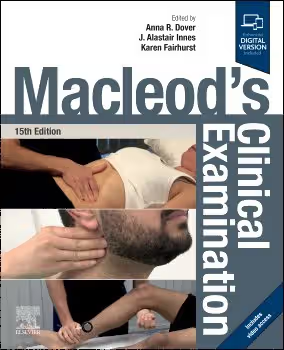
Dover, A. R., Innes, J. A., & Fairhurst, K. (Eds.). (2023). Macleod's Clinical Examination (15th ed.). Elsevier.
Chapter Summary
The fifteenth edition, published fifty years after the first, is an edited book of about 440 pages: the three editors, from Edinburgh, write the general chapters, and specialist contributors write the system chapters. Twenty-two chapters are arranged in four sections. A preliminary note on how to use the book explains that every systems chapter in Sections 2 and 3 follows the same order: an introduction to the relevant anatomy and physiology; the history (common presenting symptoms, what to ask and how to follow it up); the physical examination; investigations (how to choose the most informative initial tests and how they clarify the diagnosis); a couple of short OSCE-style scenarios; and an integrated examination sequence as a prompt and revision aid. Techniques are set out under red "Examination sequence" headings that give the exact order of steps, and 32 videos demonstrate the main routines.
Section 1: Principles of Clinical History and Examination (Chapters 1–3)
"Managing clinical encounters with patients", "General aspects of history taking" and "General aspects of examination" set out the foundations: how to conduct an encounter with a patient, how to structure a history, and the general examination that precedes the examination of any one system.
Section 2: System-Based Examination (Chapters 4–14)
The core of the book, one chapter per system: "The cardiovascular system", "The respiratory system", "The gastrointestinal system", "The nervous system", "The visual system", "The ear, nose and throat", "The endocrine system", "The reproductive system", "The renal system", "The musculoskeletal system", and "The skin, hair and nails". The cardiovascular, nervous system and musculoskeletal chapters are the longest. The video list shows what is demonstrated for these systems, for example motor and sensory examination of the limbs and hand, examination of several cranial nerves, of the ear, neck and thyroid, gynaecological and obstetric examination, the GALS screen and examination of the spine and each major joint.
Section 3: Applying History and Examination Skills in Specific Situations (Chapters 15–19)
"Babies and children", "Patients with mental illness and learning disability", "The frail patient", "The deteriorating patient" and "The dying patient": adaptations of the core method to particular groups and circumstances. The video list includes the Timed Up and Go test, used in assessing frailty.
Section 4: Putting History and Examination Skills to Use (Chapters 20–22)
"Reaching and communicating a diagnosis", "Adapting skills for practice" and "Preparing for assessment" close the book by turning findings into a differential diagnosis, discussing how the skills are used in practice, and preparing students for clinical examinations.
Key Concepts
Sections 1–2: The Core Method
- Clinical encounter: the structured meeting with a patient within which history and examination take place.
- History taking: eliciting presenting symptoms, asking the right questions and following up the answers for each system.
- Examination sequence: a fixed order of steps for examining a system, given in the book as a checklist and shown in videos.
- Physical basis of signs: the publisher stresses that the book explains why clinical signs arise, linked to the anatomy and physiology at the start of each chapter.
- Initial investigations: choosing the first tests that best clarify the diagnosis for each system.
Sections 3–4: Applying the Skills
- Adapted assessment: modifying history and examination for children, people with mental illness or learning disability, frail, deteriorating and dying patients.
- Differential diagnosis: moving from findings to a reasoned list of possible diagnoses and explaining it to the patient.
- Assessment preparation: readiness for OSCEs and other clinical examinations.
Critical Analysis
Strengths
- A consistent template. Every systems chapter follows the same sequence from anatomy and physiology to history, examination, investigations, OSCE examples and an integrated sequence. Once a student has worked through one chapter, every other chapter can be navigated the same way.
- Procedure made explicit. The red-headed examination sequences give the order of steps exactly, and 32 videos demonstrate key routines; among them are motor and sensory examination of the limbs, cranial nerve, ear, neck and thyroid examinations, gynaecological and obstetric examination, and the musculoskeletal examinations joint by joint. The publisher notes that many videos are new or revised for this edition in line with current guidance.
- Beyond the routine examination. Section 3 gives whole chapters to children, mental illness and learning disability, frailty, the deteriorating patient and the dying patient, situations in which a standard system examination is not enough. Section 4 adds diagnosis, communication and assessment preparation.
- Written by practising specialists. Each systems chapter is written by clinicians in that field, while the editors write the general chapters, which keeps the specialist content current within a single framework.
Limitations
- Breadth over depth on disease. The book teaches how to elicit and interpret symptoms and signs and which initial tests to choose; it does not cover the management of the diseases those findings point to, for which a medicine or surgery textbook is needed.
- Size. At more than 400 pages it is too long to read through before a first clinical attachment; students will want to work through it system by system, alongside their placements.
- UK framing. The editors and contributors are largely based in Edinburgh, and the publisher lists MRCP (UK) PACES among the examinations it supports; readers training elsewhere should check local conventions for examination routines and assessment formats.
Where It Fits in the Course
This is the clinical skills text of the course and the natural companion to the books on disease. Clinical Medicine: Lecture Notes by Bradley, Gurnell and Wood is a concise guide for students starting on the wards, also organized around history, examination and diagnosis by system; it links findings to the underlying diseases without encyclopaedic detail, while Macleod's sets out the examination techniques step by step. Davidson's Principles and Practice of Medicine, from the same Edinburgh tradition, explains disease and its management system by system, so a chapter of Macleod's followed by the matching chapter of Davidson's takes a student from the sign to the diagnosis and treatment. Harrison's Principles of Internal Medicine and Goldman-Cecil Medicine are the large reference works for detailed questions, and the Oxford Handbook of Medical Sciences revises the basic science that Macleod's summarizes at the start of each chapter.
How to Use This Book
The publisher addresses the book to medical students, junior doctors preparing for postgraduate clinical examinations, nurse practitioners, and paramedics; basic anatomy and physiology are enough to begin, and no clinical experience is assumed.
A practical plan:
- Before the wards: read Section 1 (Chapters 1–3) in full; it sets the framework for every encounter.
- System by system: before each clinical attachment or skills session, read the relevant systems chapter, watch its videos, and practise the examination sequence on a colleague until it can be done without notes. The cardiovascular, respiratory, gastrointestinal and nervous system chapters come first for most courses.
- On placement: after seeing a patient, return to the chapter to check what you missed in the history, which signs you should have looked for, and which initial investigations the book recommends.
- Specific situations: read Section 3 chapters when you meet those patients, for example the chapter on children during a paediatric attachment.
- Before examinations: use the OSCE examples and integrated sequences in each chapter, together with Chapter 22, for revision, and Chapter 20 to practise presenting a differential diagnosis.
Pair Macleod's with a textbook of medicine so that each finding is connected to the disease that causes it.