01 / Reading Guide
Reading Guide
Citation
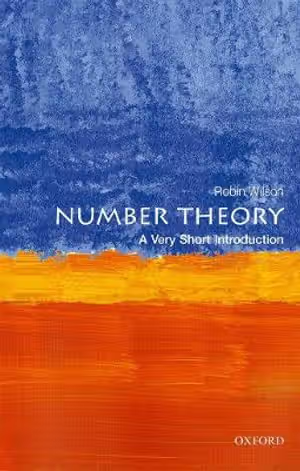
Wilson, R. (2020). Number Theory: A Very Short Introduction. Oxford University Press.
Chapter Summary
The book is a pocket-sized volume in Oxford's Very Short Introductions series: nine chapters on about 150 pages, followed by a short further-reading list and an index. A list of 36 illustrations, from portraits of Euclid, Fermat, Euler and Gauss to graphs of the prime-counting function, shows how much of the exposition is carried by pictures and examples. The publisher describes the book as an introduction to the main areas of classical number theory, ancient and modern, set in historical context.
Chapter 1: What is number theory?
The opening chapter poses a string of questions that the book will answer. They include in which years February has five Sundays, what is special about 4,294,967,297, how many whole-number right-angled triangles have a side of length 29, and how many eggs satisfy given remainders. Others ask how many shuffles restore a pack of cards, how primes keep credit cards secure, and what the Riemann hypothesis is. The chapter introduces the integers, squares and right-angled triangles, with the founding figures Euclid, Fermat, Euler and Gauss.
Chapter 2: Multiplying and dividing
Divisibility, the division rule, greatest common divisors (illustrated with gears and with the life cycle of periodical cicadas), patterns such as sums of odd numbers and squares of odd numbers, and casting out nines.
Chapter 3: Prime-time mathematics
Factorization into primes, Mersenne primes and the search for record primes, and a link between primes and the construction of regular polygons.
Chapter 4: Congruences, clocks, and calendars
Modular arithmetic presented through 12-hour and 7-day clocks, with calendar questions of the kind raised in Chapter 1.
Chapter 5: More triangles and squares
Diophantine equations, from linear equations such as 2x + 3y = 13 to the questions about triangles and squares promised by the chapter title. The chapter includes Bachet's edition of Diophantus's Arithmetica and Wiles's proof of Fermat's Last Theorem.
Chapter 6: From cards to cryptography
Results on powers and remainders, illustrated by necklaces of beads and card shuffling, leading to public-key cryptography, which the publisher links to an eighteenth-century result on primes.
Chapter 7: Conjectures and theorems
The distribution of primes, comparing the prime-counting function π(x) with x/log x, together with famous conjectures and theorems about primes.
Chapter 8: How to win a million dollars
Riemann's 1859 paper, the zeta function and the location of its zeros in the complex plane: the Riemann hypothesis, the problem behind the chapter's title and the million dollars promised in Chapter 1.
Chapter 9: Aftermath
A short closing chapter after the Riemann hypothesis, before the further-reading list.
Key Concepts
Chapters 1–3: Foundations
- Divisibility and greatest common divisor: the basic relations between whole numbers and how to compute common factors.
- Prime factorization: every whole number is built from primes, the "building blocks" in the publisher's phrase.
- Mersenne primes: primes of the form 2ⁿ − 1, the source of record-breaking primes.
Chapters 4–6: Congruences, equations and codes
- Congruences: arithmetic of remainders, modelled on clocks and calendars.
- Diophantine equations: equations to be solved in whole numbers, from linear equations to Fermat's Last Theorem.
- Public-key cryptography: secure codes based on properties of primes.
Chapters 7–8: Primes at large
- Prime-counting function π(x): the number of primes up to x, approximated by x/log x.
- Riemann hypothesis: the conjecture about the zeros of the zeta function that governs the fine distribution of the primes.
Critical Analysis
Strengths
- Questions first. Chapter 1 opens with concrete puzzles about calendars, eggs, birds and cards, and the rest of the book develops the theory needed to answer them. This makes it an inviting first look at the subject.
- History as the thread. The publisher stresses that Wilson, a historian of mathematics, places problems in their historical setting, drawing on Euclid, Fermat, Euler and Gauss. Illustrations such as Bachet's Arithmetica, Riemann's 1859 paper and commemorative stamps support this.
- Reaches modern topics. Within 150 pages the book goes from divisibility to public-key cryptography, Wiles's proof of Fermat's Last Theorem and the Riemann hypothesis.
- Short and self-contained. The series format and the brief further-reading list make it easy to read in a few sittings before or during a course.
Limitations
- An overview, not a course text. The book has no exercise sets in its contents and cannot replace a textbook for students who must prove theorems themselves.
- Breadth over depth. Topics such as quadratic reciprocity, primitive roots, continued fractions or algebraic number theory do not appear among the chapter titles. Major results such as Wiles's proof and the prime number theorem can only be described, not proved, at this length.
- Little guidance for continued study. The further-reading list runs to two pages, so students will need course reading lists to choose their next book.
Where It Fits in the Course
Wilson's book is the orientation volume in this number theory list. It can be read in a few evenings before a course starts, or alongside the first weeks, to see where the subject is going. The natural next book is Joseph Silverman's A Friendly Introduction to Number Theory, which works through many of the same themes (Pythagorean triples, primes, congruences, RSA, Fermat's Last Theorem) with exercises and proofs. David Burton's Elementary Number Theory and Kraft and Washington's An Introduction to Number Theory with Cryptography are fuller course textbooks, the latter with cryptography at the centre.
Ireland and Rosen's A Classical Introduction to Modern Number Theory and Hardy and Wright's An Introduction to the Theory of Numbers are for much later, after a first course. Wilson's chapters on the distribution of primes and the Riemann hypothesis give a first sense of the analytic questions that those books, and Hardy and Wright in particular, treat in depth.
How to Use This Book
The book is written for general readers as well as students, assuming only school arithmetic and algebra. It suits prospective mathematics students, students in other fields curious about primes and cryptography, and anyone about to start a number theory course.
- Read it straight through. The chapters follow a single path from divisibility in Chapter 2 through primes, congruences, equations and cryptography to the distribution of primes, so reading in order is the natural approach.
- Try the Chapter 1 questions first. Attempt each puzzle before reading on, then check which chapter answers it.
- Keep a pencil handy. Work the small numerical examples (greatest common divisors, remainders on clocks, small Diophantine equations) as they appear.
- Then move to a textbook. After finishing, start Silverman's book or the course text, and return to Wilson's historical chapters for context when the same topics come up.
- Use the further-reading list as a starting point for books on the history of the subject and on the Riemann hypothesis.