01 / Reading Guide
Reading Guide
Citation
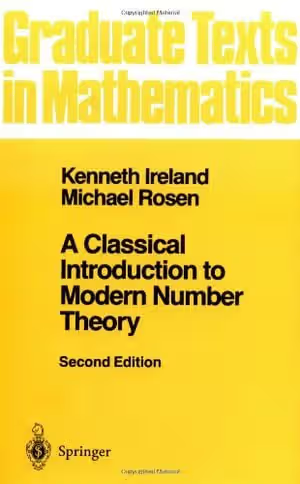
Ireland, K., & Rosen, M. (1990). A Classical Introduction to Modern Number Theory (2nd ed.). Springer.
Chapter Summary
The second edition of this Graduate Texts in Mathematics volume has 20 chapters. Springer describes it as bridging the gap between elementary number theory and the systematic study of advanced topics, requiring only a familiarity with basic abstract algebra, stressing historical development and covering significant results with comparatively elementary proofs. The second edition corrected the first and added two chapters: a complete proof of the Mordell-Weil theorem for elliptic curves over the rationals, and an overview of recent progress on the arithmetic of elliptic curves.
Chapters 1–4: Unique Factorization; Applications of Unique Factorization; Congruence; The Structure of U(ℤ/nℤ)
The opening chapters set up the elementary toolkit: unique factorization and its consequences, then congruences and the structure of the unit group modulo n. Chapter 2 builds explicitly on the importance of prime numbers established in Chapter 1.
Chapters 5–6: Quadratic Reciprocity; Quadratic Gauss Sums
Chapter 5 takes up the quadratic reciprocity law, the first of the reciprocity laws in the book, and Chapter 6 treats quadratic Gauss sums.
Chapters 7–8: Finite Fields; Gauss and Jacobi Sums
Chapter 7 covers finite fields, and Chapter 8 treats Gauss and Jacobi sums.
Chapter 9: Cubic and Biquadratic Reciprocity
Chapter 9 continues from the quadratic reciprocity of Chapter 5 to cubic and biquadratic reciprocity.
Chapters 10–11: Equations over Finite Fields; The Zeta Function
These chapters study equations over finite fields and then the zeta function, the part of the book that leads toward the geometric ideas of modern number theory.
Chapters 12–14: Algebraic Number Theory; Quadratic and Cyclotomic Fields; The Stickelberger Relation and the Eisenstein Reciprocity Law
Chapter 12 gives the general theory of algebraic number fields and their rings of integers. Chapter 13 then considers two classes of fields studied by Gauss, Eisenstein, Kummer and Dirichlet in connection with quadratic forms, higher reciprocity and Fermat's Last Theorem. Chapter 14 proves two important theorems about cyclotomic fields named in its title.
Chapters 15–16: Bernoulli Numbers; Dirichlet L-functions
Chapter 15 introduces the sequence of rational numbers discovered by Jacob Bernoulli, and Chapter 16 treats Dirichlet L-functions.
Chapter 17: Diophantine Equations
The chapter applies the earlier machinery to Diophantine equations.
Chapters 18–19: Elliptic Curves; The Mordell-Weil Theorem
Chapter 18 brings many of the book's themes together in the arithmetic of elliptic curves. Chapter 19, new in the second edition, proves the Mordell-Weil theorem over the rationals.
Chapter 20: New Progress in Arithmetic Geometry
Also new in the second edition, a survey of the dramatic developments in arithmetic geometry in the 1980s, in which problems once thought inaccessible were resolved.
Key Concepts
Chapters 1–9: Elementary theory and reciprocity
- Unique factorization: the starting point and the subject of two chapters.
- Quadratic, cubic and biquadratic reciprocity: the reciprocity laws of Chapters 5 and 9.
- Gauss and Jacobi sums: the tools developed in Chapters 6 and 8.
- Finite fields: the subject of Chapter 7.
Chapters 10–20: Zeta functions, algebraic number theory and elliptic curves
- Zeta function of equations over finite fields: Chapters 10–11.
- Algebraic number fields, cyclotomic fields, Stickelberger relation, Eisenstein reciprocity: Chapters 12–14.
- Bernoulli numbers and Dirichlet L-functions: Chapters 15–16.
- Elliptic curves and the Mordell-Weil theorem: Chapters 18–19.
Critical Analysis
Strengths
- History as an organizing thread. Springer stresses historical development throughout, and the chapter titles trace a path from the reciprocity laws and Gauss and Jacobi sums to zeta functions, cyclotomic fields and elliptic curves.
- Accessible entry to modern ideas. Fernando Gouvêa, reviewing the second edition (MathDL, January 2006), calls it his go-to book for a student who wants an advanced independent study project in number theory, ideal for readers who have taken elementary number theory and a standard abstract algebra course. Mathematical Reviews, in a comment quoted by Springer, calls it a unique and valuable contribution among recent books that restore a sense of history to number theory.
- Elementary proofs and exercises. The publisher describes comparatively elementary proofs of significant results (some new), an extensive bibliography and many challenging exercises.
- Two additions in the second edition. The Mordell-Weil theorem and the closing survey bring the book to the research frontier of its time.
Limitations
- Dated closing survey. Chapter 20 surveys the developments of the 1980s, so later results lie outside the book.
- Not a first course. Springer lists basic abstract algebra as the prerequisite, but the book is a Graduate Texts in Mathematics volume with challenging exercises, and readers with no elementary number theory will want a gentler book first.
- Selected topics. The chapters are organized around reciprocity, finite fields, zeta functions and elliptic curves; the contents list has no general treatment of analytic number theory beyond Dirichlet L-functions.
Where It Fits in the Course
This is the modern-algebraic book in the number theory list. A first course comes before it: Joseph Silverman's A Friendly Introduction to Number Theory and David Burton's Elementary Number Theory teach the elementary material, and Kraft and Washington add cryptography. Robin Wilson's Number Theory: A Very Short Introduction is a quick overview. Hardy and Wright's An Introduction to the Theory of Numbers covers elementary and analytic number theory with a chapter on elliptic curves in its sixth edition; Ireland and Rosen go further into the algebraic and arithmetic-geometric side, and the two are complementary rather than substitutes.
How to Use This Book
The book suits advanced undergraduates and beginning graduate students who have taken elementary number theory and a first abstract algebra course covering groups, rings and fields.
- Core: Chapters 1–9 and 12–14 form a coherent course on reciprocity laws and algebraic number fields. Chapters 7–8 supply the finite-field and character-sum tools used later.
- Optional extensions: Chapters 10–11 (zeta functions) and 15–16 (Bernoulli numbers, Dirichlet L-functions) can be taken independently of each other, and Chapters 17–20 form a path toward elliptic curves.
- Practice: work the exercises, which Springer describes as challenging, and use Chapter 20 as a reading list for what lies beyond the book.