01 / Reading Guide
Reading Guide
Citation
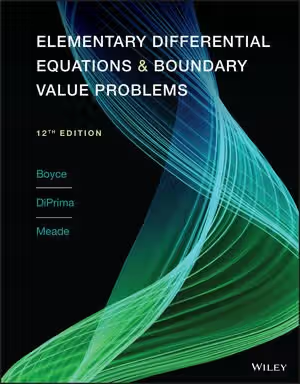
Boyce, W. E., DiPrima, R. C., & Meade, D. B. (2021). Elementary Differential Equations and Boundary Value Problems (12th ed.). Wiley.
Chapter Summary
The twelfth edition has eleven chapters and about 640 pages. Chapters 1–9 cover ordinary differential equations and Chapters 10–11 cover partial differential equations and boundary value problems. Answers to problems are at the back. Douglas Meade prepared this revision; both original authors are deceased. According to the publisher, it adds concept-check questions to every end-of-chapter problem set and worksheets for each section. The preface says the general structure is unchanged from the previous edition. Wiley describes the chapters as self-contained, so instructors can choose their selection, order and depth.
Chapter 1: Introduction
Two models, a falling object and a population of field mice preyed on by owls, introduce direction fields and equilibrium solutions. The chapter then solves some simple equations and classifies differential equations by type and order. Three short historical sections run from Newton, Leibniz and the Bernoullis to recent computational advances, and the chapter discusses how to use software for graphing and numerical work.
Chapter 2: First-Order Differential Equations
Linear equations with integrating factors, separable equations, modelling with first-order equations, differences between linear and nonlinear equations, autonomous equations and population dynamics, exact equations, Euler's method, the existence and uniqueness theorem, and first-order difference equations.
Chapter 3: Second-Order Linear Differential Equations
Homogeneous equations with constant coefficients, the Wronskian, complex and repeated roots of the characteristic equation, reduction of order, undetermined coefficients and variation of parameters. The chapter ends with mechanical and electrical vibrations and forced periodic vibrations.
Chapter 4: Higher-Order Linear Differential Equations
The general theory of nth-order linear equations, and the constant-coefficient, undetermined-coefficient and variation-of-parameters methods extended from Chapter 3.
Chapter 5: Series Solutions of Second-Order Linear Equations
After a review of power series, the chapter finds series solutions near ordinary points and, after Euler equations, near regular singular points. It ends with Bessel's equation.
Chapter 6: The Laplace Transform
The definition of the transform, its use for initial value problems, step functions and discontinuous forcing, impulse functions and the convolution integral.
Chapter 7: Systems of First-Order Linear Equations
The chapter opens with a review of matrices, linear algebraic systems, eigenvalues and eigenvectors. It then develops the basic theory of linear systems and constant-coefficient homogeneous systems, with complex and repeated eigenvalues, fundamental matrices and nonhomogeneous systems.
Chapter 8: Numerical Methods
The Euler (tangent line) method and its improvements, the Runge–Kutta method, multistep methods, numerical methods for systems, and a further discussion of errors and stability.
Chapter 9: Nonlinear Differential Equations and Stability
The phase plane for linear systems, autonomous systems and stability, and locally linear systems. Applications to competing species and predator–prey equations follow. The chapter covers Liapunov's second method and periodic solutions and limit cycles, and closes with chaos and strange attractors in the Lorenz equations.
Chapter 10: Partial Differential Equations and Fourier Series
Two-point boundary value problems lead to Fourier series, the Fourier convergence theorem and even and odd functions. Separation of variables is then applied to heat conduction in a rod and other heat problems, the wave equation for a vibrating string, and Laplace's equation. Two appendices follow the chapter.
Chapter 11: Boundary Value Problems and Sturm–Liouville Theory
Two-point boundary value problems revisited, Sturm–Liouville problems (regular, nonhomogeneous and singular), a Bessel series expansion as a further example of separation of variables, and series of orthogonal functions with mean convergence.
Key Concepts
Chapters 1–2: Foundations and first-order equations
- Direction field: a plot of short tangent segments showing how solutions behave without solving the equation.
- Integrating factor: the multiplier that turns a linear first-order equation into an exact derivative.
- Autonomous equation and equilibrium: an equation without explicit time dependence, analysed through its equilibrium solutions.
- Existence and uniqueness theorem: conditions under which an initial value problem has exactly one solution.
Chapters 3–5: Linear equations of higher order
- Characteristic equation: the algebraic equation whose roots give solutions of constant-coefficient linear equations.
- Wronskian: the determinant used to test whether solutions are linearly independent.
- Undetermined coefficients and variation of parameters: the two methods for nonhomogeneous equations.
- Regular singular point: a point where series solutions need a modified form, as in Bessel's equation.
Chapters 6–8: Transforms, systems and numerical methods
- Laplace transform: converts initial value problems, including discontinuous and impulsive forcing, into algebra.
- Eigenvalue method for systems: solutions of constant-coefficient linear systems from eigenvalues and eigenvectors.
- Runge–Kutta and multistep methods: numerical schemes more accurate than Euler's method.
Chapters 9–11: Stability, PDEs and boundary value problems
- Phase plane and local linearization: classifying equilibria of nonlinear systems through their linear approximations.
- Liapunov's second method: proving stability with an energy-like function.
- Fourier series and separation of variables: the route to solving the heat, wave and Laplace equations.
- Sturm–Liouville problem: an eigenvalue problem whose eigenfunctions form an orthogonal set.
Critical Analysis
Strengths
- Applied but theoretically sound. The publisher describes the viewpoint as that of the applied mathematician. It combines an exposition of the elementary theory that is sound but not abstract with methods of solution, analysis and approximation. Existence and uniqueness, the Wronskian, Liapunov's method and Sturm–Liouville theory sit alongside solution techniques.
- Problems that ask for conclusions. The preface stresses that the solution is not an end in itself. Many problems ask students to draw conclusions about the solution, such as long-term behaviour or how a parameter changes it. Instructors can assign as many of these as the course goals require.
- Flexible use of technology. The preface and publisher say the book suits courses with anything from no computing to intensive computing. Problems that ask for a "sketch" are meant to be done by hand, and Chapter 1 discusses using freely available graphing tools.
- Broad coverage with modelling throughout. Population dynamics, vibrations, competing species, predator–prey models, the Lorenz equations and heat and wave problems are all in the contents. The historical sections in Chapter 1 and the biographical footnotes place the subject in context.
Limitations
- Long and comprehensive. At about 640 pages and eleven chapters, the book contains more than a one-semester course can cover. Students need a plan for what to skip.
- Linear algebra arrives late and briefly. Matrices, eigenvalues and eigenvectors are reviewed within Chapter 7. The publisher notes that some familiarity with matrices helps; students with no linear algebra will find that chapter dense.
- Some support is outside the book. Solutions to selected problems are in a separate Student Solutions Manual. Interactive GeoGebra figures and many of the additional assignable problems belong to the WileyPLUS online course.
- Little change from the previous edition. The preface describes the revisions as minor, so earlier editions differ mainly in problems and presentation.
Where It Fits in the Course
Boyce, DiPrima and Meade is the standard comprehensive first course in this list. Jiří Lebl's free Notes on Diffy Qs is the closest alternative. Its author describes it as a drop-in replacement for Boyce and DiPrima and keys its sections to them, so the two can be used side by side. Lebl is free and aimed at engineers, and Boyce offers more examples, problems and topics such as series solutions near singular points, Liapunov's method and Sturm–Liouville theory.
After this book, Hirsch, Smale and Devaney's Differential Equations, Dynamical Systems, and an Introduction to Chaos develops the qualitative, dynamical-systems view that Boyce's Chapter 9 introduces. Arrowsmith and colleagues' Dynamical Systems: Differential Equations, Maps, and Chaotic Behaviour goes further into maps and chaos. Brock and Malliaris's Differential Equations, Stability, and Chaos in Dynamic Economics applies the same stability ideas to economic models.
How to Use This Book
The book is written for undergraduates in mathematics, science and engineering taking a first course in differential equations. The stated prerequisite is a working knowledge of calculus from a normal two- or three-semester sequence. Some familiarity with matrices helps for the chapters on systems.
- One-semester ODE course: Chapters 1–3 are the core, with Sections 2.7–2.9 and the vibrations sections chosen as time allows. Add Chapter 6 (Laplace transform) and Chapter 7 (systems), and finish with the first sections of Chapter 9 on the phase plane and stability.
- Optional or second-course material: Chapter 4 extends Chapter 3 directly. Chapter 5 on series solutions and Chapter 8 on numerical methods can be taken up as needed. Chapters 10 and 11 form a natural unit for a course on Fourier series and boundary value problems.
- Work actively: sketch direction fields and phase portraits by hand first, then check them with software. Use the concept checks before the end-of-chapter problems, and do the problems that ask what the solution means, not only how to find it.
- Self-study: answers to problems are in the back of the book. Lebl's free notes give a second explanation section by section.