01 / Reading Guide
Reading Guide
Citation
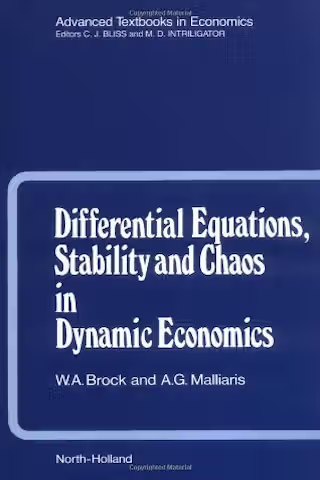
Brock, W. A., & Malliaris, A. G. (1989). Differential Equations, Stability and Chaos in Dynamic Economics. North-Holland.
Chapter Summary
The book belongs to North-Holland's Advanced Textbooks in Economics series and runs to about 390 pages. It introduces economists to three mathematical methods: ordinary differential equations, stability techniques and chaotic dynamics. The publisher's description lists the theory covered: existence and continuation of solutions, uniqueness, dependence on initial data and parameters, linear systems, stability of linear systems, two-dimensional phase analysis, local and global stability, the stability manifold, stability of optimal control and empirical tests for chaotic dynamics. Applications include microeconomic dynamics, investment theory, macroeconomic policies, capital theory, business cycles and financial economics. Every chapter ends with two sections, one on miscellaneous applications and exercises and one on further remarks and references, and the book as a whole offers a guide to over 500 references on differential equations, stability analysis and chaotic dynamics.
Chapters 1–2: Basic Properties of Differential Equations; Linear Differential Equations
The first two chapters supply the mathematical base. The first deals with the basic properties of differential equations; among the topics the publisher lists are existence, continuation and uniqueness of solutions and dependence on initial data and parameters. The second turns to linear differential equations and the behaviour of linear systems.
Chapters 3–4: Stability Methods: An Introduction; Advanced Stability Methods
Two chapters develop stability analysis. The introduction starts from the stability of linear systems and two-dimensional phase analysis. The advanced chapter moves on to local and global stability and the stability manifold, the tools needed for nonlinear economic models.
Chapter 5: Stability of Optimal Control
This chapter applies stability analysis to optimal control, the framework in which an economic agent chooses a path over time. It connects the mathematical chapters to the dynamic optimisation models used in economic theory.
Chapters 6–9: Microeconomic Dynamics; Stability in Investment Theory; Macroeconomic Policies; Stability in Capital Theory
The middle of the book is a run of applications. Chapters 6 and 7 treat microeconomic dynamics and investment theory, Chapter 8 treats macroeconomic policies, and Chapter 9 treats capital theory, each using the stability methods of the preceding chapters.
Chapter 10: Introduction to Chaos and Other Aspects of Nonlinearity
The last numbered chapter introduces chaotic dynamics and other nonlinear behaviour, including the empirical tests for chaos that the publisher's description mentions. The book closes with an appendix, a bibliography and an index.
Key Concepts
Chapters 1–2
- Existence and uniqueness of solutions: conditions under which a differential equation has one well-defined solution.
- Dependence on initial data and parameters: how solutions change when starting points or parameters change.
- Linear systems: the class of systems whose solutions and stability can be analysed completely.
Chapters 3–5
- Stability of linear systems: whether a system returns to or moves away from its steady state.
- Phase analysis in two dimensions: studying behaviour of a two-variable system in the plane.
- Local and global stability; stability manifold: tools for nonlinear systems.
- Stability of optimal control: stability results for dynamic optimisation problems.
Chapters 6–10
- Microeconomic dynamics, investment theory, macroeconomic policies, capital theory: the application areas named in the contents.
- Chaotic dynamics: deterministic nonlinear systems whose behaviour looks irregular, with empirical tests for detecting it.
Critical Analysis
Strengths
- A defined purpose. The book is built around three named methods and states what each is for: ordinary differential equations, stability techniques and chaotic dynamics. Its contents follow that order, from basic properties to linear systems, stability, optimal control, applications and chaos.
- Applications in the economic fields most connected to dynamics. Four of the ten chapters apply the methods to microeconomic dynamics, investment, macroeconomic policy and capital theory, and the description adds business cycles and financial economics.
- Exercises and guidance to the literature. The two closing sections of every chapter, on applications and exercises and on further remarks and references, give readers problems to work and a route into more than 500 references.
Limitations
- Date. The book was published in 1989, and later work on dynamic systems, chaos and its empirical testing in economics is not in it. The book is a source for the methods and for the literature up to that point.
- Mathematical demands. The publisher addresses it to graduate students in economics with an interest in economic theory, economic researchers and applied mathematicians, and its contents begin with the general properties of differential equations rather than with a review of calculus and linear algebra.
- Scope. The book concentrates on continuous-time differential equations; readers whose models are in discrete time will need other material.
Where It Fits in the Course
Among the mathematical economics books on the list, this is a specialised graduate-level book. Lis and Rosser's Basic Mathematics for Economists and Sydsaeter, Hammond, Strom and Carvajal's Essential Mathematics for Economic Analysis are introductory books written for economics students, starting from elementary techniques. Chiang and Wainwright's Fundamental Methods of Mathematical Economics is the long-established intermediate text whose treatment moves from equilibrium analysis and matrices through optimisation to dynamic tools, and Ian Jacques's Mathematics for Economics and Business is a general mathematics text for economics and business.
Brock and Malliaris is the natural next step for a reader who has worked through the dynamic tools in Chiang and Wainwright and needs the stability theory, optimal control and chaos behind research-level dynamic models.
How to Use This Book
The book is for graduate students in economic theory, researchers building dynamic models, and applied mathematicians interested in economic applications. Comfort with calculus and linear algebra, and with economic theory at the graduate level, is a sensible starting point.
A practical plan:
- Core: Chapters 1 to 4, then Chapter 5 for anyone using optimal control. Work the exercises, since each chapter ends with them.
- Applications: pick the application chapter that matches a research interest: microeconomic dynamics, investment, macroeconomic policy or capital theory.
- Chaos: read Chapter 10 last, and treat it as an introduction to be supplemented with more recent literature.
- Reference use: the further-remarks sections at the end of chapters are a guide to the literature of the time; use them to find original papers.