01 / Reading Guide
Reading Guide
Citation
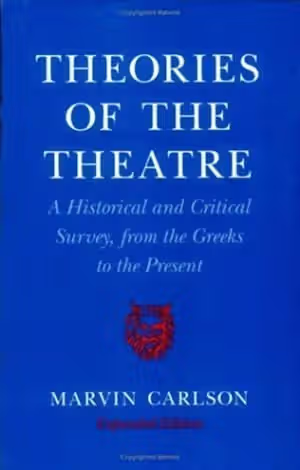
Carlson, M. (1993). Theories of the Theatre: A Historical and Critical Survey, from the Greeks to the Present (expanded ed.). Cornell University Press.
Chapter Summary
The book has 22 chapters arranged chronologically and by country or region, from ancient Greece to the end of the twentieth century. It runs to about 550 pages including a preface, a preface to the expanded edition and an index. Each chapter surveys what critics, playwrights and other writers of the period said about drama and theatre, and Simon Goldhill's review notes that primary sources are translated and secondary scholarship is largely left aside. The expanded edition adds the final chapter, on the period since 1980.
Chapters 1–3: Aristotle and the Greeks; Roman and Late Classic Theory; The Medieval Period
The opening chapters cover the earliest writing on drama in Greece, its continuation in Roman and late classical theory, and the theatre-related writing of the medieval period. Goldhill notes that Aristophanes, Plato and Aristotle together receive barely six pages.
Chapters 4–7: The Italian Renaissance; The Spanish Renaissance; The French Renaissance; The Renaissance in England and the Netherlands
Four chapters follow the Renaissance country by country. The Italian chapter is the longest of the group, at about twenty pages.
Chapters 8–10: Seventeenth-Century France; The Restoration and Eighteenth Century in England; Eighteenth-Century France
These chapters cover the neoclassical period in France and England, and the French theory of the eighteenth century. Chapter 8, on seventeenth-century France, runs to about twenty pages.
Chapters 11–13: Germany to Hegel; Italy and France in the Early Nineteenth Century; Nineteenth-Century England
Germany to Hegel is the longest chapter before the twentieth century, and Goldhill singles out Aristotle and Hegel as the figures against whom much later theory is articulated. The next two chapters follow Italy, France and England through the first part of the nineteenth century.
Chapters 14–16: Russian Theory to 1900; The Germanic Tradition in the Late Nineteenth Century; France in the Late Nineteenth Century
The chapters on the later nineteenth century move to Russia, the German-speaking world and France. Goldhill cites the Russian chapter as an example of the lesser-known writers the book brings into view.
Chapters 17–22: The Early Twentieth Century, 1900–1914; The Twentieth Century, 1914–1930; 1930–1950; 1950–1965; 1965–1980; The Twentieth Century since 1980
Six chapters, roughly 240 pages and a little under half of the book, cover the twentieth century in successive periods. The blurb describes the survey as ending with semiotics and post-structuralism, and the expanded edition's final chapter on the period since 1980 emphasizes the impact of feminist theory.
Key Concepts
Chapters 1–10: Greeks to the eighteenth century
- Western dramatic theory: the subject of the whole survey, treated chronologically and by country.
- Classical theory: the Greek and Roman material of Chapters 1–2, which Goldhill describes as a point of reference for much later writing.
- Renaissance theory by country: the Italian, Spanish, French, and English and Dutch chapters.
- Neoclassical theory: the chapters on seventeenth-century France, the Restoration and eighteenth-century England, and eighteenth-century France.
Chapters 11–22: Hegel to the present
- Romantic and post-Romantic theory: the German, French, Italian, English and Russian chapters of the nineteenth century.
- Modern theory by period: successive chapters from 1900 to 1980, each a survey of the main theoretical statements of its years.
- Semiotics, post-structuralism and feminist theory: the topics the blurb names for the late twentieth century and for the added chapter.
Critical Analysis
Strengths
- Range and layout. One book runs from Aristotle to 1991 in 22 chapters ordered by period and place, with a table of contents that works as a map of the field. Goldhill calls it a useful starting point for a teacher or researcher who wants to dip into unfamiliar territory, and notes that few readers will finish it without meeting writers and debates they did not know.
- Readable condensation. Goldhill describes the writing as clear and easy, with primary sources fluently translated and secondary material kept out of the way.
- Recurring themes. His review identifies concerns that emerge across chapters: tragedy's didacticism and grandeur, the contest between naturalism and formalism, and the role of the emotions.
- Updated for later theory. The expanded edition adds a chapter covering developments since 1980 and the impact of feminist theory.
Limitations
- Thin on argument. Goldhill, a classicist, objects that the book reduces theory to a succession of brief pronouncements and leaves out the aesthetic, ethical and social context that gave them force; his example is the few pages given to Plato and Aristotle.
- Hard to look things up. He notes the absence of a bibliography and an inadequate index, so tracing one theme across chapters means reading the whole book.
- Weighted toward the recent past. About 240 pages go to the twentieth century, and Goldhill thinks the detail given to recent decades is out of proportion to the brief treatment of earlier periods.
- A teleological history. Goldhill reads the book's weight on the twentieth century as an attempt to show how we arrived at present-day theory, an aim he considers impossible to complete; and the survey is confined to Western theory.
Where It Fits in the Course
This is the history-of-ideas book among the drama texts. Mick Wallis and Simon Shepherd's Studying Plays teaches how to analyse a play text for performance, and Christopher Balme's Cambridge Introduction to Theatre Studies explains the methods of the discipline; both are better first books, and Carlson then supplies the longer history of what critics have said. Theatre Histories (Nellhaus, Lei, Underiner and Ybarra) tells the story of theatre across world cultures and so balances Carlson's Western focus, while the Norton anthology and Hamlet provide plays against which his summaries can be checked.
How to Use This Book
The book suits upper-level undergraduates and graduate students in theatre or literary studies who have read major plays from several periods. It is a reference to dip into more than a book to read straight through.
- Plan by period: when studying a play or movement, read the chapter for its time and place, then follow the names it introduces into primary texts.
- Core for most courses: Chapter 1 (Aristotle) with Chapters 8, 11 and 16 for neoclassical, Hegelian and late nineteenth-century theory, and Chapters 17–22 for modern theory.
- Pair with context: because the book keeps to the theorists' statements, add a theatre history or a play anthology for the stage practice and cultural setting, and use Goldhill's review as a reminder to check key claims, such as those about Plato and Aristotle, against the primary texts.