01 / Reading Guide
Reading Guide
Citation
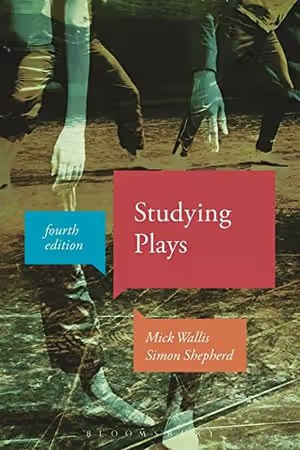
Wallis, M., & Shepherd, S. (2018). Studying Plays (4th ed.). Bloomsbury Academic.
Chapter Summary
The fourth edition runs to 248 pages: an introduction, eight chapters, a glossary, a bibliography and an index. Earlier editions appeared in 1998 and 2002 (Arnold) and 2010 (Hodder Education); this edition is published by Bloomsbury. Its plan has stayed constant: the first edition's back cover described it as an introduction to the methods and terminology of analysing dramatic texts, organised around the key elements of drama (character, dialogue, action and space) and the ways plays affect audiences. Bloomsbury's description of the fourth edition names Shakespeare's King Lear, Ibsen's A Doll's House and Timberlake Wertenbaker's Our Country's Good among the familiar examples, and lists three additions: new examples from twenty-first-century plays by established and emerging writers for a range of theatres and companies, new material on how plays structure and engage audience response, and a new section on theatre of witness and testimony, monodrama and postdramatic texts. It also promises fuller guidance on studying plays in and as performance, both live and through recordings available online. Mick Wallis is Professor Emeritus of Performance and Culture at the University of Leeds and Simon Shepherd Professor Emeritus of Theatre at the Royal Central School of Speech and Drama.
Chapter 1: Getting Started
The opening chapter introduces the method of the book. The publisher's preview shows it closing on an exercise that can be applied to any play and any sequence, and that works best for plays with almost no stage directions, used to reveal the layering of the dramatic text and to preview the topics of the following chapters.
Chapters 2–4: Characters and Persons; Dialogue; Plot and Action
Three chapters take the core elements of a play text in turn: how characters are constructed as persons on stage, how dialogue works, and how plot relates to action. These correspond to the elements the book has been built around since its first edition.
Chapters 5–6: The Actor's Body; Spaces
The book then moves from the text to its realisation in the theatre: the body of the performer and the spaces in which plays are staged, the area the publisher calls "theatrical space".
Chapter 7: Dealing with Some Newer Kinds of Drama
This chapter, titled "Dealing with Some New Kinds of Text" in some booksellers' listings, contains the material the publisher marks as new to the fourth edition: theatre of witness and testimony, monodrama and postdramatic texts. The third edition had already added a section on "post-dramatic" text, along with discussions of design-led text and "in-yer-face" theatre.
Chapter 8: Culture and Interpretation
The final chapter turns to culture and interpretation, the questions of how plays relate to their cultural setting and how they are interpreted, before the glossary and bibliography.
Key Concepts
Elements of the play text (Chapters 1–4)
- The dramatic text as layered: a script holds more than its words, as the opening exercise shows even for plays with almost no stage directions.
- Characters and persons: the distinction the chapter title draws between dramatic characters and the persons who embody them.
- Dialogue: how speech is written and works within a play.
- Plot and action: the arrangement of events and what is done on stage.
Performance and context (Chapters 5–8)
- The actor's body: performance as part of what a play means.
- Theatrical space: the stage and the wider space of performance.
- Postdramatic text, testimony and monodrama: newer forms that do not rest on conventional character and plot.
- Audience response: how plays structure the experience of those watching.
Critical Analysis
Strengths
- Plays as material for performance. From the first edition onwards, the book has treated a play text through its effects on an audience and its realisation on stage, and the fourth edition adds guidance on studying live and recorded performance.
- A clear progression. The chapters move from basic elements (character, dialogue, plot) to the body and space, then to newer forms and to culture, a sequence that matches an introductory module.
- Updated for recent theatre. The fourth edition draws new examples from twenty-first-century plays and adds a section on testimony, monodrama and the postdramatic, forms that the previous edition had already identified as part of many drama modules. Jonathan Pitches (University of Leeds), in an endorsement printed by the publisher, says it is suited to the studio as much as the seminar room.
- Exercises. The preview shows practical exercises built into the chapters, a feature the publisher already highlighted for the third edition.
Limitations
- Not an anthology or history. The book refers to plays but does not reprint them, and it does not offer a history of drama; students need the texts and a historical survey alongside it.
- Short for its range. At about 250 pages for eight chapters, each element receives a concise treatment, so readers wanting depth on theory or on particular traditions will need further reading.
Where It Fits in the Course
In the drama course this is the introductory method book: it shows how to read a play as something written for performance. The Norton Anthology of Drama supplies the plays to which that method can be applied, and the book's own examples, such as King Lear, connect naturally with Hamlet, the Shakespeare tragedy on the course list. Christopher Balme's Cambridge Introduction to Theatre Studies widens the view from play texts to the discipline of theatre studies as a whole, and Theatre Histories: An Introduction supplies the historical survey this book does not attempt. Marvin Carlson's Theories of the Theatre is a historical survey of dramatic theory, best read after this book has given students a working vocabulary.
How to Use This Book
The book is aimed at students beginning drama, theatre or English courses who have not studied plays before. Read the introduction and Chapter 1 first and do the exercise it sets on a play you are studying. Then take Chapters 2–6 in order alongside a set play, applying each chapter's questions to it, and use Chapter 7 when the course reaches contemporary or experimental work.
Read the plays the book discusses, and where possible watch them in performance, live or in the online recordings the authors point to. Use the glossary to fix terms, and the bibliography to move on to more specialised reading once a particular element, such as space or the body, becomes the focus of an essay.