01 / Reading Guide
Reading Guide
Citation
Puchner, M. (Gen. Ed.), Akbari, S. C., Denecke, W., Fuchs, B., Levine, C., Lewis, P., & Wilson, E. (2023). The Norton Anthology of World Literature: Post-1650 (5th ed., Vols. D–F). W. W. Norton & Company.
Chapter Summary
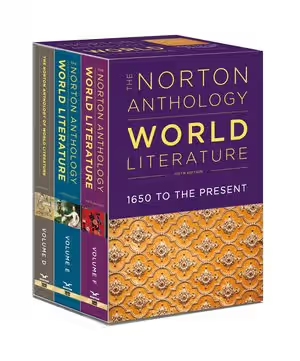
This ISBN is the package of the three later volumes of the fifth edition, which Norton labels "1650 to the Present": Volume D (784 pages), Volume E (960 pages) and Volume F (1,344 pages). Volume D also reaches back to earlier East Asian works, such as Zeami's noh drama and The Journey to the West, that belong with its sections. Volumes A–C, from the beginnings to 1650, are sold separately. Each volume opens with a list of what is new to the edition, a preface and acknowledgments, is divided into numbered sections with period introductions, and ends with selected bibliographies, a timeline and an index. Within sections, each author or work has its own headnote; thematic clusters gather shorter texts around a topic. New to the fifth edition, according to Norton, are more than 150 new selections across the full edition, fresh translations, and a "Translation Lab" in every volume that sets several English versions of the same poem side by side. Works are in English translation, and the contents mark new selections and new translations.
Volume D, Section I: East Asian Drama
Four dramatic works from Japan, China and Korea: Zeami's noh play Atsumori, excerpts from Kong Shangren's The Peach Blossom Fan and Chikamatsu's The Love Suicides at Amijima, and selections from the Korean Song of Ch'un-hyang.
Volume D, Section II: The Enlightenment in Europe and the Americas
A cluster titled "What Is Enlightenment?" (Johnson's Dictionary, Kant, Descartes, the Encyclopédie, Franklin, Hume, Beattie, Vastey, Wollstonecraft, Sade and William Apess) precedes major works: Molière's Tartuffe, Aphra Behn's Oroonoko, Sor Juana Inés de la Cruz's Response and poems (with a Translation Lab comparing four versions of one of her redondillas), Swift's Gulliver's Travels (Part IV) and "A Modest Proposal", Pope's The Rape of the Lock and Voltaire's Candide.
Volume D, Section III: Literatures of Early Modern East Asia
Chinese fiction (excerpts from Wu Cheng'en's The Journey to the West and Cao Xueqin's The Story of the Stone), Korean prose (The Tale of Hong Kiltong and The Memoirs of Lady Hyegyŏng) and Japanese writing (Ihara Saikaku and a cluster on "The World of Haiku" centred on Bashō's The Narrow Road to the Deep North).
Volume E, Section I: An Age of Revolutions in Europe and the Americas
A cluster of revolutionary documents (the US Declaration of Independence, the Declaration of the Rights of Man, Olympe de Gouges, Burke, Dessalines, Wordsworth, Bolívar and the Declaration of Sentiments), followed by Rousseau's Confessions, Equiano's Interesting Narrative, Goethe's Faust (Part I), Douglass's Narrative and Melville's "Bartleby, the Scrivener". A long cluster, "Romantic Poets and Their Successors", runs from Blake, Wordsworth, Coleridge and Keats to Leopardi, Baudelaire, Dickinson, Christina Rossetti, Rosalía de Castro, Rimbaud and Rubén Darío, and ends with a Translation Lab on Baudelaire's "La Chevelure".
Volume E, Section II: At the Crossroads of Empire
Nguyễn Du's The Tale of Kiều, Ghalib's ghazals, Liu E's The Travels of Lao Can, Pandita Ramabai, Machemba's letter to Major von Wissmann and Mark Twain's King Leopold's Soliloquy, with a cluster on "Poetry and Politics" (Shelley, Heine, Mickiewicz, Barrett Browning, Whitman, Speranza, Martí, E. Pauline Johnson and others).
Volume E, Section III: Realism across the World
Dostoyevsky's Notes from Underground, Flaubert's "A Simple Heart", Tolstoy's The Death of Ivan Ilyich, Ibsen's Hedda Gabler, Machado de Assis, López Portillo y Rojas, Chekhov's The Cherry Orchard and "The Lady with the Dog", Tagore and Higuchi Ichiyō.
Volume F, Orature
A prefatory section of oral literature: European folktales, Anansi stories from Ghana, Jamaica, Haiti and the United States, songs and a story of enslaved people in the United States, Malagasy wisdom poetry, a Hawaiian folktale and a poem by Esther Belin.
Volume F, Section I: Modernities and Modernisms, 1900–1945
Fiction and drama from Conrad's Heart of Darkness, Mann's Death in Venice, Proust, Joyce's "The Dead" and Kafka's The Metamorphosis to Lu Xun, Pirandello, Akutagawa, Premchand, Kawabata, Woolf's A Room of One's Own, Brecht, Lao She, Ch'ae Man-sik, Césaire, Borges and Zhang Ailing; a cluster of manifestos (Futurism, Chen Duxiu, Dada, Surrealism and later political manifestos); and a large cluster of twentieth-century poetry, from Cavafy, Yeats, Rilke and Eliot to Akhmatova, Lorca, Neruda, Faiz, Paz, Celan, Amichai, Adonis, Walcott and Heaney, closing with a Translation Lab on Rilke's "Archaic Torso of Apollo" that includes a machine translation.
Volume F, Sections II–III: Postwar and Postcolonial Literature, 1945–1989; Contemporary World Literature
Section II gathers Cortázar, Borowski, Lessing, Baldwin, Camus, Lispector, Salih, Fuentes, Mahfouz, García Márquez, Aidoo, Silko, Ngũgĩ, Soyinka's Death and the King's Horseman, Head, El Saadawi, Ōe, Rushdie, Kincaid, Pak Wansŏ, Erdrich, al-Shaykh, Atwood, Mo Yan, Yu Hua and Nguyen Huy Thiep. Section III presents contemporary writers including Yoko Tawada, Chu T'ien-hsin, Bolaño, Pamuk, Adichie, Lynn Nottage's Ruined, Kathy Jetñil-Kijiner, Toni Morrison, Mariana Enríquez and Natalie Diaz.
Key Concepts
Organisation
- Period and region: the volumes divide literature by era and, within eras, by cultural area (for example East Asia, Europe and the Americas).
- Thematic cluster: a group of shorter texts on one topic, such as Enlightenment, revolution, poetry and politics, or manifestos, read alongside the major works.
- Headnote and period introduction: the editorial apparatus that places each author and section in context.
Reading in translation
- Translation Lab: several English versions of one poem (Sor Juana, Baudelaire, Rilke) printed together to show how translators interpret.
- New translation: the edition marks works newly translated for or chosen for it.
Literary periods
- Enlightenment: the eighteenth-century debate over reason and authority that Volume D documents.
- Romanticism and realism: the nineteenth-century movements around which Volume E is built.
- Modernism and postcolonial literature: the twentieth-century movements that structure Volume F.
- Orature: oral literature (folktales, songs, wisdom poetry) given its own section at the start of Volume F.
Critical Analysis
Strengths
- Global coverage within each period. The contents set East Asian drama and fiction beside the European Enlightenment, works from Vietnam, India and China beside European Romanticism, and twentieth- and twenty-first-century writers from Africa, Asia, Europe, the Americas and the Pacific. Norton describes the edition as expanding coverage beyond the West, with more Indigenous texts, travel accounts and speeches.
- Translation made visible. The Translation Labs, new to this edition, ask students to compare several versions of the same poem, and the contents flag new translations, so reading in translation becomes a subject of study rather than something taken for granted.
- Context through clusters. Clusters of documents and short texts (revolutionary declarations, manifestos, "Poetry and Politics") let a course read major works against the debates of their time.
- Substantial texts. Many works appear complete or in long excerpts: Faust Part I, Candide, Notes from Underground, Heart of Darkness, The Metamorphosis and several full plays.
Limitations
- Bulk. The three volumes total about 3,100 pages, far more than a semester can cover, so every course must select.
- Half the anthology. This package begins in the mid-seventeenth century; courses that start with antiquity need Volumes A–C (or the shorter edition).
- Excerpts of long novels. Large works such as The Story of the Stone, The Journey to the West and Proust's Swann's Way appear only in selections, which introduce rather than replace the whole works.
- Anglophone translations only. All works are in English, so the anthology depends on its translators; the Translation Labs address this for a few poems but not for prose.
Where It Fits in the Course
In this course the anthology supplies the primary texts that the other books discuss. Ben Hutchinson's Comparative Literature: A Very Short Introduction and Domínguez, Saussy and Villanueva's Introducing Comparative Literature explain what it means to read across languages and traditions, and are useful companions from the first weeks. David Damrosch's What Is World Literature? argues that world literature is a mode of circulation and reading, works that gain in translation, which gives a framework for the Translation Labs.
Pascale Casanova's The World Republic of Letters and Erich Auerbach's Mimesis are more demanding studies that suit later stages of the course: Casanova for the uneven geography of recognition visible in the postcolonial sections of Volume F, Auerbach for the representation of reality that Volume E's realism section samples worldwide.
How to Use This Book
The anthology is designed for undergraduate survey courses, with an introduction to each section and a headnote for each author, so students need no prior knowledge of the traditions represented. It works best with a syllabus that makes deliberate choices:
- Read the section introduction first, then the headnote before each work; together they supply the historical and cultural context the texts assume.
- Pair across regions: for example, Candide with The Journey to the West, Notes from Underground with Lu Xun's "Diary of a Madman", or Heart of Darkness with the postcolonial writers of Volume F, using the clusters as bridges.
- Use the Translation Labs as class exercises: compare versions line by line before discussing which choices each translator made.
- Consult the timelines and bibliographies at the back of each volume for context and further reading.
- Choose complete works where possible for papers, and treat excerpts as invitations to read the whole book in a full translation.
Students should check which volumes their course uses, since this package does not include the pre-1650 volumes.