01 / Reading Guide
Reading Guide
Citation
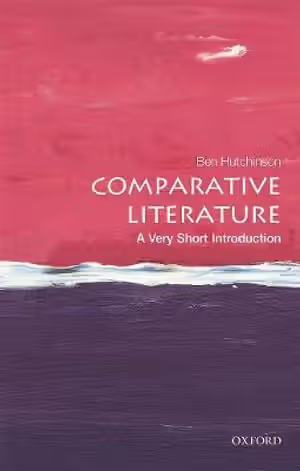
Hutchinson, B. (2018). Comparative Literature: A Very Short Introduction. Oxford University Press. Very Short Introductions.
Chapter Summary
The book is a pocket-sized volume of about 150 pages in five chapters, followed by further reading and an index. The publisher presents comparative literature as "both the past and the future of literary studies" and frames the book's story around political history: from colonial empire-building in the nineteenth century, through the Jewish diaspora of the twentieth, to the postcolonial culture wars of the twenty-first. It notes that even the name of the discipline differs between languages (comparative in English, compared in French, comparing in German), uses the image of a Rorschach test in which people see what they want to see, and ends with George Steiner's remark that "to read is to compare".
Chapter 1: Metaphors of Reading
The opening chapter asks basic questions that frame the rest of the book: what literature is, why we compare texts and who can do comparative work. According to Toloo Riazi's review in Studies in 20th & 21st Century Literature (2019), Hutchinson argues that making sense of a text means comparing it with others and so placing ourselves in a framework of references, defines comparative literature as the study of cross-cultural connections and of multiplicity, and associates it with a sense of non-belonging, of being in "no place".
Chapter 2: Practices and Principles
The chapter Riazi considers the most important sets out the criteria for comparison as a matter of "themes and techniques". It contrasts close and distant reading, periods and regions, canon and counter-canon, genres and styles, and writers and readers. Hutchinson argues that a counter-canon presupposes a canon, and that comparison should be seen from the author's side as well as the reader's: intertextuality is a form of authorial comparison, and writers often invite comparative reading of their work.
Chapter 3: History and Heroes
A history of the discipline across broad periods, including colonialism, modernity and the waves of Jewish migration in the twentieth century. Riazi describes a threefold perspective: how European literatures were compared within Europe, how they were compared outside it, and how literatures outside Europe, such as Persian and Arabic, have been compared among themselves. The chapter links the histories of comparative philology, comparative literature and cultural colonialism.
Chapter 4: Disciplines and Debates
Comparative literature is placed in relation to literary theory, cultural studies, postcolonialism, world literature, translation studies and reception studies, as an "indiscipline" positioned between language, literature and culture. The chapter also examines the European, quasi-colonial vision of the world that the discipline only partly outgrew in the twentieth century.
Chapter 5: The Futures of Comparative Literature
The final chapter considers the discipline's place among the humanities and its potential to draw on other disciplines and the social sciences. Riazi highlights its argument that comparative literature can be a home for those who are "transnational not out of desire, but despair".
Key Concepts
Chapters 1–2: Metaphors of Reading; Practices and Principles
- Reading as comparison: understanding a text by setting it against others, summed up in Steiner's phrase "to read is to compare".
- Cross-cultural connection: the core object of comparative study, across languages, cultures and genres.
- Canon and counter-canon: the problem that alternative canons depend on the canon they challenge.
- Authorial comparison: intertextuality as comparison made by writers themselves, not only by readers.
Chapter 3: History and Heroes
- Comparative philology: the nineteenth-century study of languages from which comparative literature developed.
- Eurocentrism: the discipline's historical focus on Europe and on comparisons made from a European standpoint.
Chapters 4–5: Disciplines and Debates; The Futures of Comparative Literature
- "Indiscipline": comparative literature as a field without fixed borders, between language, literature and culture.
- World literature and translation studies: neighbouring fields with which the discipline is in constant negotiation.
- Transnationalism: the condition of writers and readers who cross borders, which the book connects with the discipline's future.
Critical Analysis
Strengths
- History tied to politics. The publisher's framing and Riazi's review both emphasise that the book tells the discipline's story as part of the political history of modernity, from empire to migration, which explains why comparative literature took the shapes it did.
- A systematic chapter on method. Riazi singles out "Practices and Principles" as the core of the book, with its pairs of criteria (close/distant reading, canon/counter-canon, genre/style, writer/reader). The blogger and reviewer Bernie Gourley, otherwise critical, also found the second chapter well organised for learning.
- Interdisciplinary range. Chapter 4 covers the discipline's relations with theory, cultural studies, postcolonialism, world literature, translation and reception in a few pages.
- Endorsed by leading comparatists. The publisher quotes Marina Warner and Susan Bassnett, identified as President of the British Comparative Literature Association, who calls it a fascinating and optimistic study.
Limitations
- A slow start for beginners. Gourley found the first chapter vague and the book less friendly to newcomers than many in the series; he suggests returning to Chapter 1 after the rest.
- More about critics than about literary works. The same reviewer observed that the book spends much of its space comparing theorists, such as Barthes and Steiner, rather than demonstrating comparisons between literary texts.
- Very short by design. At about 150 pages, each debate is outlined rather than developed, and readers will need the further reading and fuller studies.
Where It Fits in the Course
In the world and comparative literature course, Hutchinson's book is the quickest way into the field and works well in the first week. Introducing Comparative Literature: New Trends and Applications by César Domínguez, Haun Saussy and Darío Villanueva is a longer, more detailed guide to the discipline's theoretical positions and practical applications and makes a natural next step. David Damrosch's What Is World Literature? and Pascale Casanova's The World Republic of Letters develop at length two of the debates that Hutchinson's fourth chapter introduces, world literature as circulation and as a field of competition. Erich Auerbach's Mimesis, a classic of comparative criticism built on close readings, shows the method in action, and The Norton Anthology of World Literature supplies the texts on which to practise.
How to Use This Book
The book suits first-year students, students beginning a comparative literature programme and general readers; it assumes no previous study of the discipline.
- Core: Chapter 2 (method) and Chapter 3 (history). Readers who find the opening abstract can begin with Chapter 2 and return to Chapter 1 afterwards.
- Then: Chapter 4, as a map of neighbouring fields to explore through the further reading, and Chapter 5 at the end of a course.
- Practise comparison. Take one pair of criteria from Chapter 2, for example genre versus style, and apply it to two texts from different languages read in translation.
- Watch the terms. Notice how the name of the discipline changes across languages, a small example of the book's argument that comparison reveals one's own assumptions.
- Follow up. Move from the further reading to Damrosch, Casanova and the Domínguez–Saussy–Villanueva guide.