01 / Reading Guide
Reading Guide
Citation
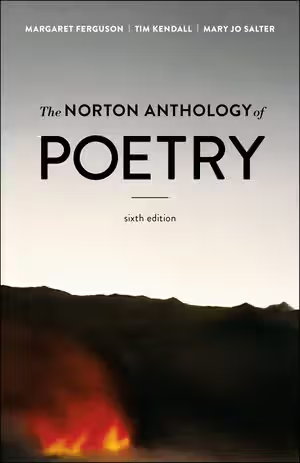
Ferguson, M., Kendall, T., & Salter, M. J. (Eds.). (2018). The Norton Anthology of Poetry (6th ed.). W. W. Norton & Company.
Chapter Summary
Format of the Sixth Edition
The sixth edition is a single volume of about 2,150 pages. Norton gives its size as 1,871 poems by 355 poets, of which 351 poems and 44 poets are new to this edition. The contents are not divided into numbered chapters or period sections: poets follow one another in order of birth, from the Old English period to poets born in the early 1970s, with a few anonymous groups (medieval lyrics, early modern ballads, Elizabethan and Jacobean songs, a selection of American song) placed at their point in the sequence. The book ends with suggestions for further reading, a glossary, biographical sketches of the poets, permissions acknowledgments and an index. The publisher describes the glossary of terms relating to versification and syntax as new in this edition, along with revised annotations and glosses and updated biographical sketches. Online, the edition is supported by six "Poetry Workshops" (tutorials using audio, video and interactive exercises), a playlist of recordings made with the Poetry Archive, and "Poets in Dialogue" notes linking poems across time and place. The sections below follow the sequence of the official contents list.
Old and Middle English poetry
The anthology opens with Cædmon's Hymn, an extract from Beowulf in Seamus Heaney's translation, riddles, "The Wife's Lament" and "The Seafarer" (translated by Mary Jo Salter, one of the editors), followed by anonymous lyrics of the thirteenth and fourteenth centuries. Chaucer is represented by the General Prologue and the Wife of Bath's Prologue and Tale from The Canterbury Tales and by shorter poems; Langland, Pearl, fifteenth-century carols and lyrics, Dunbar and Skelton complete the medieval section.
The sixteenth and seventeenth centuries
Early modern ballads ("Lord Randal", "Sir Patrick Spens" and others) and anonymous Elizabethan songs precede Wyatt, Ralegh, Spenser (Book 1, Cantos 1–2 of The Faerie Queene and the Amoretti), Sidney, Shakespeare (about fifty sonnets and songs), Donne, Jonson, Herbert, Anne Bradstreet and Marvell. Milton's section includes "Lycidas" and selections from Paradise Lost: the invocations of Books 1 and 3 and extracts from Books 4, 7, 9 and 12.
The Restoration and the eighteenth century
The selections include Dryden, Anne Killigrew and Pope, whose Rape of the Lock appears alongside Part II of An Essay on Criticism and extracts from An Essay on Man. Later eighteenth-century poets such as Anna Laetitia Barbauld, Joanna Baillie and Phillis Wheatley take their places in the same chronology.
The Romantic and Victorian periods
Wordsworth (including extracts from The Prelude), Coleridge, Byron, Shelley and Keats lead into the Victorians: Tennyson (extracts from In Memoriam), the Brownings, Christina Rossetti, Swinburne and Hopkins. American poets of the century appear in the same sequence, with Whitman's "Song of Myself" and about forty poems by Emily Dickinson.
The twentieth century
Hardy, Yeats, Frost, Stevens, Pound and the First World War poets lead into T. S. Eliot ("Prufrock", The Waste Land and "Little Gidding" from Four Quartets). The section "American Song" gathers spirituals ("Go Down, Moses"), blues and popular song ("Strange Fruit", Billie Holiday, Bob Dylan, Stephen Sondheim). Later twentieth-century selections include Langston Hughes, Auden, Bishop, Gwendolyn Brooks, Ginsberg's "Howl", Plath, Walcott, Heaney and Lucille Clifton, as well as poets from Australia, New Zealand, South Africa and Canada.
Contemporary poets
The final pages present poets born from the 1940s to the early 1970s, among them Rita Dove, Louise Erdrich, Carol Ann Duffy, Li-Young Lee, Simon Armitage, Alice Oswald, Natasha Trethewey, Christian Bök (extracts from Eunoia), A. E. Stallings, Terrance Hayes ("The Golden Shovel") and Tracy K. Smith.
Key Concepts
Organisation and apparatus
- Chronology by poet: the poems are arranged by the birth dates of their authors, so the book reads as a continuous history of poetry in English.
- Annotations and glosses: footnotes explain difficult words and allusions; Norton describes them as revised for this edition.
- Glossary of versification and syntax: a new reference list of technical terms for metre, form and sentence structure.
- Biographical sketches: brief notes on each poet at the back of the book.
Range
- Long poems in selection: major long poems such as The Faerie Queene, Paradise Lost and The Prelude appear as extracts, while shorter long poems such as The Rape of the Lock and The Waste Land are given whole.
- Anonymous and popular traditions: ballads, carols and "American Song" sit alongside authored poems.
- Poetry in English worldwide: British, Irish, American, Caribbean, Australian, New Zealand, South African and Canadian poets in one sequence.
Critical Analysis
Strengths
- Scale. With 1,871 poems by 355 poets, the anthology can serve as a course text for any period and as a reference after the course, which is how Norton presents it.
- Continuity across periods and nations. A single chronological sequence lets readers trace forms (the sonnet, the ballad, the elegy) from the Middle Ages to the twenty-first century and across national traditions.
- Strong representation of major poets. Shakespeare, Donne, Dickinson and others receive dozens of poems each, enough for close study of a single poet without a separate edition.
- Revised apparatus and online support. The new glossary, revised glosses, Poetry Workshops, recordings and "Poets in Dialogue" notes give help with reading and hearing poems.
Limitations
- No guidance on how to read poetry. The contents list shows no introductory essay on reading or on versification; technical help comes through the glossary and the online workshops. Students needing a step-by-step introduction should pair it with a handbook.
- Long works only in part. Spenser, Milton and Wordsworth are represented by selected books and extracts, so courses that study those poems need complete editions.
- Size and stopping point. A single volume of over 2,000 pages is heavy to carry, and the youngest poets included were born in 1972, so the most recent poetry needs other sources.
Where It Fits in the Course
In the poetry course this is the primary text: the store of poems that the other books help students read. The Norton Introduction to Poetry is the companion that teaches reading, with chapters on the elements of poetry and on writing about it; students new to poetry can begin there and use the anthology to range more widely. The Princeton Encyclopedia of Poetry and Poetics is the reference for any term, form or tradition met in the anthology, and Jonathan Culler's Theory of the Lyric offers a sustained argument about what lyric poems do, best read once a student knows a good number of the poems collected here. Kaveh Akbar's Calling a Wolf a Wolf is a single contemporary collection that can be read against the anthology's final section.
How to Use This Book
The anthology is for any undergraduate studying poetry in English and for readers who want a lifetime reference. It assumes no previous study, but it offers guidance only through notes, glossary and biographical sketches. Do not read it straight through. Follow the syllabus selections, and for each poet read the biographical sketch at the back before the poems.
Read every assigned poem twice, once aloud or with the Poetry Archive recordings, and use the footnotes and the glossary to name what you notice. To study a form or theme, follow it through the chronology: for example, read sonnets by Wyatt, Shakespeare, Milton, Wordsworth and Hopkins in sequence. Use the Poetry Workshops for practice with metre and form, and turn to a complete edition when a course spends time on a long poem printed here only in extracts.