01 / Reading Guide
Reading Guide
Citation
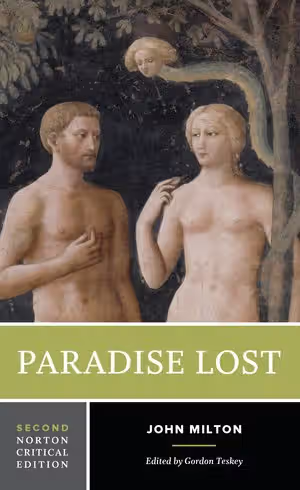
Milton, J. (2020). Paradise Lost (G. Teskey, Ed.; 2nd ed.; Norton Critical Edition). W. W. Norton & Company.
Chapter Summary
Introduction and the Text
The second edition opens with prefaces to both editions and an introduction by Gordon Teskey in two parts, "The Life of John Milton" and "On the Text of Paradise Lost" (pages xix to xxxiv). The poem itself runs from page 3 to about page 310. It begins with Milton's prefatory note "The Verse" and then the twelve books. The edition prints the 1674 text, with emendations from the first edition and a scribal manuscript, and spelling and punctuation modernized for students. Explanatory annotations accompany the text. The whole volume has about 620 pages, so the poem fills roughly half.
Books One–Two: Hell
The poem announces its subject, the first disobedience and the loss of Eden, and invokes the Muse. Satan and the other rebel angels lie in Hell after their defeat. Satan rallies them, and they build the palace Pandemonium. In Book Two the fallen angels debate in council what to do next, and Satan undertakes to journey alone to the newly created world. At the gates of Hell he meets Sin and Death and crosses Chaos.
Book Three: Heaven
An invocation to light leads into a scene in Heaven. God foresees the fall of humankind, and the Son offers himself to redeem it. Satan reaches the sun and, disguised, deceives an angel to learn the way to Earth.
Book Four: Eden
Satan enters Paradise and sees Adam and Eve. The book describes the garden and the couple's life in it. Satan overhears the single command they have been given and is found at Eve's ear by the guardian angels. He is made to leave.
Books Five–Six: Raphael and the War in Heaven
Raphael is sent to warn Adam, and Adam and Eve entertain him. In Book Five Raphael begins to relate how Satan rebelled, and Abdiel stands alone against him. In Book Six he tells the war in Heaven, ending with the Son's victory over the rebels.
Books Seven–Eight: Creation and Adam's Questions
Raphael describes the creation of the world in six days (Book Seven). In Book Eight Adam asks about the heavens, tells of his own creation and his first sight of Eve, and Raphael cautions him about passion.
Book Nine: The Fall
Satan enters the serpent. Eve proposes that she and Adam work apart, the serpent persuades her to eat the forbidden fruit, and Adam, finding what she has done, chooses to eat as well. It is the longest book in the poem on the page, running from page 200 to page 233.
Books Ten–Twelve: Judgment and Exile
In Book Ten the Son judges the pair, Sin and Death build a bridge from Hell, and Adam laments his fate until he and Eve are reconciled and repent. In Book Eleven the angel Michael shows Adam visions of the future, including Cain and Abel and the flood. In Book Twelve Michael tells the rest of history and leads the couple out of Eden into a world that lies "all before them".
Sources and Backgrounds
The edition presents selections from the Bible: Genesis 1 to 3 and 11 to 12, Exodus 14, Psalms, Isaiah, Ezekiel 1, Mark 13, Acts 13, 1 Corinthians 15 and Revelation. It also reprints two Milton prose works, the introduction to Book II of The Reason of Church Government and the whole of Areopagitica.
Criticism
The criticism section collects seventy-eight commentaries, thirty-nine of them new to this edition. It opens with classic criticism, from Aemilia Lanyer, Andrew Marvell and John Dryden through Samuel Johnson, William Blake, Mary Wollstonecraft, Percy Shelley, T. S. Eliot and Virginia Woolf, and continues with modern criticism arranged by topic: Satan, God, Eve and Adam, style and versification, Christian ideology, race and religion, politics, gender and sexuality, and general criticism. A glossary of names (page 537) and suggestions for further reading (page 583) end the volume.
Key Concepts
Books One–Eight
- The invocation and the epic subject: the first lines state the theme and call on a Muse, a convention of epic that the poem uses and re-purposes.
- Rebellion and the council in Hell: Satan's leadership and the debate among the fallen angels set the poem's questions about authority.
- Freedom and foreknowledge: Book Three has God foresee the fall while insisting humans are free.
- Innocence in Eden: Books Four to Eight show a couple in a world of work, conversation and a single prohibition.
Books Nine–Twelve
- Temptation and the Fall: Book Nine dramatizes how each of the pair chooses to eat.
- Judgment and repentance: Book Ten moves from blame to confession and reconciliation.
- History as consolation: Michael's vision gives Adam a view of the future that leads to the poem's closing lines.
Critical Analysis
Strengths
- A text prepared for students. The edition modernizes spelling and punctuation while basing itself on the 1674 text, and it supplies abundant annotation and a glossary of names.
- Related writings in the same volume. The Bible passages and Areopagitica are placed beside the poem so that readers can see where Milton draws on scripture and argues for free publication.
- A wide range of criticism, arranged by topic. The section is arranged by topic, which means a student can go straight to Satan, to God, to politics or to style. Rayna Kalas (Cornell), quoted by Norton, praises the new selections on race, religion, politics and gender.
Limitations
- Size and apparatus. The volume has about 620 pages, of which the poem fills roughly half, so a reader who wants only the text may find the apparatus an added weight.
- A selection, not a survey. The edition's seventy-eight commentaries are excerpts, and a student writing a longer essay will need to go on to the complete works.
- A demanding poem. The poem has long sentences and a dense set of classical and biblical references; the glossary of names alone runs to some forty-six pages. The annotations help but do not remove the difficulty.
Where It Fits in the Course
In the British literature course, Paradise Lost is the seventeenth-century epic on the list. Middlemarch in Ronjaunee Chatterjee's Norton Critical Edition has the same series structure and is a Victorian novel. The Norton Anthology of English Literature is a survey anthology and the histories by Carter and McRae, Sanders and Bate are for background on the period. Readers who have also taken the classical literature course will recognise Milton's use of epic conventions from Homer and Virgil: an invocation, a council, a catalogue of figures and a descent to Hell.
How to Use This Book
No special background is needed, though some experience of reading verse closely is helpful. Read Teskey's introduction first, then the poem a book at a time with the notes, reading difficult sentences aloud. The core books are I, II, IV, IX, X and XII, which cover Hell, Satan's journey, Eden, the Fall and the exile. Books III, V to VIII and XI are the theology, the war in Heaven and creation, and Adam's education, and they reward a second pass.
Use the Bible selections when a passage draws on scripture, and read Areopagitica alongside the poem if you are interested in Milton's politics. After finishing the poem, use the topical commentaries to prepare essays: pick one topic, such as Satan or Eve and Adam, and read the pieces under it together.