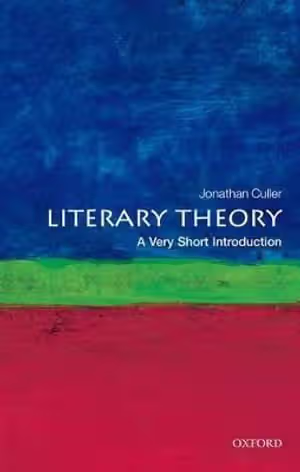
01 / Reading Guide
Reading Guide
Citation
Culler, J. (2011). Literary Theory: A Very Short Introduction (2nd ed.). Oxford University Press. Very Short Introductions.
Chapter Summary
This second edition is a pocket-sized book of about 160 pages: nine short chapters, an appendix on theoretical schools and movements, references, further reading and an index. The first edition (1997) had eight chapters; the second adds a ninth, "Ethics and aesthetics", and, according to the publisher, new material on the "death of theory", trauma theory, ecocriticism and the links between narrative theory and cognitive science, with updated bibliographies. Its organising decision is stated in the publisher's description: rather than describing rival "schools" one after another, Culler sketches the key "moves" that theory has encouraged and what they imply for thinking about literature, identity and language. The schools themselves are left to the appendix.
Chapter 1: What is theory?
The opening chapter (about 18 pages) asks what the word "theory" means in literary and cultural studies, before any particular position is introduced. It sets up the book's claim that theory is better understood as a set of questions and arguments than as a list of doctrines.
Chapter 2: What is literature and does it matter?
The longest chapter in the book (roughly 24 pages) takes up the question in its title: what distinguishes literature from other kinds of writing, and why the category should matter. Placing it second makes the definition of the object of study the first concrete problem a reader meets.
Chapter 3: Literature and cultural studies
A short chapter on the relation between literary study and the wider study of culture, a relation the publisher's description presents as one of the book's guiding questions ("Is there a relationship between literature and culture?").
Chapter 4: Language, meaning, and interpretation
This chapter turns to language and how meaning is produced and interpreted. Its title links the linguistic side of theory, associated in the book's vocabulary with figures such as Roman Jakobson, to questions of interpretation.
Chapter 5: Rhetoric, poetics, and poetry
Here the focus moves to the study of figures and of poetic language, and to poetry and the lyric. The publisher singles out poetry, poetics and rhetoric as one of the areas on which the book sheds light.
Chapter 6: Narrative
A chapter on the theory of narrative: how stories are told and by whom. The book's vocabulary includes narrators, focalization and plot, and the second edition's new material on narrative theory and cognitive science belongs to this subject.
Chapter 7: Performative language
This chapter introduces the idea that language does things as well as saying things. The book's vocabulary of "performative" and "constative" utterances shows that the distinction between utterances that perform an act and statements that describe is central here.
Chapter 8: Identity, identification, and the subject
The last chapter of the original edition addresses questions of identity and the subject, which the publisher places among the implications of theory for "human identity". Feminism, queer theory and psychoanalysis appear in the book's vocabulary, alongside names such as Judith Butler, Eve Sedgwick and Louis Althusser.
Chapter 9: Ethics and aesthetics
New in the second edition, this chapter considers the relation between literature, ethics and aesthetic value, a theme the first edition did not treat in a chapter of its own.
Appendix: Theoretical schools and movements
The appendix gives brief accounts of the named movements that the chapters deliberately avoid using as an organising frame. According to the publisher, the book outlines approaches such as deconstruction, semiotics and postcolonial theory with easily grasped examples.
Key Concepts
Chapters 1–3: Theory, literature and culture
- Theory as "moves": the book's framing of theory as a set of recurring arguments and questions rather than a sequence of competing schools.
- Literariness: the question of what makes a text literature and whether that category matters.
- Cultural studies: the study of culture more broadly, considered in relation to the study of literature.
Chapters 4–7: Language, rhetoric, narrative and performance
- Interpretation: how readers arrive at meanings, and what language contributes to that process.
- Poetics and rhetoric: the study of the conventions and figures that make literary effects possible.
- Narrative theory: the analysis of how stories are structured and told, including the narrator's point of view.
- Performative utterance: language that accomplishes an act rather than describing a state of affairs, contrasted with constative statements.
Chapters 8–9 and Appendix: Identity, value and schools
- The subject: the theoretical question of how identities are formed and how people identify with others and with fictions.
- Ethics and aesthetics: the relation between literary value and moral or political judgement.
- Schools and movements: named approaches (for example deconstruction, semiotics, postcolonial theory) that the appendix summarises.
Critical Analysis
Strengths
- Organised by problems, not by schools. The publisher's description identifies this as the book's distinctive approach. A student meets the questions that the various schools answer before meeting the schools, which makes the appendix easier to use and helps avoid the impression that theory is a list of labels to memorise.
- Clarity praised by reviewers. Frank Kermode, reviewing the first edition in a comment reprinted by the publisher, judged that a clearer treatment of the subject was hard to imagine and that, within its length, it was also remarkably comprehensive. The book has been translated into some twenty languages, according to the author note.
- Written by a leading theorist. Culler is the author of Structuralist Poetics and On Deconstruction, and of short introductions to Saussure and Barthes, so the expositions come from someone who has shaped the field rather than only summarised it.
- Updated for a later stage of the field. The second edition adds a chapter on ethics and aesthetics and brings in topics, such as trauma theory and ecocriticism, that came to prominence after 1997.
Limitations
- Very short by design. Nine chapters in about 130 pages of text cannot set out any one theory in detail; most chapters are twelve to fourteen pages. Students who need to apply a particular approach to a text will need a fuller guide.
- Little on the schools as such. Because the named movements are confined to the appendix, readers who are asked to write, for example, a Marxist or feminist reading will find less direct help here than in books organised school by school.
- No worked readings of whole texts. The book uses short examples rather than demonstrating approaches on a complete literary work; nothing in the publisher's material indicates exercises or study questions.
- Updated in 2011. The latest edition is now well over a decade old, so more recent developments in theory are not covered.
Where It Fits in the Course
In this course it is the shortest and most conceptual way in. Peter Barry's Beginning Theory covers similar ground school by school, summarising what each kind of critic does and demonstrating it on a short text; it pairs well with Culler, since one supplies the questions and the other the methods. Lois Tyson's Critical Theory Today goes further in application, explaining each approach and then reading The Great Gatsby through it.
Terry Eagleton's Literary Theory: An Introduction is a longer, more argumentative account of the major schools, best read after Culler. M. A. R. Habib's A History of Literary Criticism supplies the long history from Plato onwards, and The Norton Anthology of Theory and Criticism provides the primary texts. Culler is most useful at the start of a course and again at the end, when the questions in Chapters 1 and 2 can be reread with the schools in mind.
How to Use This Book
The book assumes no previous study of theory; some experience of reading and discussing literature is enough. It can be read in a few sittings, so it suits the first week of a theory course, a summer before university, or revision.
A practical plan:
- Read Chapters 1 and 2 first and slowly. They frame everything that follows, and the question of what literature is recurs throughout the course.
- Read Chapters 3–8 in order, pausing after each to write down the central question it raises and one literary text it could be tested on.
- Chapter 9 works well once a course reaches debates about value, canons or politics.
- Use the appendix as a map. When a lecture introduces a school, read its appendix entry, then return to the chapter whose questions that school addresses.
- Follow the further reading at the end of the book for primary texts, ideally alongside an anthology such as the Norton.
Because the book is so brief, it works best as a framework to be filled in by a fuller guide and by the theorists' own writings.